
(Kitco News) – Asset prices were a mixed bag on Tuesday as Bitcoin (BTC) and gold struggled to generate momentum after Fed Chair Powell said the U.S. economy is on a deflationary path, before reiterating that the central bank wants to see more progress towards their inflation goal of 2% before committing to interest rate cuts.
Stocks, meanwhile, trended higher following the comments from Powell, also receiving a boost from the latest job openings data, which showed the labor market is showing resilience as the number of open jobs climbed to 8.14 million at the end of May, an increase from the 7.92 million job openings in April.
Both the DXY and U.S. 10-year Treasury yield recorded declines on Tuesday as stocks rallied higher, while crude oil fell by 0.56%, and gold climbed back to neutral at the time of writing.
At the market close, the S&P, Dow, and Nasdaq all finished in the green, up 0.62%, 0.41%, and 0.84%, respectively, with the closes for the S&P and Nasdaq representing new record highs.
Data provided by TradingView shows that after trading near $63,000 in the early morning hours, Bitcoin experienced a leg down following Powell’s comments, hitting a low of $61,730 in the afternoon.

BTC/USD Chart by TradingView
At the time of writing, Bitcoin trades at $61,952, a decrease of 1.96% on the 24-hour chart.
Slow path to recovery
“BTC is gradually recovering from recent lows, though this recovery is accompanied by some choppy intraday price action,” said analysts at Secure Digital Markets. “Upon reaching the 20-day moving average, BTC experienced a 3% pullback and is now attempting to stabilize within the $61,000 - $62,000 range.”
“Historically, BTC has shown strong performance in July, with an average gain of over 11% in the past decade, and positive returns in 7 out of the last 10 years,” they noted. “Specifically, from 2019 to 2022, July returns have been impressive at approximately 27%, 20%, and 24%, respectively.”
With Bitcoin largely trading sideways for nearly four months, the inclination for traders to FOMO or dump their holdings has decreased, and derivatives data suggests many are taking a wait-and-see approach before placing their next bets.
“The Deribit BTC DVOL index, which measures expected price volatility over the next 30 days based on options data, has dropped to its lowest level since early February,” Secure Digital Markets said. “This decline indicates a reduced demand for options, as market participants appear less inclined to panic or seek protective hedging strategies.”
More than any other factor, the analysts pointed to typical post-halving weakness as the source for the sideways price action and suggested that it could continue for the better part of summer.
“Following the April halving event, BTC prices have fallen by over 10%. Historically, BTC tends to experience a pullback shortly after a halving, followed by the beginning of a new uptrend a few months later, often surpassing previous record highs,” they noted. “Given the typically low trading volumes during the summer, this trend may persist for the next 30 to 60 days. We anticipate that a strong uptrend will begin by the end of Q3, potentially driving prices to new highs before 2025.”
An uptick in flows into spot BTC exchange-traded funds (ETFs) also suggests that some are using the low volatility as an opportunity to acquire Bitcoin ahead of the predicted pump, as inflows have picked up after several weeks of outflows.
“In the US BTC ETF market, a notable net inflow of $129.5 million was recorded, largely driven by Fidelity, marking the highest figure since early June after a period of significant outflows totaling over $900 million,” Secure Digital Markets said.
Looking at the markets as a whole, the analysts said “Investors are contemplating whether the strong start to 2024 can be sustained in the second half of the year. While megacap tech stocks continue to perform well, some bearish analysts are concerned that poor market breadth could signal upcoming volatility.”
According to market analyst Daan Crypto Trades, this bout of sideways trading near the all-time high (ATH) is the longest in Bitcoin's history, giving credence to traders who feel like it has been an eternity since Bitcoin made a notable move higher after setting history by hitting a new ATH before the halving.
#Bitcoin 4 months and counting. ⏳
This has been the longest consolidation around the previous cycle's highs we've seen in $BTC's history. pic.twitter.com/g32bNOQ0a9— Daan Crypto Trades (@DaanCrypto) July 2, 2024
But traders should be careful what they wish for, as Pentoshi highlighted the possibility of a major move on the horizon, before noting that it could be to the downside.
“For $BTC I wanted to start off with what I view to be the worst case scenario,” Pentoshi tweeted. “Lets say, 48-51k. Essentially 20-25% lower. And in this scenario people should get more bullish the lower it went bc the upside becomes greater. But again, let's call that max drawdown. Hard to imagine now, but not out of the realm of possibilities. It's the spot where I'd max allocate.”
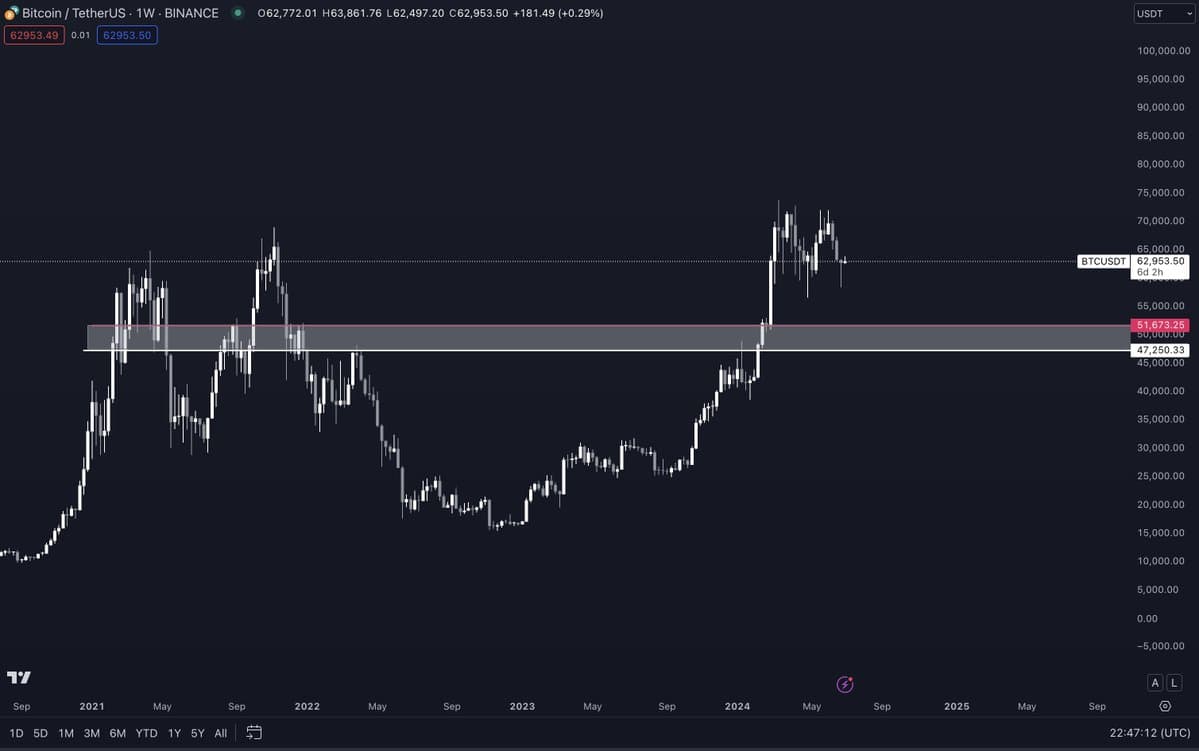
“The upside, however, is uncapped bc we will go back into a period of heavy printing soon,” he added. “So I see BTC as something separate from the alt market in the sense that it will most likely drift up forever through ETF's, and with a finite supply and people competing for it, including more nation-states in the future.”
Altcoins see red
Altcoins largely followed Bitcoin’s lead lower, with most tokens in the top 200 recording losses on Tuesday.
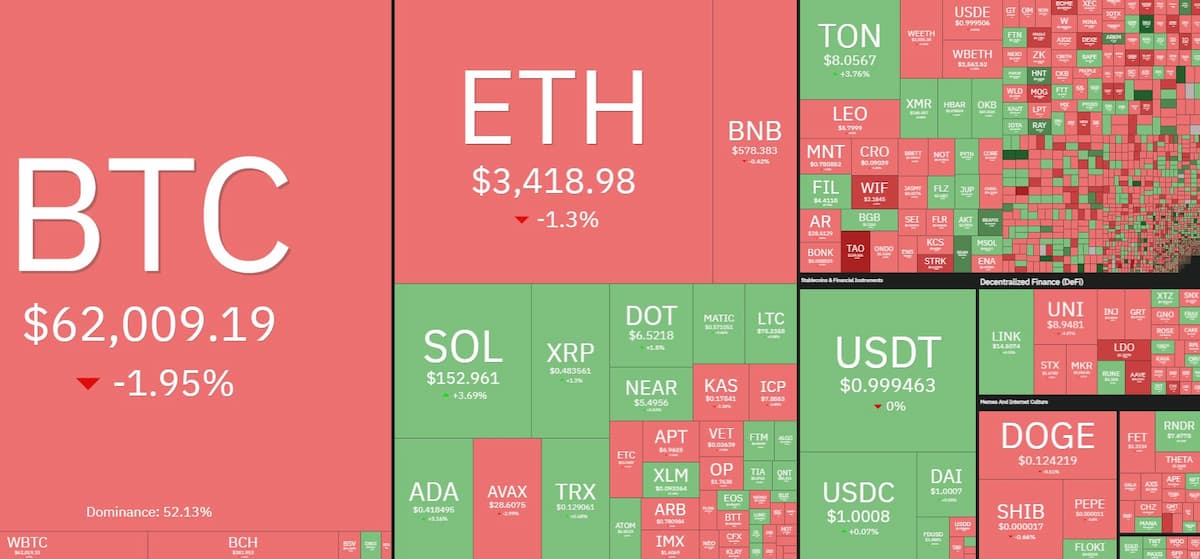
Daily cryptocurrency market performance. Source: Coin360
BinaryX (BNX) was the standout performer, gaining 21.4% to trade at $0.9755, while Arcblock (ABT) climbed 9.8%, and Helium (HNT) increased by 6.5%. Pendle (PENDLE) was the top loser, falling by 14.1%, followed by a loss of 10.3% for ether.fi (ETHFI), and a decline of 8.3% for Aave (AAVE).
The overall cryptocurrency market cap now stands at $2.29 trillion, and Bitcoin’s dominance rate is 53.2%.
