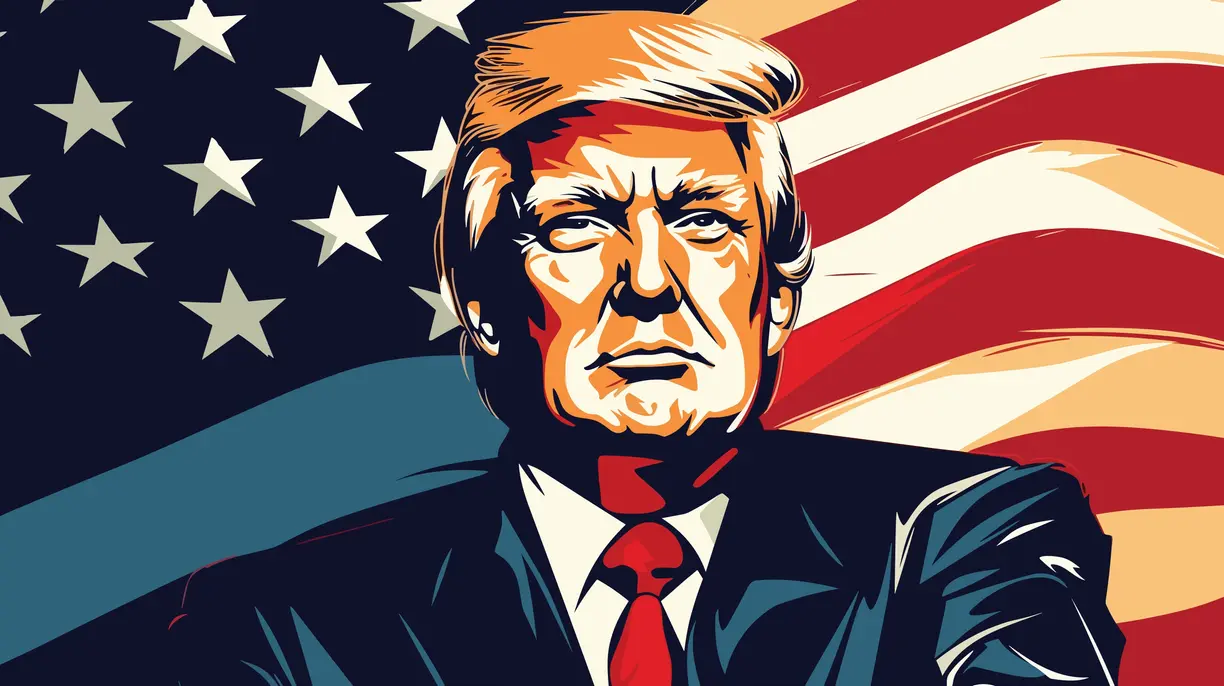
(Kitco News) – Presidential candidate Donald Trump continues to lean into the strategy of supporting the cryptocurrency ecosystem to attract younger voters, and he is now combining it with his efforts to combat the rise of China, telling Bloomberg that if the U.S. doesn’t lead in crypto, another country, likely China, will.
“If we don’t do it, China is going to pick it up and China’s going to have it – or somebody else, but most likely China. China’s very much into it,” Trump said when asked about his pivot to supporting crypto. “Also, it’s not going away.”
“Now, if I throw it aside, it’s going to be picked up in another country, most likely China—they’re pretty advanced in that sphere,” he added. “So you have to look at it – what I want, again, is what is good for the country.”
Trump said that while the crypto industry in the U.S. has “a good foundation, it’s a baby. It’s an infant right now. But I don’t want to be responsible for allowing another country to take over this sphere. And so I think we’re going to be good.”
Further explaining the pivot on the industry he once referred to as a “fraud” and “a disaster waiting to happen,” Trump pointed to another prominent crypto critic: JPMorgan CEO Jamie Dimon.
“And you ask Jamie Dimon, Jamie Dimon was, you know, very negative, and now, all of a sudden, he’s changed his tune a little bit,” Trump said. In a surprising twist, Trump also suggested that he was considering Dimon for the role of Treasury Secretary if he is re-elected as president.
“I have a lot of respect for Jamie Dimon,” Trump said. “He is somebody that I would consider, sure.”
Trump also claimed that he has developed a deeper understanding of the crypto industry through interactions with industry leaders and the launch of multiple series of non-fungible tokens (NFT).
“I did it three times [and] I’m going to do another one, because the people want me to do another one,” Trump said, suggesting another NFT series is in the works. “It’s unbelievable spirit. Beautiful. But the thing I really noticed was everything was paid in – I would say almost all of it was paid in crypto, in this new currency. And it opened my eyes.”
These comments follow similar statements he made in May.
“I am very positive and [open-minded] to cryptocurrency companies and all things related to this new and burgeoning industry,” Trump wrote on Truth Social. “Our country must be the leader in the field, there is no second place.”
In the wake of Saturday’s assassination attempt, Trump has received backing from some of the industry’s staunchest supporters, including Tesla CEO Elon Musk, Tron (TRX) founder Justin Sun, the Winklevoss twins, Kraken co-founder Jesse Powell, and ARK Invest CEO Cathie Wood.
He is also scheduled to speak at next week’s Bitcoin 2024 conference in Nashville, the largest Bitcoin conference in the world.
VP pick strengthens crypto platform
On Monday, Trump announced crypto-friendly Ohio Senator JD Vance as his vice presidential running mate for the 2024 Republican ticket, making Vance the first VP candidate to have publicly disclosed holding Bitcoin (BTC).
In a 2022 financial disclosures report filed with the U.S. Senate, Vance disclosed Bitcoin holdings valued between $100,001 and $250,000, which were kept on Coinbase.
According to Coinbase’s Stand with Crypto initiative, Vance has established himself as a “strong” supporter of crypto based on an assessment of positive social media posts and pro-crypto voting records.
And he further endeared himself to the crypto community this week after a video resurfaced of him saying SEC Chair Gary Gensler was “the worst person” to regulate crypto.
??? NEW VIDEO
Ohio Senator JD Vance on Gensler:
He is way way way too political in his regulation of securities.
He has it backwards when wanting to ban useful tokens and seemingly not caring about those without specific utility.
Sen. Vance sees blockchain as key to… pic.twitter.com/yKoNmk4Bm4— Bill Hughes : wchughes.eth ? (@BillHughesDC) February 27, 2024
“If there’s a candidate for the worst person in my view, at least in terms of my substantive disagreement [...] it's Gary Gensler,” Vance said. “He wants to inject politics way too much into the actual business of securities in the U.S. The approach that Gary has taken to regulating blockchain and crypto is the exact opposite of what it should be.”
Gensler occupies the role of arch-nemesis of the industry in the eyes of many crypto proponents, so the statements from Vance have led many to see his selection as VP as a positive for the cryptocurrency ecosystem.
In May, Vance joined 60 Senators in voting to reverse the SEC’s controversial SAB 121 accounting guidelines – a measure that was also approved by the House before ultimately being vetoed by President Biden.
In February, Vance was the lead signatory on a letter sent to Gensler that raised concerns over an enforcement action against crypto mining firm Debt Box, where a judge found that SEC lawyers used false statements to justify freezing assets linked to the company.
“It is unconscionable that any federal agency [...] [which] has often pursued its regulatory mission through enforcement actions rather than rulemakings [...] could operate in such an unethical and unprofessional manner,” Vance wrote in the letter. “Regardless of whether Commission staff deliberately misrepresented evidence or unknowingly presented false information, this case suggests other enforcement cases brought by the Commission may be deserving of scrutiny. It is difficult to maintain confidence that other cases are not predicated upon dubious evidence, obfuscations, or outright misrepresentations.”
And in February 2022, Vance highlighted crypto’s ability to combat government overreach after Canada’s finance minister froze the bank accounts of a convoy of truckers protesting COVID-19 lockdowns.
“This is why crypto is taking off, the regime will cut off your access to banking if you have the wrong politics,” he said in a post on X.
Before becoming the Republican Senator of Ohio, 39-year-old Vance served in the U.S. Marines, studied law at Yale, and later worked in venture capital under PayPal co-founder Peter Thiel.
