

(Kitco News) – It was crypto’s time to shine on Friday as Bitcoin (BTC) and a large percentage of altcoins surged higher while other markets – including stocks, oil, gold, and silver – recorded losses in the wake of a crippling global IT outage that saw flights around the world grounded and many essential services disrupted.
“The global IT outage demonstrates the limitations and risks of our reliance on centralized proprietary systems and supply chains,” said Yannik Schrade, co-founder and CEO of Arcium. “This situation highlights that this type of supply chain with single points of failure deeply permeates our current internet infrastructure, and hospitals, companies, and the traditional financial system sit on top of a house of cards that can easily collapse.”
“Centralized infrastructure is a legacy approach that needs to be overcome,” he added. “Blockchain technology, and especially decentralized confidential computing (DeCC), is a much needed and realistic alternative.”
“The biggest lesson from this global outage is to verify and not simply trust,” Schrade said. “Trust should not be part of the equation with systems for important industries like healthcare, finance, and infrastructure. We have the technology and cryptography to eliminate single points of failure and need to do so.”
Elaborating on how decentralized blockchain systems could have helped avoid today’s outage, Schrade said “Distributed computing attempts to solve this kind of problem by eliminating single points of failure.”
“Decentralization can allow for higher resilience and remove the dependency on any single actor that could fail,” he said. “With new cryptography like secure multi-party computations (MPCs), it’s now possible to run even the most sensitive computations in a decentralized, distributed setting without risking data leaks. MPCs provide far better security and data confidentiality guarantees than centralized legacy systems.”
Analysts at Secure Digital Markets noted that volatility has been on the rise since the beginning of July, posing a threat to stocks and other risk assets.
“The VIX has skyrocketed by 35% since July began, hinting at rising market volatility,” they said. “This spike could spell trouble for the equity market and other risk assets. If the VIX breaches the April high of 21.40, we could see bearish effects across these assets.”
“Despite a broad sell-off on Thursday, rotation remains a key theme,” they added. “The S&P 500 is down over 1%, and the Nasdaq has slipped 2.87%, jeopardizing its six-week winning streak. This divergence is a relief to some Wall Street experts concerned about over-reliance on a few massive tech stocks. The Nasdaq's underperformance this week can be attributed to a shift away from the megacap AI stocks that had been driving its gains.”
Friday saw the shift away from megacaps continue, which put pressure on the major indices. At the closing bell, the S&P, Dow, and Nasdaq all finished lower, down 0.71%, 0.93%, and 0.81%, respectively.
And stocks weren’t alone in their struggles as crude oil prices fell 3.0% to $80.28, gold lost 2.29%, trading at $2,400.20 at the time of writing, and silver dropped 2.76% to $29.39. The DXY increased by 0.23%, bringing its two-day rally to 0.68%, and the U.S. 10-year Treasury yield climbed to 4.241%.
Data provided by TradingView shows that while other markets struggled, Bitcoin experienced one of its strongest days in weeks, spiking from support at $64,000 to hit a high of $67,490, an increase of 5.56% on the 24-hour chart.
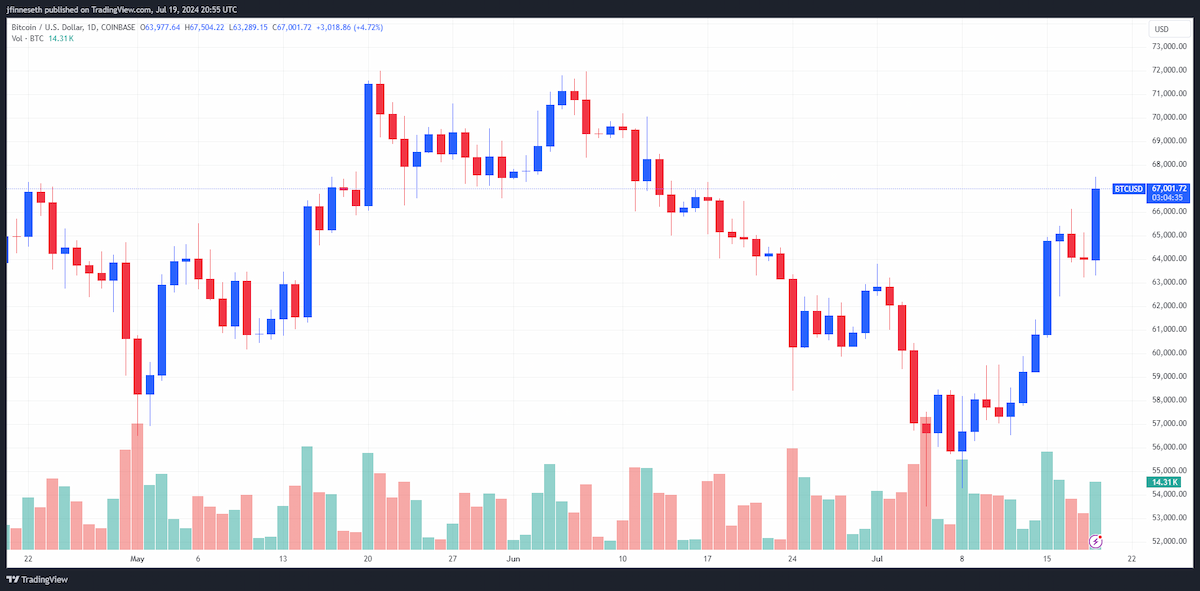
BTC/USD Chart by TradingView
A promising second half ahead
According to analysts at Ryze Labs, things could continue to improve for Bitcoin moving forward as the second half of 2024 will see an improvement on the liquidity front.
“We remain optimistic that liquidity conditions will improve in the second half of 2024,” they said. “With the Fed's quantitative tightening tapering off and slowing inflation, a weakening economy should prompt the Fed to begin cutting rates sooner rather than later. Retail positioning in treasuries and money market funds remains high at $1.8 trillion, which will likely flow into riskier assets once rates decrease.”
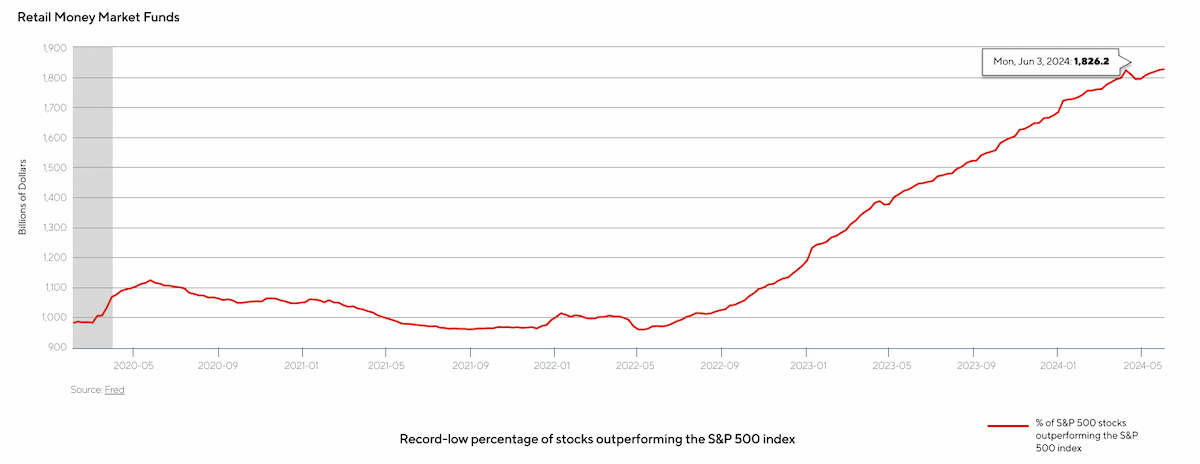
“Furthermore, small to medium-sized businesses tend to underperform in an elevated rate environment due to high borrowing costs,” they added. “Currently, a record-low percentage of stocks, at 22%, are outperforming the S&P 500 index. We expect this narrow dispersion of outperforming equities to widen significantly as monetary policy loosens.”
With Bitcoin now above $66,000, TradingView analyst The_ForexX_Mindset identified $68,300 as the next area of resistance to watch.
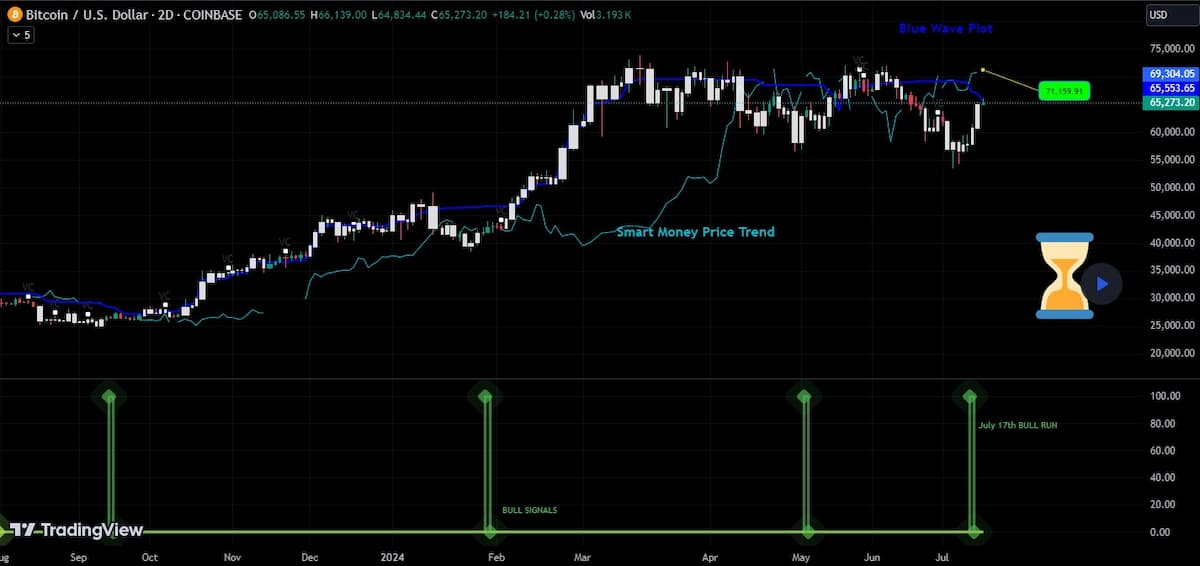
“Smart money value line contraction is around the $68,300 area,” he said. “This is where the trend usually always gets rejected. If I’m short trading I’d cash out at $6,700 but BITCOIN reads long.”
Legendary trader Peter Brandt had bad news for gold investors, noting the formation of an inverse head and shoulders pattern on the $BTC/$GC_F chart that suggests Bitcoin could outperform gold by a factor of five to one over the next ten years.
This is not @PeterSchiff day. And next 10 years will be cruel as well.
The $BTC / $GC_F ratio chart is forming a channel that might become the right shoulder of an inv. H&S pattern projecting ratio of 150 to 1, meaning BTC will outpace Gold by 5X @RaoulGMI what do you th ink? pic.twitter.com/Yg3NxFfb0x— Peter Brandt (@PeterLBrandt) July 19, 2024
And market analyst Wolf said his “realistic target for $BTC in this cycle, expected between Q2 and Q4 2025, is between 110k and 135k, with potential wicks up to 150k - 180k.”
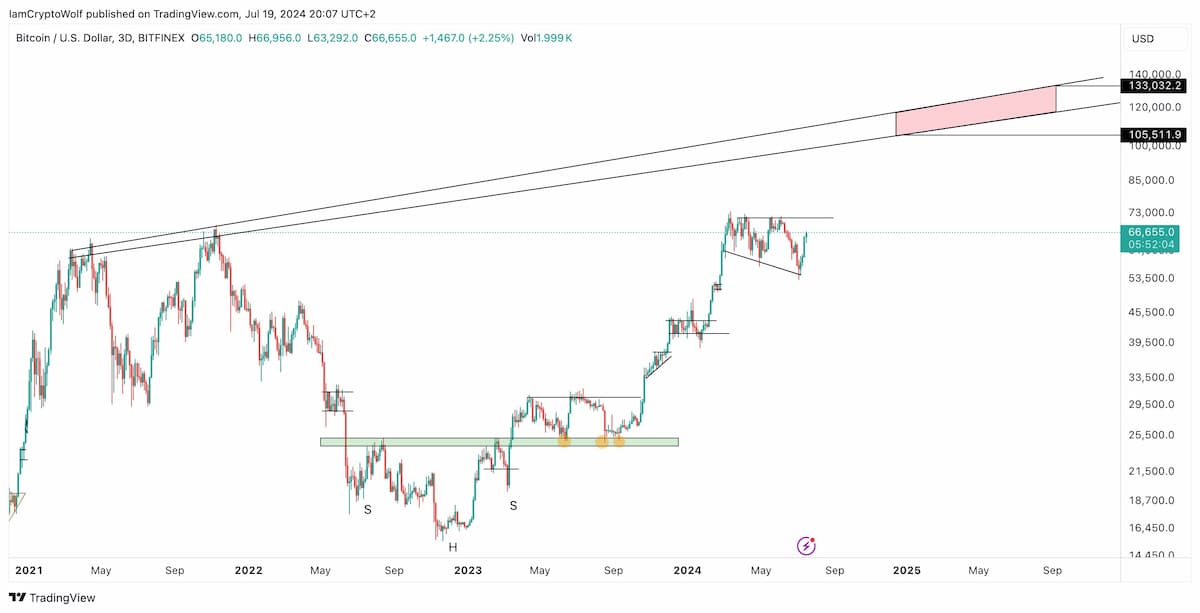
At the time of writing, Bitcoin trades at $67,058 for an increase of 5.44% on the 24-hour chart.
Altcoins surge higher
Altcoins largely followed Bitcoin’s lead higher on Friday, with all but a dozen tokens in the top 200 recording gains.
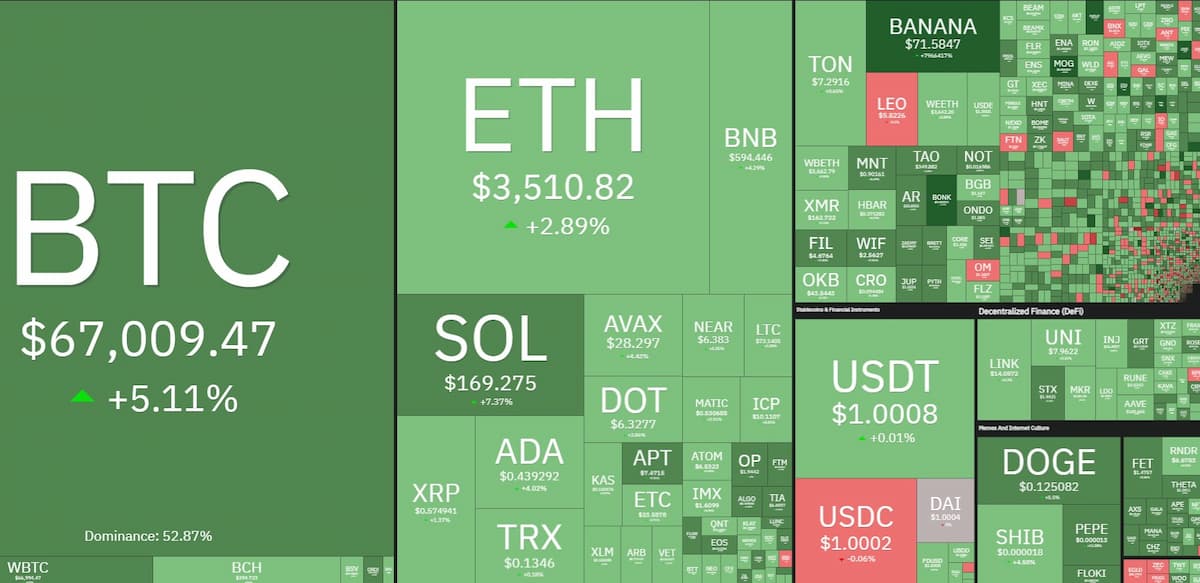
Daily cryptocurrency market performance. Source: Coin360
Meme tokens Bonk (BONK) and Mog Coin (MOG) led the field with gains of 21.9%, followed by DeFi platform Jito (JTO), which climbed 16.8%. Aragon (ANT) was the biggest loser, falling 5.5%, while Axelar (AXL) declined 4%, and BinaryX (BNX) lost 3.62%.
The overall cryptocurrency market cap now stands at $2.44 trillion, and Bitcoin’s dominance rate is 54.3%.
