

(Kitco News) - The gold market is holding in positive territory on the session after the latest data showed improvement in the U.S. service sector, but a decline into contractionary territory for manufacturing this month.
S&P Global announced on Wednesday that its flash Purchasing Managers Index for the service sector rose to 56 in July, up from June’s reading of 55.3. Activity in the service sector was stronger than expected, as economists forecasted a reading of 54.4.
Activity in the manufacturing sector declined, however, falling to 49.5 from June’s reading of 51.6. Economists were expecting a slight improvement to 51.7.
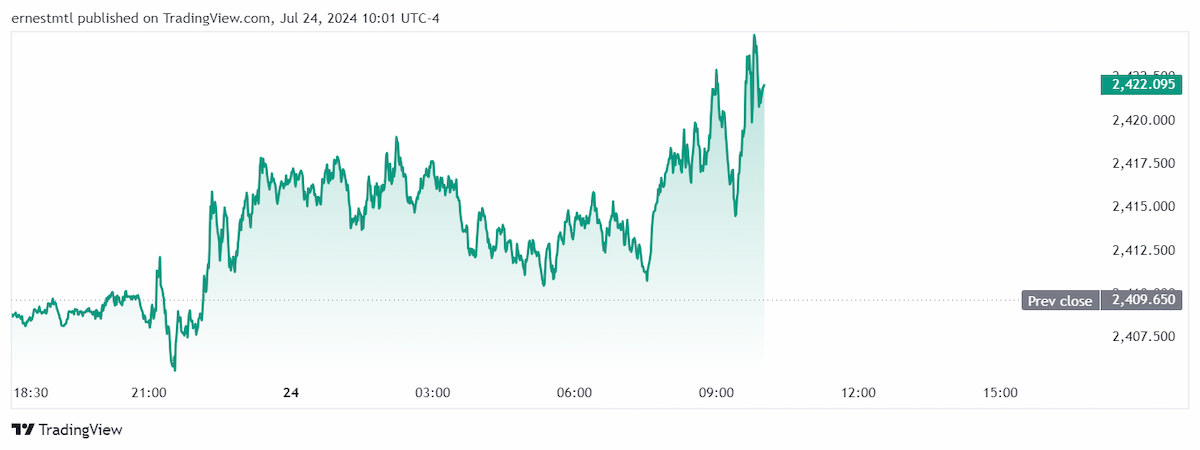
The gold market whipsawed in the minutes following the 9:45 am EDT release, but spot gold is managing to hold onto its earlier gains. It last traded at $2,422.26 an ounce, up 0.52% on the day.
The headline Composite Output Index rose from 54.8 in June to 55 in July, its highest level since April 2022, according to the report. “Output has now risen continually over the past one-and-a-half-years, with the pace of expansion having improved markedly in recent months after slowing in April,” the report said. “The service sector outperformed manufacturing for a fourth straight month, with the sectoral divergence widening to the greatest since June of last year. While the service sector expanded in July at the strongest rate since March 2022, manufacturing output fell into decline for the first time since January.”
“The flash PMI data signal a ‘Goldilocks’ scenario at the start of the third quarter, with the economy growing at a robust pace while inflation moderates,” said Chris Williamson, Chief Business Economist at S&P Global Market Intelligence. “Output across manufacturing and services is expanding at the strongest rate for over two years in July, the survey data indicative of GDP rising at an annualized rate of 2.5% after a 2.0% gain was signaled for the second quarter.”
“The rate of increase of average prices charged for goods and services has meanwhile slowed further, dropping to a level consistent with the Fed’s 2% target,” he added, but noted that both the growth and inflation pictures contained worrying elements to monitor in the coming months.
“From the output perspective, growth has become worryingly skewed, with manufacturing slipping back into contraction as the service sector gains further strength,” Williamson said. “Some of the production decline was linked to staff shortages, so could prove temporary – something which is supported by the sector reporting improved confidence about future growth prospects. However, both manufacturers and service providers are reporting heightened uncertainty around the election, which is dampening investment and hiring.”
“In terms of inflation, the July survey saw input costs rise at an increased rate, linked to rising raw material, shipping and labour costs,” he concluded. “These higher costs could feed through to higher selling prices if sustained, or cause a squeeze on margins.”
