

(Kitco News) – Traders awoke to red screens across financial markets on Monday as the disastrous performance of the Japanese stock market and yen sent shockwaves worldwide, resulting in plunging asset prices and a drop in U.S. bond yields.
While each market has its own reasons for the weak performance, the drawdown in cryptocurrency prices has been exacerbated by heavy selling activity from Jump Crypto, the digital asset arm of the Chicago-based proprietary trading firm Jump Trading.
“The immediate trigger in crypto seems to have been aggressive ETH selling from Jump Trading and Paradigm VC,” said analysts at QCP Group. “The move was probably exacerbated by market makers scrambling to cut short gamma as front-end ETH volumes spiked more than 30% to 120%!”
Ethereum (ETH) price fell over 27% over 24 hours, hitting a low of $2,116 in the early hours on Monday before dip buyers pushed it back above $2,300.
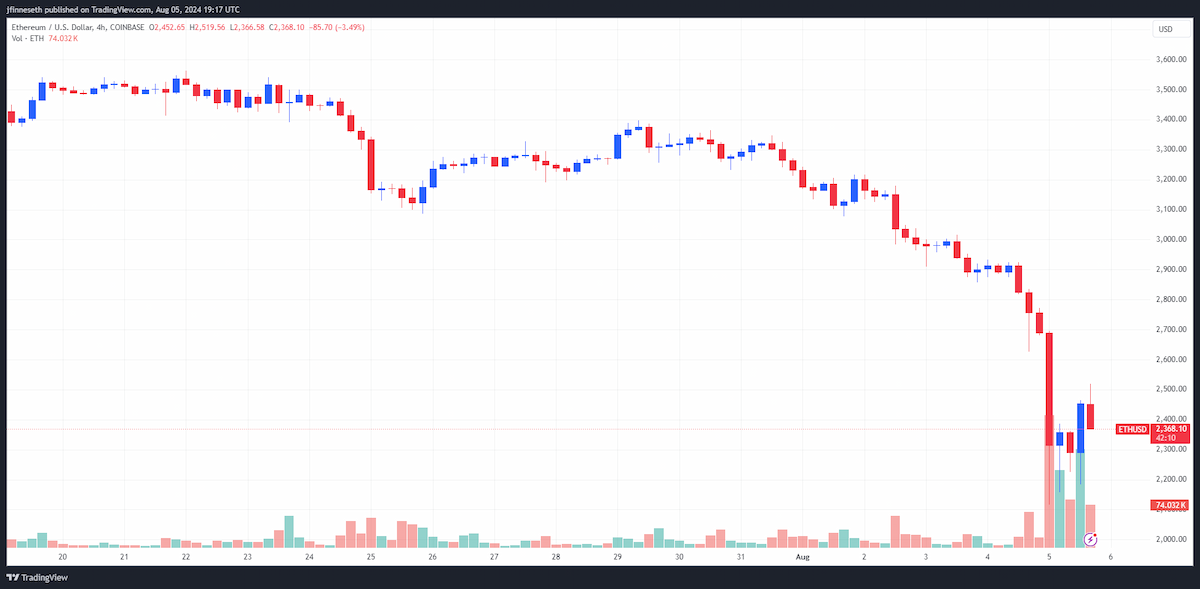
ETH/USD Chart by TradingView
Over the past couple of weeks, Jump Crypto moved hundreds of millions of dollars worth of digital assets to crypto exchanges, selling more than $377 million worth of Wrapped Lido Staked ETH (wstETH) since July 24. According to Lookonchain, the firm is looking to sell a total of $481 million worth of wstETH.
In just the past 24 hours, data provided by blockchain analytics platform SpotOnChain indicates that Jump Crypto moved 17,576 ETH, worth more than $46.78 million, to multiple exchanges including Binance, OKX, Coinbase, Bybit, and Gate.io.
“Apart from the general macroeconomic conditions, Ether’s disproportionate price drop – relative to BTC and other top 10 assets – is largely driven by the Jump Crypto sell-off and liquidation of other whale wallets,” said Alice Liu, Lead Researcher at CoinMarketCap. “Jump Trading moved over 17.5k ETH in the past 24 hours. During this crash, it was observed that around 64k $ETH were liquidated from 25 whale addresses worth around $150million.”
“ETH has also shown a slower recovery compared to BTC – it has been identified on-chain that Jump Crypto still has $104mil in wrapped ETH tokens in the unstaking process, suggesting potential further liquidation,” she added.
The sales follow a June 20 report from Reuters that the U.S. Commodity Futures Trading Commission (CFTC) is probing Jump Trading's involvement in the cryptocurrency space. The firm’s president, Kanav Kariya, stepped down from his role on June 24.
But it's not just the sales by Jump Crypto that are weighing on the crypto market, according to QCP Group, as macroeconomic factors are also playing a crucial role.
QCP analysts noted that Friday’s weaker-than-expected unemployment data was a significant catalyst. “Additionally, huge unwinds across all assets have caused volatility to spike sharply,” they said. “The VIX touched 50 (it was only higher during the Covid panic and the 2008 financial crisis), and USDJPY 1M at-the-money Vols spiked to 16%! This is likely to cause further unwinds.”
Also adding to the downside momentum is an uptick in military tensions between Israel and Iran, which has caused many to adopt a risk-off stance until the situation cools down.
“A global risk-off mood has also set in with Israel killing the Hamas leader over the weekend. Iran has vowed to take action, and the US has actually started to deploy troops into the Middle East,” QCP analysts said.
According to analysts at Bernstein, the sharp sell-off for Bitcoin (BTC) and the crypto market is not surprising as it is a common occurrence in times of rising economic uncertainty.
“Bitcoin’s initial reaction as a ‘risk off’ asset is not surprising,” Bernstein analysts Gautam Chhugani, Mahika Sapra and Sanskar Chindalia wrote in a note to clients on Monday. “This has often been the pattern for Bitcoin markets (seen before in March 2020 flash crash too), particularly, as it is the only market trading over the weekend. We remain calm.”
“We don’t see any incremental negatives for crypto here,” the analysts added. “If rate cuts and monetary liquidity is the usual template response to U.S. recession fears, we expect ‘hard assets’ such as Bitcoin (digital gold) to reprice up.”
They cited the availability of spot BTC exchange-traded funds (ETFs) as their reason for continued bullishness as they offer a highly liquid market that wasn’t available in previous cycles. They also pointed to recent reports that wirehouses like Morgan Stanley are working to give their clients access to the ETFs as a sign that inflows into BTC ETFs are about to start climbing again.
“We expect more wirehouse approvals into Q3 and Q4, thus providing further on-ramps for asset allocation to Bitcoin,” they said. “Bitcoin ETF flows have remained sticky so far, exceeding $17 billion year-to-date.”
The Bitcoin ETFs have already played a role in helping the market recover from its early Monday crash as the price of BTC has rebounded more than 11.5% from its low of $49,053 amid heavy inflows into BlackRock’s iShares Bitcoin Trust (ITIB).
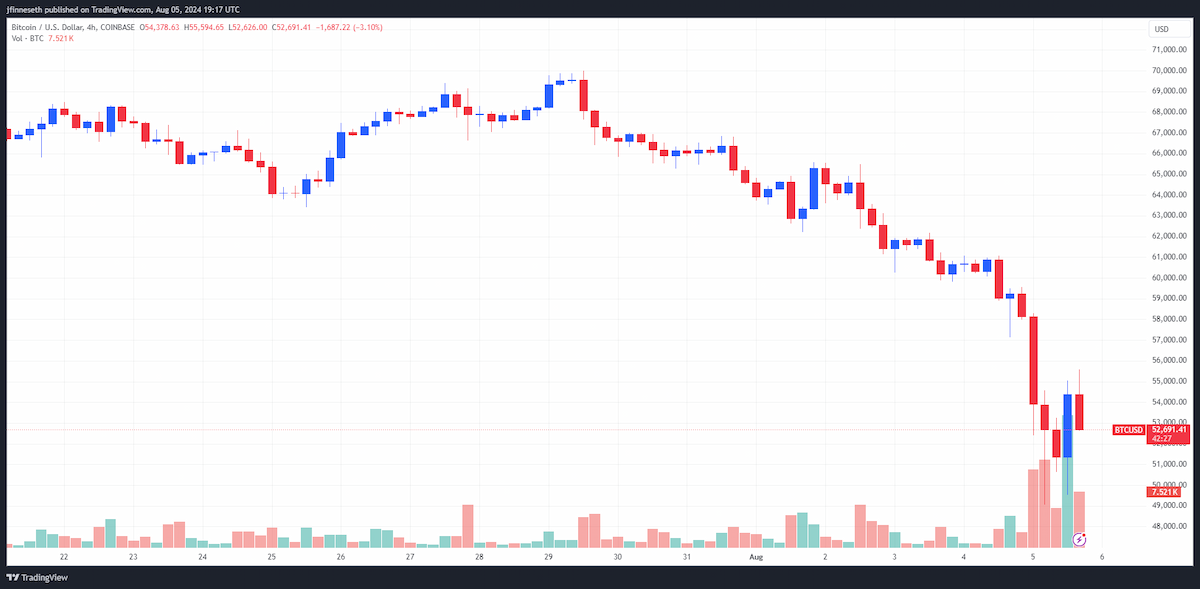
BTC/USD Chart by TradingView
Data provided by CoinMarketCap shows that IBIT has seen $2.46 billion in trading volume on Monday, while the Fidelity Wise Origin Bitcoin Fund (FBTC) has seen nearly $720 million in trading volume.
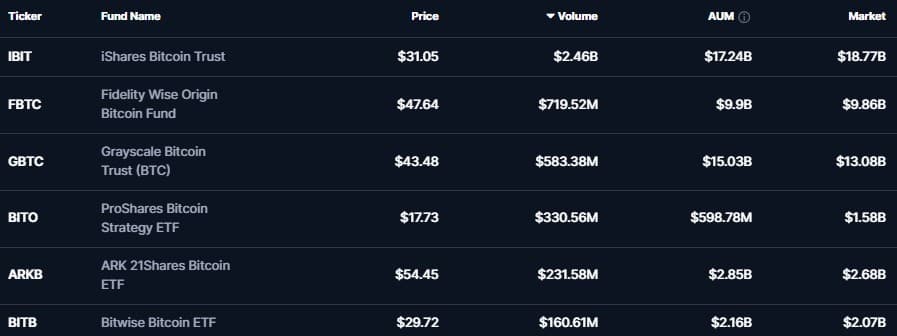
Overall, Bernstein analysts said that Bitcoin remains a “Trump Trade” given the market favoring the U.S. presidential candidate’s pro-crypto stance.
“It’s not surprising that as the Polymarket odds between Trump and Harris narrowed, Bitcoin and crypto have traded weak,” they said. “We expect Bitcoin and crypto markets to be range bound until the U.S. elections, trading off catalysts such as the presidential debate and the final election outcome.”
The analysts concluded by saying they anticipate the crypto market will respond to macroeconomic and election cues throughout Q3, and that if broader equity markets recover off the back of a Fed response, Bitcoin and crypto markets will follow suit.
