
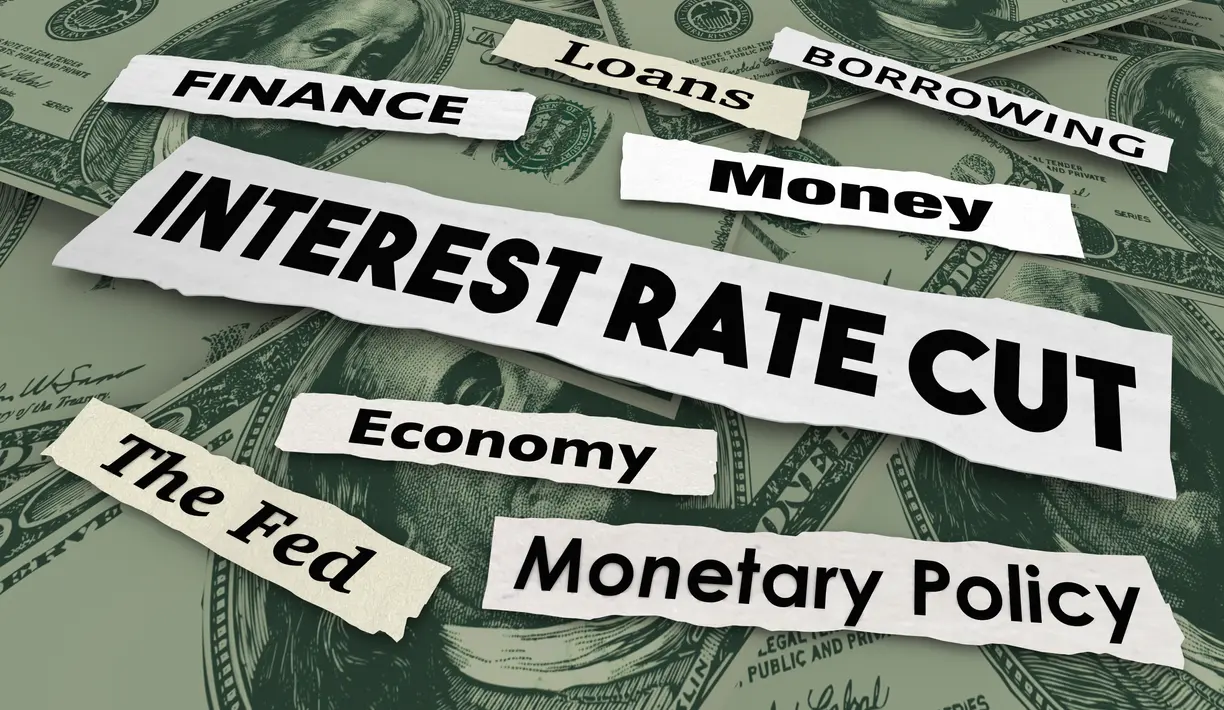
(Kitco News) – The odds of an interest rate cut at the September Federal Open Market Committee (FOMC) meeting improved on Tuesday after the July Producer Price Index (PPI) showed that inflation continues to cool, while consumer data shows that people are struggling to make ends meet after years of persistently high prices.
Last week, the calls for an emergency rate cut spiked amid a ‘Black Monday’ sell-off that saw asset prices fall across the board. The drawdown shook investor confidence, and at one point, the swap market was pricing in a 60% chance of an emergency 25-basis-point rate cut within the next week as market participants believed the Fed would need to take drastic measures to head off a recession.
Jeremy Siegel, professor emeritus of finance at the University of Pennsylvania's Wharton School of Business, told CNBC’s “Squawk Box” that the Fed needs to issue an emergency 75 basis-point rate cut, followed by another 75 basis-point rate cut at their September policy meeting, as interest rates should be about 175 basis points lower from where they are now.
In response to Siegel’s statement, Chicago Federal Reserve President Austan Goolsbee refrained from commenting on the possibility of an emergency rate cut but said that the Fed would address economic deterioration if necessary.
“The Fed’s job is very straightforward: maximize employment, stabilize prices, and maintain financial stability. That’s what we’re going to do,” Goolsbee told CNBC. “We’re forward-looking about it. So if the conditions collectively start coming in like that on the through line, there’s deterioration on any of those parts, we’re going to fix it.”
He also sought to downplay fears that a recession is imminent. “Jobs numbers came in weaker than expected, but [are] not looking yet like recession,” he said. “I do think you want to be forward-looking of where the economy is headed for making the decisions. The payroll jobs number is plus or minus 100,000 a month, so be a little careful over-concluding about things in the margin of error.”
However, Goolsbee did acknowledge that the Fed's policy is currently restrictive, saying it should only hold that position if the economy looks like it’s overheating.
“Should we reduce restrictiveness? I’m not going to bind our hands of what should happen going forward because we’re still going to get more information,” he said. “But if we are not overheating, we should not be tightening or restrictive in real terms.”
The five largest banks in the U.S. agree with Goolsbee on this matter and now think the Fed will act soon to cut interest rates.
“The rate tide has quickly turned,” said Bank of America economists in a recent note to clients, adding they now see a September rate cut as “a virtual lock.”
Wells Fargo analysts agreed and see the Fed cutting 50 bps in September and another 50 bps in November, citing deteriorating conditions in the labor market.
They said that while the Fed has largely been successful at returning inflation to its 2% target, “recent data suggest the risks to the 'full employment' part of the Fed's dual mandate are rising,” and highlighted that payroll growth has decelerated while unemployment is increasing, signaling potential labor market vulnerabilities.
They also agreed with Goolsbee that the Fed is restrictive, saying, “As measured by the real fed funds rate, the stance of monetary policy is quite restrictive at present.”
“The FOMC (Federal Open Market Committee) needs to get back to a ‘neutral’ stance of policy quickly or else it risks a vicious circle of labor market weakness,” they warned.
Wells Fargo analysts predicted that by mid-2025, the target range for the federal funds rate will fall to 3.25-3.50%, a range that many observers consider to be a neutral rate. They see a series of cuts in the coming months after the total of 100 bps in September and November, including a 25 bps reduction in December, followed by an additional 25 bps cuts at the January, March, and June meetings in 2025.
Analysts at JPMorgan said that if the Fed had known about the uptick in unemployment shown in the data provided by the Bureau of Labor Statistics at the beginning of August, they would have already implemented the first rate cut. The data showed that unemployment rose from 4.1% in June to 4.3% in July, with the number of jobless Americans soaring to 7.2 million.
“Had the Fed had this [jobs] report in hand going into the #FOMC meeting this past Wednesday, it almost certainly would have cut the policy rate by at least 25bp,” said Michael Feroli, Chief U.S. Economist at JPMorgan. “Now that it looks to be materially behind the curve, we expect a 50bp cut at the September meeting, followed by another 50bp cut in November.”
Citigroup economists Veronica Clark and Andrew Hollenhorst also see the Fed cutting 100 bps by November, a 25 bps cut in December, and they predicted additional rate cuts at future meetings until rates fall into the 3% to 3.25% range, which will be reached in mid-2025.
And Goldman Sachs economists David Mericle and Manuel Abecasis said that while the Fed should avoid overreacting to one bad jobs report, they do see multiple 25 bps cuts coming as the central bank looks to avoid tipping the economy into a recession.
“It is usually a mistake to infer too much from one jobs report absent a major shock that abruptly changes the picture,” they wrote in an investor note before raising their recession forecast by 0.1 percentage point to 25%. “We changed our Fed forecast after the employment report to include an initial string of three consecutive 25bp (basis point) rate cuts in September, November, and December.”
