
(Kitco News) – While most analysts agree that the talk of imminent de-dollarization has been overblown in news headlines, they also can’t deny that a fundamental shift in how countries around the world transact is underway that is slowly seeing the standing of the U.S. dollar diminished on the global stage.
The BRICS bloc is often highlighted as the greatest threat to USD supremacy, especially following recent developments with the BRICS Bridge—an independent, standalone mutual payment system connecting members. Recent efforts by two of the group's largest members show that there are indeed plans underway to ditch the dollar.
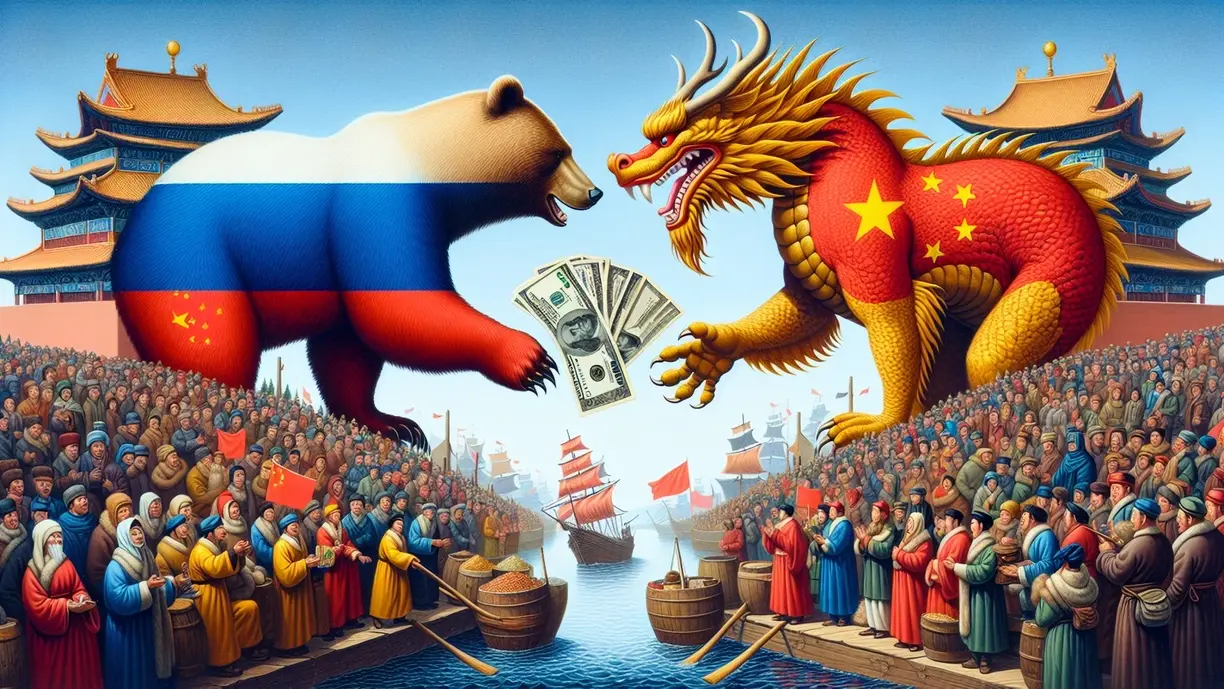
According to a report from Izvestia, 90% of the trade settlements that occur between Russia and China are now done using their national currencies, showing they’ve almost entirely pushed out the role of the USD in cross-border transactions.
“It is important that we have switched to settlements in national currencies,” said Anton Siluanov, head of the Russian Ministry of Finance. “More than 90% of settlements are made in rubles and yuan.”
And the amount of trade between the two nations is expected to remain elevated, with Siluanov telling reporters during a meeting with his Chinese counterpart Lan Foan that this year’s trade turnover between Russia and China could match or surpass the previous year's high level.
Data provided by the PRC Customs Administration shows that trade turnover for the first seven months of 2024 hit $136.67 billion, an increase of 1.6% compared to the same period last year.
In May, Siluanov told Izvestia that Russia and China switched to using rubles and yuan in bilateral settlements due to the rising risks associated with conducting transactions in the currencies of “unfriendly countries.”
“We see that settlements in the currencies of unfriendly countries have great risks and are stalled,” he said. “Therefore, this is our way out of this situation - to develop settlements in yuan and rubles.”
After noting that Beijing also saw a problem with transacting in Western currencies, Siluanov said, “In this regard, settlements between the Russian Federation and China in national currencies will be developed and supported.”
As Siluanov made those statements, Russian President Vladimir Putin also touted the increased use of national currencies in trade between Russia and China, commenting that 90% of all payments between the two countries were already made in rubles and yuan while talking to reporters amid negotiations with Chinese President Xi Jinping.
Putin said this motivated the trade partners to expand trade flows, adding that Russia and China had agreed to actively use national payment systems to service trade turnover.
On May 8, Putin also reported that more than 90% of the settlements within the Eurasian Economic Union (EAEU) are conducted in national currencies.
“The volume of mutual trade has almost doubled – from $45 billion to $89 billion – and more than 90% of settlements are already conducted in national currencies,” Putin said at a narrow-format meeting of the Supreme Eurasian Economic Council in Moscow as part of the summit for the 10th anniversary of the creation of the EAEU.
He added that during this period, the total GDP of the member states increased from $1.6 trillion to $2.5 trillion, while the trade turnover of the EAEU countries with third countries increased by 60%, from $579 billion to $923 billion, and the volume of mutual trade showed nearly twofold growth.
At the time, Putin said these economic indicators “demonstrate that the Eurasian Union has become an effective and dynamic integration structure, whose activities contribute to the growth of trade and cooperation and bring benefits to all participants in the union.”
