
(Kitco News) - Gold’s record-high prices, combined with growing economic uncertainty and market volatility, are bringing a new focus to the precious metal’s role within global financial markets.
Ahead of the Global Precious Metals Conference in October, the London Bullion Market Association continues to advocate that gold should be considered a High-Quality Liquid Asset (HQLA) within the modern financial landscape.
In a recent interview with Kitco News, Ruth Crowell, Chief Executive Officer of the LBMA, said the association continues to make progress in its efforts to recognize gold as a HQLA. She added that this effort comes at an opportune time as investors continue to worry about the health of the global economy.
“There’s been a huge amount of focus on the U.S. banking crisis last year, in terms of there not being enough HQLA out there. Looking ahead, how do we ensure the system remains resilient?” she said. “We now have data from both the COVID crisis as well as the U.S. banking crisis showing how well gold performed as a high-quality liquid asset, operating very similarly, both in terms of volume and price, as U.S. treasuries. There is a challenge out there [that] regulators are trying to solve, and gold could be the potential solution.”
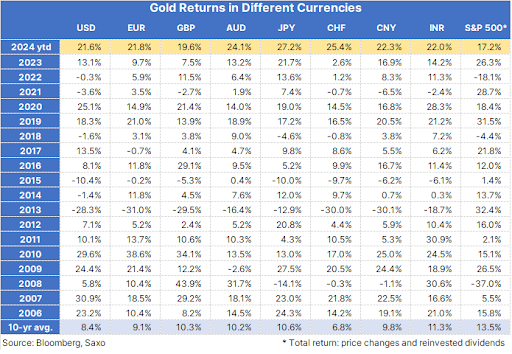
In this year’s rally, gold has established that it can compete as a global currency. With the latest push above $2,500 an ounce, gold prices are up more than 20% against the U.S. dollar, euro, and British pound. Year-to-date, gold is up roughly 17% against the S&P 500.
“If you have to pick commodities or currencies, it acts more like a currency because that’s how it’s traded. That’s how it’s treated on a trading desk. And certainly, that’s how we’re seeing central banks treat it as they continue to buy more to build up their reserves,” said Crowell. “When you compare it to other OTC markets and to the FX market, gold stacks up very, very well.”
Crowell added that one major advantage of gold compared to other currencies is that it has no third-party or political risks.
This past week, the gold market also reached a unique milestone. At $2,500 an ounce, the standard 400oz gold bar is now worth $1 million. The 400oz bar is the industry standard, as set by the London Bullion Market Association. Today’s million-dollar bar weighs approximately 12 kilograms.
The 400oz bar, also known as the Good Delivery Bar, is an essential tool in the global marketplace and the standard by which central banks store their official gold reserves. All physical settlements of gold trading in the London loco market are conducted with 400oz bars.
At the start of the summer, an LBMA delegation, which included Crowell, made another pitch to the Bank of International Settlements (BIS) to get gold reclassified from its Tier 1 status and recognized as an HQLA.
Crowell said that the discussion was productive, but the LBMA still has work to do, describing the process as a marathon, not a sprint. She added that the market has seen a significant evolution in just the last five years.
“We went from quite an opaque market to one of the most transparent OTC markets in the world with our daily trade reporting,” she said.
Although the LBMA has five years of trade data, the organization still has some gaps to fill. One void the LBMA needs to address is the go-forward rate that disappeared when the London Interbank Offered Rate (LIBOR) was disbanded.
However, Crowell added that she doesn’t expect the LBMA will have to reinvent a new lease rate for the gold market.
“I think the benchmark world has changed significantly, and you don’t need to resurrect that type of information again. I think we have enough trade data and sufficient volume,” Crowell said. “Now it comes down to how we use the data to meet market needs.”
Looking ahead to the LBMA’s upcoming conference, which will be held in Miami, Florida, Crowell noted that in 2023, the conference attracted record attendance, and this year’s conference is on par with last year.
