
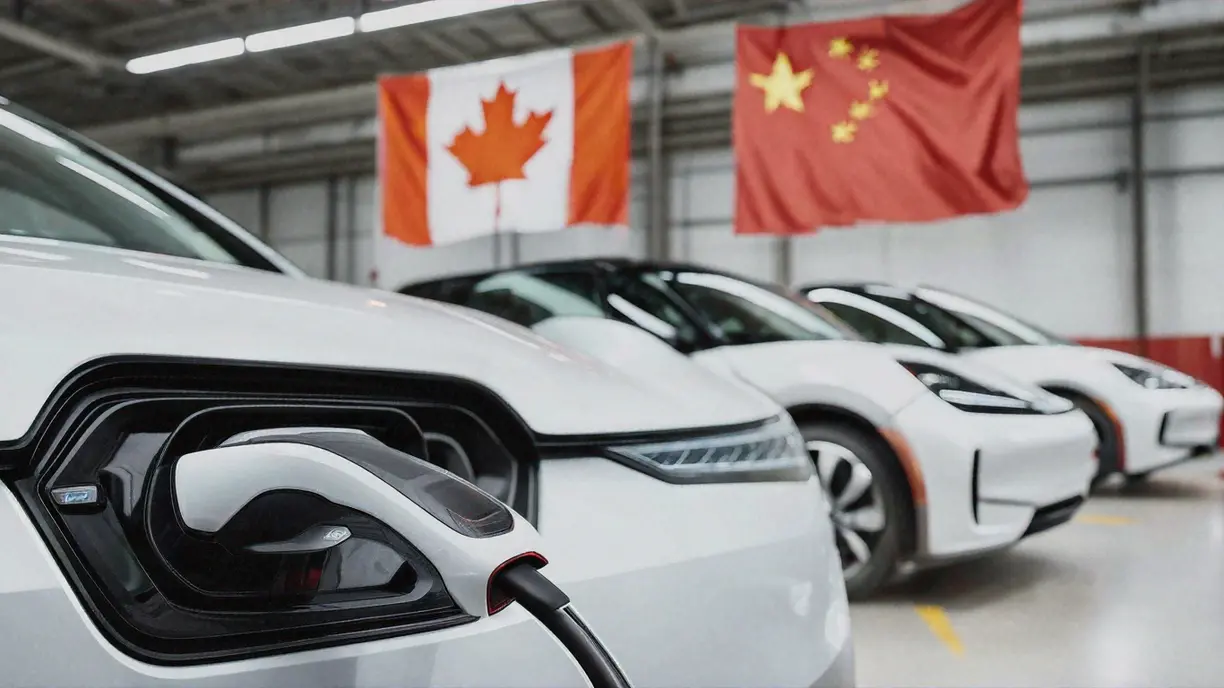
(Kitco News) – Canadian Prime Minister Justin Trudeau announced Monday that the country would follow suit with the United States and impose a 100% tariff on the import of Chinese electric vehicles to help combat the influx of what many have said are unfairly subsidized cars.
“I think we all know that China is not playing by the same rules,” Trudeau told reporters on the sidelines of a three-day closed-door cabinet meeting in Halifax, Nova Scotia. “What is important about this is we're doing it in alignment and in parallel with other economies around the world.”
Along with tariffs on electric vehicles – which will apply to electric and certain hybrid passenger automobiles, trucks, buses, and delivery vans – Canada will also place a 25% tariff on imported steel and aluminum from China.
Trudeau said the decision comes as Ottawa is looking to counter what he called China's intentional, state-directed policy of over-capacity. “Actors like China have chosen to give themselves an unfair advantage in the global marketplace, compromising the security of our critical industries and displacing dedicated Canadian auto and metal workers. So, we're taking action to address that,” he said.
“China has an intentional state-directed policy of overcapacity and oversupply designed to cripple our own industry,” said Deputy Prime Minister Chrystia Freeland. “We simply will not allow that to happen to our EV sector, which has shown such promise.”
With generous subsidies enabling Chinese firms to sell EVs for as little as $12,000, while China’s solar cell plants and steel and aluminum mills have enough capacity to meet much of the world’s demand, governments are scrambling to find ways to limit the effect these factors have on their local economies. Chinese officials have argued their production keeps prices low and is helping to hasten the transition to the green economy.
The decision to enact the 100% surtax on Chinese-made EVs, which will go into effect on October 1, comes after discussions with U.S. national security advisor Jake Sullivan, who met with Trudeau and cabinet ministers on Sunday.
“The U.S. does believe that a united front, a coordinated approach on these issues benefits all of us,” Sullivan told reporters on Sunday.
Sullivan will now fly to Beijing on Tuesday, where he is expected to receive pushback from Chinese officials, who are likely to raise concerns about the tariffs amid China’s work to repair its economy after the COVID-19 pandemic.
In May, U.S. President Joe Biden announced a four-fold increase in Chinese electric vehicle tariffs, raising them to 100%, while he also doubled the duties on semiconductors and solar cells to 50% and put a 25% tariff on lithium-ion batteries and other strategic goods, including steel. The move was done to help protect U.S. companies from Chinese excess production.
Implementation of the tariffs was delayed until September, and there is some speculation that the panned duties could be reduced this week.
In August, the European Union imposed tariffs of up to 37.6% on imports of EVs.
Trudeau gave a similar reason for the increased tariffs, telling reporters they will help to “level the playing field for Canadian workers” and allow Canada’s burgeoning EV industry to compete at home, in North America, and globally.
“We’re doing it in alignment, in parallel, with other economies around the world that recognize that this is a challenge that we are all facing,” Trudeau said of the new tariffs. “Unless we all want to get to a race to the bottom, we have to stand up.”
While Chinese brands like BYD have yet to achieve significant market share in Canada, imports from China are rising, especially since Tesla started using manufacturing plants in Shanghai to make cars for the Canadian market after switching from U.S.-based factories to fill their inventory.
The new tariff will apply to Shanghai-made Teslas that are sold in Canada, which many experts say will prompt Tesla to redirect Canadian production to one of its other plants in the U.S. or Europe instead.
Canadian officials also pushed back against allegations that they are only enacting the tariffs at the direction of the U.S., with one senior government official telling reporters that the government has been studying the issue for months, since before the U.S. announced its tariffs in May.
The official said there has been a growing concern within the Canadian government that Chinese automakers are flooding North America with heavily subsidized cars that are made in a country with poor labor and environmental standards, and they decided tariffs were the best course of action.
According to a national poll by spark*insights, which was commissioned by Canada’s steel and aluminum industry associations and surveyed 1,815 adult Canadians online from August 3-7, 79% of Canadians supported the idea of the federal government imposing tariffs on steel, aluminum, and electric vehicles imported into Canada from China, with the stated goal of supporting high-value Canadian jobs.
China is Canada's second-largest trading partner, with data from the country’s largest port in Vancouver showing imports of automobiles from China saw an annual increase of 460% in 2023, largely due to the influx of Shanghai-made Teslas into Canada.
Trudeau said that Ottawa will continue to work with the U.S. and other allies to ensure that customers worldwide are not unfairly penalized by the non-market practices of countries such as China.
Guy Saint-Jacques, a former Canadian ambassador to China, said that while the decision makes sense from the perspective of protecting the Canadian economy, Beijing is unlikely to accept the tariffs without a response.
Canada “had to go with the U.S. position when you think about the economic integration that we have with the U.S.,” Saint-Jacques said. “More than 75% of our exports go to the U.S. This reflects the fear that the next president of the United States might be Donald Trump, and so they know we have to be pretty much aligned in all of this.”
He warned that Canada can expect retaliation from China in other industries, highlighting barley and pork as prime candidates because of the ample supply available from other countries. “China will want to send a message,” he said.
Flavio Volpe, president of the Automotive Parts Manufacturers' Association, which lobbied Ottawa to match the U.S. tariffs, said the Canadian government has “stepped up again for the Canadian automotive sector.”
“It's very important for us to have a level playing field,” he said. “The Chinese are very good at what they do, but what they do also includes breaking the rules.”
“We are pleased to see the federal government taking a more assertive role to support high-quality jobs here in Canada and create more balanced trade,” said Marty Warren, National Director of the United Steelworkers union (USW). “Canadians want to see the government taking action to protect and create good jobs in Canada. Our government can and should be more aggressive in stopping unfair trade, for the benefit of jobs in our local communities.”
