
(Kitco News) - While investors have been focusing on equity markets hitting record highs, many have overlooked one asset that is actually outperforming the S&P 500.
In a report published last week, market analysts at Bank of America (BoA) noted that gold is the best-performing asset so far this year. With gold’s push to record highs above $2,500 an ounce, the precious metal is up roughly 20% in 2024.
In comparison, Bank of America noted that cryptocurrencies have risen 17.7%, stocks have rallied 15.4%, the overall commodity sector is up only 1.9%, government bonds have increased by 0.6%, and the U.S. dollar has gained 0.2% year-to-date.
Gold prices are even outperforming the tech sector, with the Nasdaq Composite Index up 17%.
Although investors have largely shunned the precious metals market, Bank of America noted that gold has seen the largest inflows in four weeks. The latest trade data from the Commodity Futures Trading Commission showed speculative positioning at a four-year high.
Gold’s rally to record highs has been driven by record demand from central banks in the first half of this year. The BoA analysts said that investors should be taking their lead from central bankers.
“Do what central banks are doing... buy gold,” the analysts said. “Gold is now the second-largest reserve asset (16.1% vs. 15.6% for the Euro) and has one of the lowest correlations to stocks across asset classes.”
Gold could see more investor inflows as downside risks continue to grow in equity markets. Bank of America doesn’t expect the S&P 500 to benefit as the Federal Reserve looks to kick off its new easing cycle next month.
The analysts note that an equity selloff could happen sooner rather than later.
“History shows the first Fed cut precedes more cash inflows in a ‘soft’ landing, with bonds being the likely winner if it’s ‘hard,’” the analysts said. “Five out of six Powell Jackson Hole speeches saw the S&P 500 drop by 7.5% on average in the next three months.”
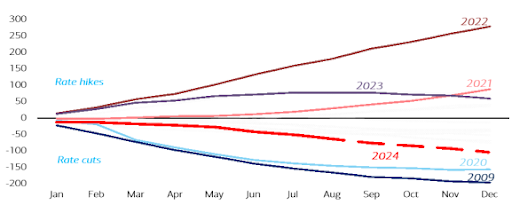
Looking at U.S. monetary policy, Bank of America said that even though the Fed is projected to deliver the third-largest rate reduction in a single year in 2024, even more may be necessary, as the U.S. government debt continues to grow and the U.S. commercial real estate market needs to roll over $1.5 trillion of CRE loans this year and next.