
(Kitco News) – Gold tends to underperform during crises in the near term but rallies long-term following rate cuts, according to a historical analysis by strategist Kerry Sun.
“Gold prices are reaching new heights, hovering around record levels of US$2,516 per ounce,” Sun wrote in Market Index. “This surge comes amid growing expectations that the Federal Reserve will cut interest rates by 25 or 50 basis points in September.”
Sun then examines the performance of gold prices following the start of the Fed’s easing cycles over the past 30 years. “Since 1995, the Fed has undergone eight cutting cycles,” he said.

"These are the forward returns for gold after the first rate cut of the given cycle,” Sun wrote.

He then shared a summary table showing the performance of gold at different timeframes following the first rate cuts.
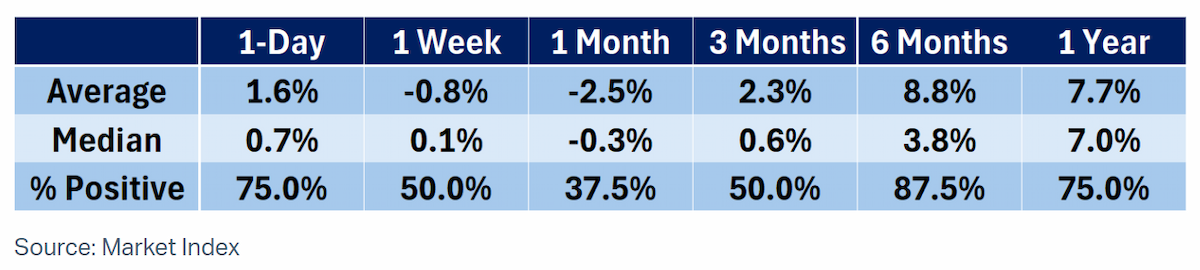
On the day of the first rate cut, “Gold tends to rally, up an average 1.6% and positive 75% of the time,” Sun observed. However, after one month, “Gold begins to struggle, down an average 2.5% and positive only 37.5% of the time. But after six to 12 months, “Returns are overwhelmingly positive, up more than 7.7% on average and positive more than 75% of the time.”
Sun also listed some key considerations for precious metals traders looking to time their entries into the gold market. The first of these is that, counterintuitively, while gold is a safe-haven, it doesn’t necessarily gain in periods of economic and geopolitical turmoil.
“While gold is often considered a defensive asset, it doesn't always perform well during periods of full-blown crisis,” he said. “During the Global Financial Crisis, gold prices fell almost 30% between March and October 2008. During the Silicon Valley Bank collapse in Feb-Mar 2023, prices fell as much as 7%.”
This was also true during the market’s most recent mini-crisis earlier this month. “When the Japanese carry trade unraveled (2-8 August 2024), gold was down 2.5%,” he noted. “This pattern might explain the poor 1-3 month performance following rate cuts, as gold prices ease under pressures such as the Dot-com bust, GFC, US-China trade war (2019), and the onset of the pandemic.”
But as economic crises begin to subside, markets tend to stabilize, and gold consistently performs very well. “Fed rate cuts are typically accompanied by quantitative easing, which boosts liquidity in financial markets and encourages lending and investment,” Sun wrote. “These conditions of ample liquidity and low interest rates generally act as tailwinds for gold prices in the longer term.”

“While gold prices may experience short-term volatility following a Fed rate cut, historical data suggests a tendency for stronger performance in the medium-to-long term,” Sun concluded. “The big question for now is – Is there a left-field crisis brewing that could drive gold prices lower in the short term? Or will the upcoming Fed rate cut take place during a period of relative economic stability?”
Gold sold off following the PCE price index release on Friday morning, but it has held above support at $2,500 per ounce.

After hitting a session low of $2,506.44 shortly after 10:30 am EDT, spot gold has recovered somewhat, last trading at $2,509.75 per ounce for a loss of 0.45% on the session.
