
(Kitco News) – The time has come for the Fed to cut interest rates, according to John Williams, President of the Federal Reserve Bank of New York.
Speaking just minutes after the release of a weaker-than-expected U.S. employment report for August on Friday morning, Williams made it clear that with inflation on track and employment and price stability now equally at risk, it’s time for the easing cycle to begin.
“The accumulated evidence has increased my confidence that inflation is moving sustainably toward 2%,” Williams told journalists at the Council on Foreign Relations in New York. “The current restrictive stance of monetary policy has been effective in restoring balance to the economy and in bringing inflation down. With the economy now in equipoise and inflation on a path to 2%, it is now appropriate to dial down the degree of restrictiveness in the stance of policy by reducing the target range for the Federal funds rate.”
“This is the natural next step in executing our strategy to achieve our dual mandate goals,” he continued. “And looking ahead, with inflation moving toward the target and the economy in balance, the stance of monetary policy can be moved to a more neutral setting over time, depending again on the evolution of the data, the outlook, and the risk to achieving our objectives.”
Williams also shared his own projections for key metrics of the United States economy going forward.
“I expect GDP growth this year to be around 2% to 2.5% percent,” he said. “I expect the unemployment rate at the end of this year to be around 4.25% and thereafter to move gradually down to my estimate of its longer-run level of around 3.75%. With the labor market in balance, I expect the process of disinflation to continue. Specifically, I expect overall PCE inflation to moderate to around 2.25% this year, and then to be near 2% next year.”
“That's my base case,” Williams added, “but it's important to emphasize that the outlook remains uncertain and I'm attentive to signs of a shift in economic conditions.”
The Fed governor listed three key risk areas that are particularly in focus. “One is the possibility of a significant further weakening in the U.S. labor market,” he said. “The second is a sharp slowdown in global growth that could spill over onto our shores. And third, the experience of the past year shows that the process of disinflation is not always smooth and can surprise both to the upside and downside.”
“We've come a long way from the unacceptably high inflation and overheated labor market that we experienced just two years ago,” Williams concluded. “Monetary policy has been unequivocally focused on returning inflation to our 2% longer-run goal. The risks to our goals are now in better balance, and policy needs to adjust to reflect that balance. Of course, one clear lesson of the past several years is the future is highly uncertain, therefore our decisions will be data-dependent with a keen eye on the achievement of our maximum employment and price stability goals.”
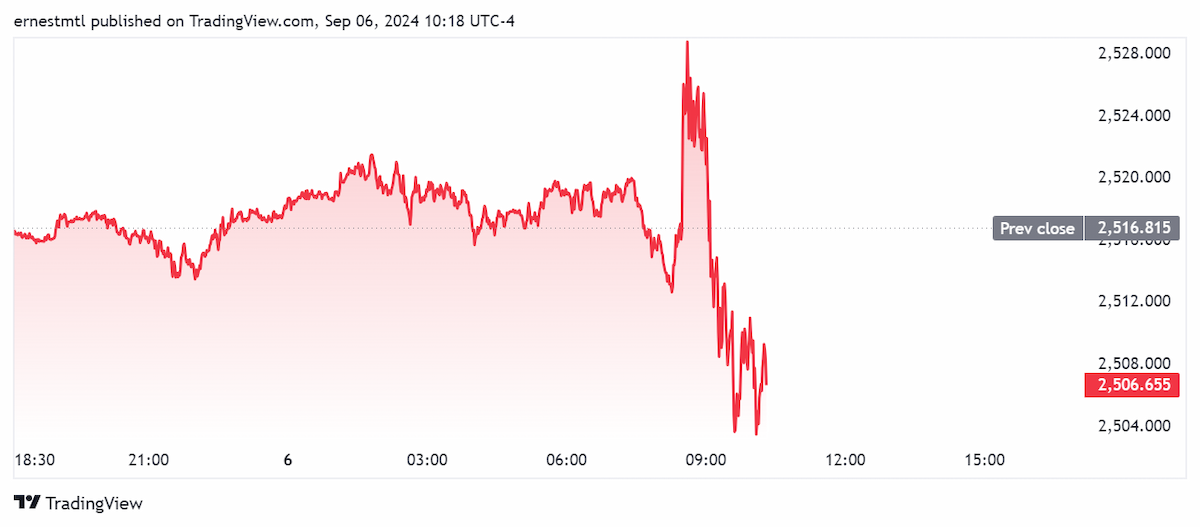
Spot gold shot to a session high of $2,529.30 in the minutes after the nonfarm payrolls release, but began its sharp decline just as Willaims began delivering his remarks. Spot gold last traded at 2506.65 for a loss of 0.25% on the session and is less than $3 off the session low.