

(Kitco News) – September trading continues to be akin to riding a rollercoaster as volatility dominated across financial markets on Tuesday ahead of the evening’s highly anticipated presidential debate between Donald Trump and Kamala Harris.
While Wall Street remains certain that an interest rate cut will be announced at next week’s Federal Open Market Committee (FOMC) meeting, market watchers are still curious about tomorrow’s Consumer Pirce Index (CPI) report for August, which could help provide clues to the size of the anticipated cut.
The report, set for release at 8:30 a.m. EST, is expected to show headline inflation at 2.5%, while consumer prices are predicted to rise 0.2% month-over-month, matching July's monthly increase.
The CPI update and Thursday's wholesale inflation reading are the last two inflation inputs ahead of the start of the FOMC next Tuesday. The CME FedWatch Tool shows the odds of a 50 bps rate cut currently stand at 33%.
At the closing bell, stocks finished mixed, with the S&P and Nasdaq in the green, up 0.45% and 0.84%, respectively, while the Dow lost 0.23%.
Data provided by TradingView shows that Bitcoin (BTC) bulls are determined to reclaim support at $58,000, with Tuesday seeing multiple attempts to flip the resistance level into support, though bears have thus far held their ground.
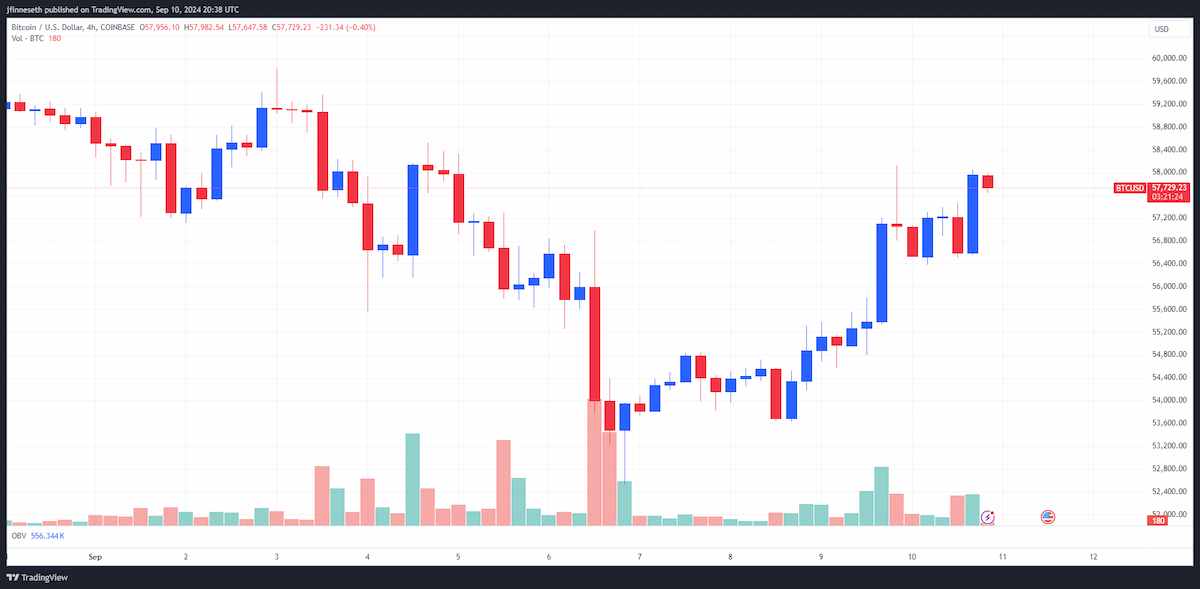
BTC/USD Chart by TradingView
According to Scott Guenther, Head of Finance at 0x, the crypto market is largely in a holding pattern as investors await tonight’s presidential debate to get a better sense of how each candidate will approach the asset class.
“Crypto is once again at the helm of macroeconomic factors, especially with this presidential election cycle,” Guenther said. “Investors don’t like uncertainty and election years are times when uncertainty increases. Whoever is elected will be a big deciding factor on the destiny of BTC, including in its price.”
“We’re already seeing analysts predict BTC at $30,000 if a Harris presidency happens,” he noted. “On top of the election, this week is a big one for hints as to how much the Fed will cut rates this month. We saw the jobs report come in slightly cooler than forecasts last week, mixed in with them revising 800K fewer jobs in the last year than originally reported. Adding in the CPI print this week, I believe investors are starting to sideline until they can get their bearings over the next few months.”
At the time of writing, Bitcoin trades at $57,866, an increase of 1.52% on the 24-hour chart.
The September effect
While Guenther pointed to uncertainty around the presidential election and interest rates as the reasons for Bitcoin’s sideways price action, Matt Hougan, Chief Investment Officer at Bitwise, noted that September has historically been bad for King Crypto.
“Septembers are terrible,” he wrote in a blog post on Monday. “Since Bitcoin started trading in 2010, the asset has fallen 4.5% on average during September. That’s by far the worst month, and one of only two months with a negative average return.”
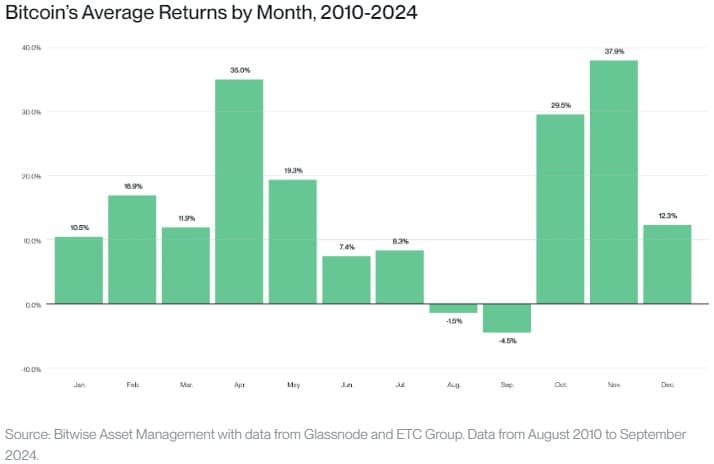
“Things don’t get better when you look more closely,” he added. “As a detailed analysis from NYDIG shows, Bitcoin has traded down in nine of 13 September's on record. September 2011 was its worst month ever, with a fall of 41.2%. So far this month, through Sunday, Bitcoin is down 7%.”
As for what drives the ‘September effect,’ Hougan offered three possible explanations.
First, “Septembers are terrible for all risk assets,” he said. “Bitcoin is not the only asset that suffers from the back-to-school blues. Since 1929, September is the only month when stocks fall more often than they rise. This effect is particularly pronounced in the tech-heavy Nasdaq-100.”
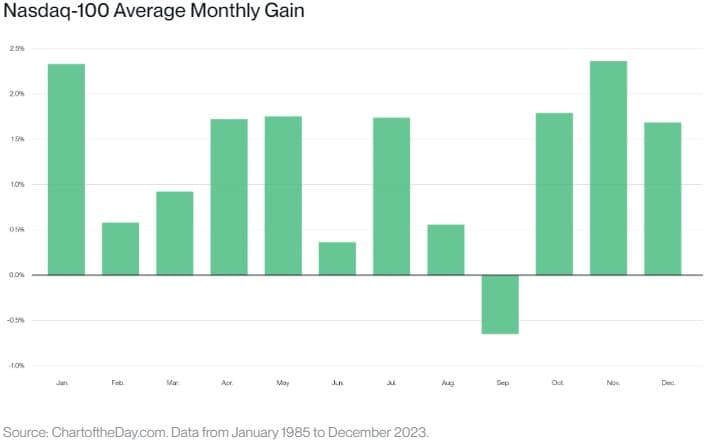
“Economists have tried to attribute this to various factors—a bump in volatility after the slow summer months, mutual funds harvesting losses at the end of their fiscal year—but no one is quite sure,” he noted. “Whatever the reason, it’s happening again: Through Friday, September 6, the Nasdaq-100 is down almost 6% this month.”
Second, he said that “SEC enforcement season weighs on crypto.”
“The SEC runs on an October-September calendar year,” Hougan noted. “Historically, that means you tend to see lots of enforcement actions in September, as lawyers try to meet their quotas for the year. True to form, SEC enforcement season is heating up: We’ve already seen a meaningful settlement with crypto fund provider Galois Capital as well as a Wells notice against NFT platform OpenSea this month.”
“Many predict more significant lawsuits and settlements against crypto entities by month’s end,” he added. “I wouldn’t be surprised; I’ve been hearing rumors of larger enforcement actions since early summer, and we’ve long warned about the perils of SEC enforcement season. I’m not sure the SEC overhang is enough to explain the September Effect on its own, but it certainly doesn’t help.”
The third theory highlighted by Hougan is “Reflexivity.”
“Probably the best explanation I’ve heard for the September Effect is that it’s simply self-reinforcing: People now expect September to be bad, and so it is,” he said. “While that might not sound earth-shattering, it’s no less true: Expectations move markets.”
“By contrast, Bitcoin investors historically love October – it’s nicknamed ‘Uptober,’ after all, thanks to Bitcoin’s 30% average rise during the month,” Hougan noted. “That probably juices the animal spirits. October and November are historically among the best months for crypto investors.”
He said that while it’s “unclear to what extent the factors above matter, whether it's a pure anomaly, or if there are various forces at work that have not been excavated,” the September effect is “impacting the psychology of today’s market.”
“Here’s what I do know: Seasonality aside, what’s most important is looking at the particulars of the market right now,” Hougan said. “And when I do that, I begin to see what’s behind crypto’s softness this September. Markets hate uncertainty, and there is a lot of uncertainty in the market right now.”
Along with the U.S. presidential election, which Hougan said “is currently a toss-up” and “will have significant ramifications for crypto,” he highlighted the debate around the timing and scale of Fed rate cuts and the mixed performance of spot Bitcoin and Ethereum (ETH) ETF flows as the main factors causing uncertainty in the market.
“My base case remains that we see a significant rally as this uncertainty starts to dissipate in October and November,” Hougan concluded. “The fact that this aligns with historical trends may or may not be a coincidence. Either way, I’m ready for it.”
Altcoins on the uptrend
Bitcoin’s move toward $58,000 inspired traders to jump back into the altcoin market as the majority of tokens in the top 200 recorded gains on Tuesday.
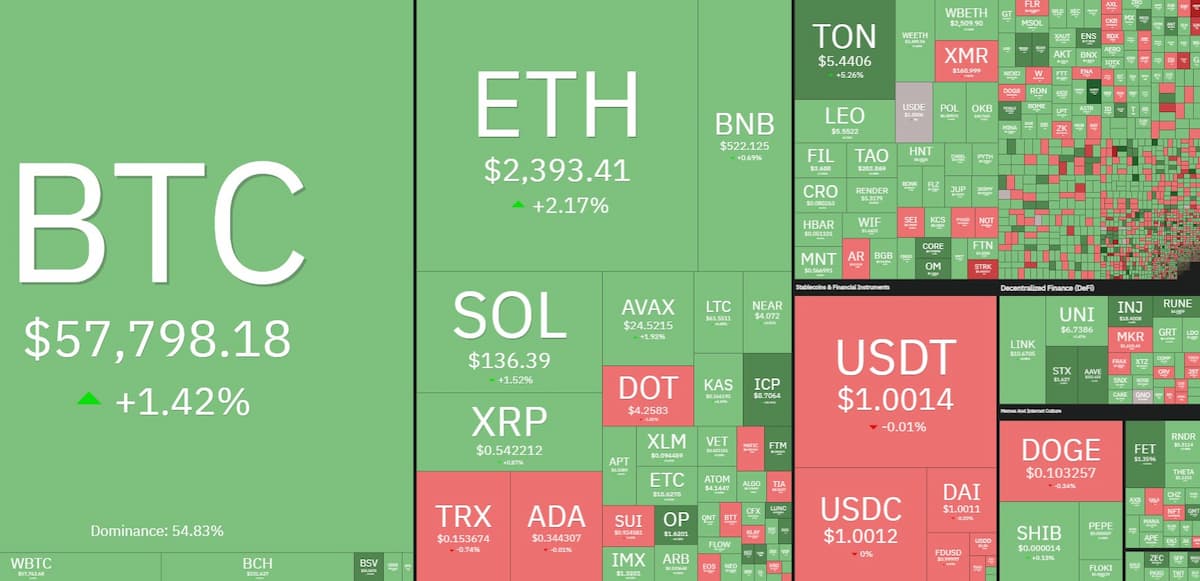
Daily cryptocurrency market performance. Source: Coin360
SuperVerse (SUPER) was the top gainer with an increase of 17.9%, followed by gains of 15.6% for Terra (LUNA) and 12.8% for WOO (WOO). Sun (SUN) was the biggest loser, falling 6.5%, while RocketPool (RPL) declined by 6.2%, and Starknet (STRK) lost 5.3%.
The overall cryptocurrency market cap now stands at $2.04 trillion, and Bitcoin’s dominance rate is 56.2%.
