
(Kitco News) – Silver (Ag) demand is based in large part on industrial applications as the grey metal is a necessary component in solar panels and the next generation of solid-state batteries, and the list of uses could soon expand greatly thanks to a breakthrough discovery by scientists in China.
According to a new study published in Matter, researchers from the Institute of Physics (IOP) of the Chinese Academy of Sciences have discovered that silver has the intrinsic capability of autonomously self-healing at the nanoscale level.
The concept of self-healing in materials science and engineering was inspired by the innate ability of some living organisms to self-heal, but thus far, the focus has generally been on “soft” materials like polymers and hydrogels.
“For solid-state metals, one may intuitively imagine that any form of self-healing will be much more difficult to achieve,” the Chinese Academy of Sciences said. “While a few past studies have showcased the self-healing behavior in metals that more or less requires the assistance of external triggers (e.g., by heating, mechanical stimulus, or electron beam irradiation), whether the autonomous self-healing can occur in metal solids without any external intervention remains a scientific curiosity.”
In the study, the scientists combined advanced in-situ transmission electron microscopy (TEM) with molecular dynamics (MD) simulations to show that “nanoscale Ag can autonomously repair itself from structural damage, such as nanocracks and nanopores, without external intervention.”
“This remarkable ability is observed not only at room temperature but also at frigid temperatures as low as 173 K,” they said. “Notably, over the same damaging area, the repeated reversible self-healing cycles can also be achieved with the same level of efficiency.”
The experiments conducted by the Academy were done in an atomic-resolution TEM by utilizing single-crystalline Ag nanosheets as testing specimens. The team purposefully created nanopores and nanocracks through in-situ drilling with the TEM electron beam, and then they kept the nanosheet in a “beam-off” state until it was time for interval TEM imaging to avoid any possible interference with the healing process.
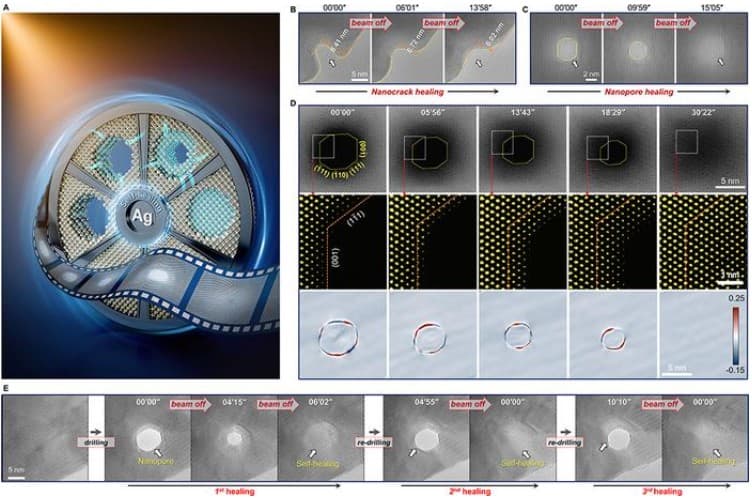
(A) An artistic poster depicting the autonomous self-healing phenomenon found in nanoscale Ag. (B, C) Sequential high-resolution TEM images showing the autonomous self-healing processes of a nanocrack (B) and nanopore (C) damage, respectively. (D) High-angle annular dark field (HAADF) images and the corresponding geometric phase analysis (GPA) of an overall self-healing process of nanopore. (E) Three runs of repeated reversible forming/healing cycles over the same region. (Image Credit: IOP)
“As an interesting and perhaps surprising result, the two representative kinds of structural damage were observed to undergo rapid self-healing autonomously within several to dozens of minutes, with the healed regions perfectly restoring the crystal lattice of Ag with atomically precise ordering,” the report noted.
“Unlike Ag, gold (Au) did not show similar self-healing behavior at room temperature, despite the fact that Au is the most relevant element to Ag in the periodic table and they share many similarities in physical and chemical properties,” the authors said.
To verify their results, additional molecular dynamics simulations were performed, and the scientists were successfully able to reproduce their experimental observations, “especially regarding the difference in the healing behavior between Ag and Au.”
“What sets Ag apart from Au is its high mobility of surface diffusion, a trait not commonly found in other metal solids,” the report noted.
The use of TEM allowed the researchers to track the trajectory of the healing process in Ag at the atomic level. By combining atomistic imaging and theoretical simulation results, the research was able to show that “self-healing is enabled by the surface-mediated self-diffusion of Ag atoms as driven by chemical potential imbalance due to the Gibbs-Thomson effect.”
“When a nascent damage structure (either nanopore or nanocrack) begins its existence in an Ag nanosheet, a concave site with negative local curvature is created,” the report said. “Due to the general curvature-dependence of chemical potential, the concave damage site will thereby have smaller chemical potential relative to the undamaged areas of the nanosheet. This built-in imbalance of chemical potential drives Ag atoms to migrate and repair the damage autonomously, showcasing a sophisticated form of material self-maintenance.”
The authors noted that “The ability of Ag to autonomously self-heal nanoscale damage at room temperature and below shows a promising possibility for developing damage-tolerant components and devices at the sub-micrometer length scale.”
“Perhaps more importantly, in a broader sense, this unusual finding at a mechanistic level may provide a guiding framework for deeper understanding of the self-healing phenomena and concepts in metal solids in general,” they concluded.
