
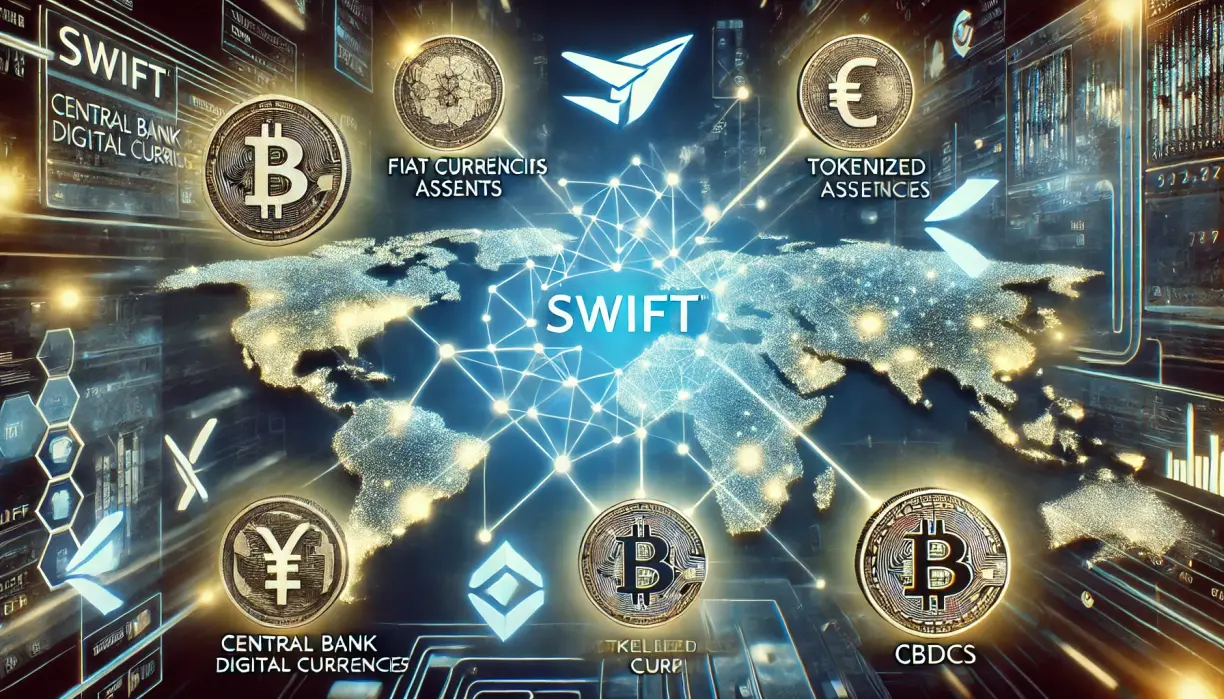
(Kitco News) – Global financial messaging network Swift announced that it is working to build real-world solutions that interlink fiat currencies with different forms of tokenized assets as part of its larger goal of offering users access to both existing and emerging assets.
“We’re paving the way towards real-world solutions that will enable our members to access and transact with regulated digital assets and currencies on the Swift network,” the firm said in a blog post. “This follows a series of groundbreaking experiments conducted with our community in recent years, which we’re now advancing to the next stage.”
Swift noted that the digital asset ecosystem and cryptocurrencies have seen tremendous growth over the past two years, which brought “greater clarity on the potential value of these developments to the industry.”
Standard Chartered has estimated that the market size of tokenized real-world assets (RWA) will climb as high as $30 trillion by 2034, while a survey by Celent and BNY Mellon found that 91% of institutional investors are interested in investing in tokenized assets.
The main problem currently, according to Swift, is “the growth in divergent platforms, technologies and regulatory environments that underpin digital innovation. This is leading to the emergence of an ecosystem of fragmented ‘digital islands’ that add costs and risks for market participants to navigate,” they said.
“Institutional investors, for instance, are unable to ramp up their digital asset businesses due to the complexities they face when dealing with a multiplicity of tokenization platforms,” Swift said. “And on the digital currency side, while the latest Atlantic Council figures show that over 130 countries and currency unions are currently exploring a central bank digital currency (CBDC), significant work is still needed to integrate these emerging currencies into the wider global economy.”
As Swift moves on to the next phase of their goal to “increase global interoperability and enable fast, frictionless, and secure transactions,” they are now focused on “expanding on our ability to interoperate new systems, technologies, assets and currencies.”
“In our innovation labs, we’ve been proactively exploring potential solutions to the challenge of extending global interoperability to CBDCs and tokenized assets for a number of years now,” they said. “Recently, we’ve brought the industry together in a series of breakthrough research projects to explore how existing Swift capabilities and infrastructure can seamlessly support interoperability across different asset classes and network types.”
The firm has conducted blockchain interoperability experiments that demonstrated how the Swift infrastructure can accommodate the transfer of tokenized value across both public and private blockchains.
They have also launched several phases of CBDC sandbox projects with the leading central and commercial banks from across Europe, Asia and North America, which demonstrated how the Swift system can interlink CBDCs on different networks and interlink multiple asset and cash networks.
“Now we’re setting our sights higher,” Swift said. “Our vision is for our members to be able to use their Swift connection to transact interchangeably using both existing and emerging asset and currency types.”
“We have a strong track record as a trusted and efficient central platform for transactions using fiat currencies and securities instruments,” they added. “Now we’re further evolving our infrastructure to be able to offer our members the same level of access to emerging digital asset classes and currencies across a range of use cases in payments, securities, FX, trade and beyond.”
The ultimate goal is to create “real-world solutions capable of interlinking various forms of digital assets and currencies – including plans to test how to enable multi-ledger Delivery-versus-Payment (DvP) and Payment-versus-Payment (PvP) transactions on Swift’s secure, global platform,” they said. “In the future, this could enable securities buyers to simultaneously pay for and exchange tokenized assets in real time on our network.”
Swift warned that without a globally accepted digital form of money, executing the cash part of DvP settlement “is particularly challenging.”
“So we’re looking at ways to connect tokenized asset settlement with the corresponding payment transfer taking place on the Swift network,” they said. “The payment leg will initially be made using existing fiat currencies, but will later be able to use tokenized forms of money, such as CBDCs, tokenized commercial bank money, or regulated stablecoins.”
The firm is also testing how it can use its interlinking capabilities to “interlink emerging bank-led networks such as the US Regulated Settlement Network with other financial infrastructure.”
“While much has already been achieved, it’s clear that there’s still plenty of work to be done,” Swift concluded. “Together with the financial community, we’re continuing to develop the technical solutions needed to achieve digital asset and currency interoperability and access. In the coming months, we’ll also be exploring what implementation will mean for the workflows, standards, and market practice requirements needed to achieve scale. We’re excited for the future of digital assets and currencies on our network and will continue to collaborate with our community to drive progress in this area.”
