

(Kitco News) – The mantra of ‘blockchain, not Bitcoin’ is one that institutional investors have repeated for years as a way to highlight the potential the technology holds to transform financial markets, and according to one of Bitcoin’s (BTC) biggest critics, the underlying technology is already being used to transform the business practices of the largest bank in the U.S.
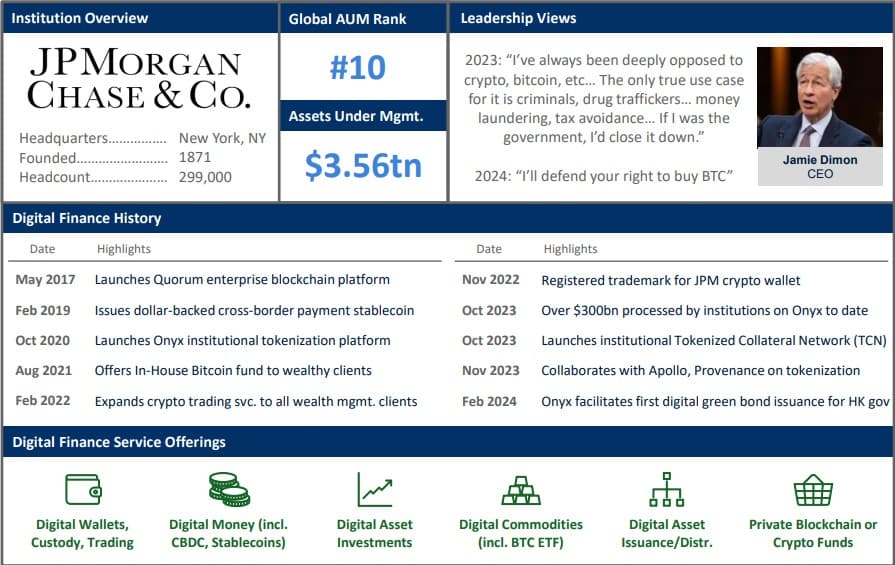
“We're probably one of the bigger users of blockchain, an actual user, like a real user,” said Jamie Dimon, the CEO of JPMorgan Chase, in an interview at the Financial Markets Quality Conference on Tuesday.
According to a report from The Block, Dimon sought to downplay the statement as just a normal part of the technological evolution underway, saying blockchain is “just a database.”
Those comments stand in sharp contrast to his opinion of Artificial Intelligence (AI), for which he sees tremendous potential. “We've been talking about blockchain for 12 years, not much has happened — it ain't like AI,” Dimon said.
The JPMorgan CEO is well-known for his anti-crypto stance, previously calling Bitcoin “a pet rock” and the industry as a whole “worthless.”
His stance on the industry hasn’t changed much despite his bank’s use of blockchain technology. In the interview, he repeated his previous statement: “Cryptocurrency... I call this a pet rock.”
But he did acknowledge that the underlying technology has promising applications, saying that blockchain is “a great way to share data” and establish trust between banks and their customers.
JPMorgan’s private, permissioned network, dubbed Onyx, is a fork of Ethereum (ETH) that is designed for wholesale payment transactions, peer-to-peer lending, borrowing, and cross-border payments.
Firms like Goldman Sachs, DBS Bank, and BNP Paribas currently use the network, and to date, Onyx has processed more than $700 billion worth of transactions.
While Dimon’s opinion of the crypto industry was the norm from the institutional side of things for more than a decade after Bitcoin’s launch, that has started to change in recent years, especially with the launch of multiple spot BTC exchange-traded funds (ETFs) in January.
According to the Institutional Digital Finance Adoption Report from Blockchain Coinvestors, which tracks digital finance adoption among the 50 largest global financial institutions, most of these firms – which manage a total of more than $130 trillion in assets – “are already active in digital finance with a handful emerging as leaders in blockchain adoption.”
“More than 50% already provide or support digital wallets, custody, and/or trading,” the report said. “More than 40% already support digital monies, such as CBDCs and/or stablecoins; more than 25% are investors, providers, or operators of digital assets commodities/ETFs; more than 25% are investors, providers, or operators of digital assets commodities/ETFs; and nearly 40% have explored digital asset issuance and distribution.”
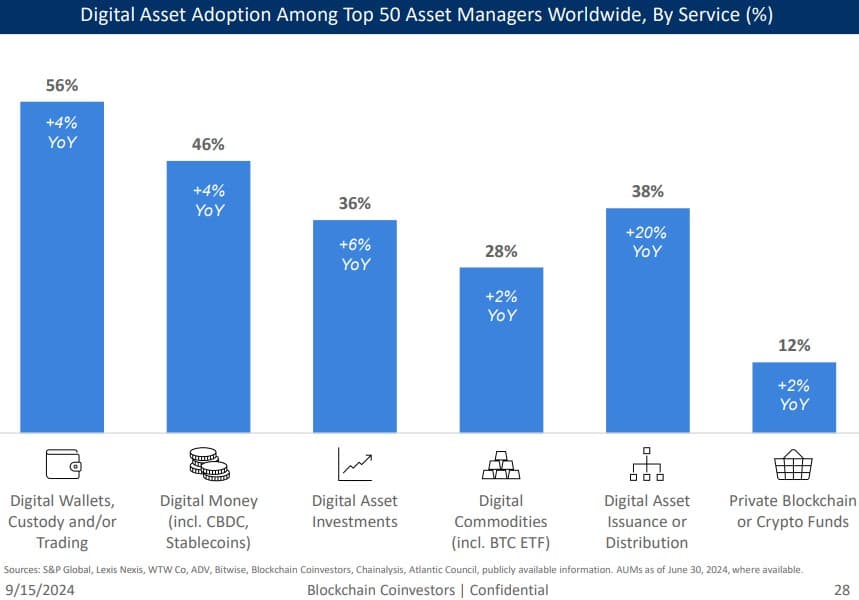
“Like communications and content, the future of finance is inevitably digital, and the majority of the world's largest financial players are building products to enable natively digital monies, commodities, and assets,” said Matthew Le Merle, Managing Partner at Blockchain Coinvestors. “In the next decade, institutions that lead in adopting blockchain technology will be the ones that redefine trust, security, and confidence in the global financial system.”
And while public comments from the likes of Dimon often derided the technology over the years, behind the scenes, institutional firms, including JPMorgan, were getting involved with the industry and experimenting with the technology as they recognized that it would be the future of finance.
“Despite perceptions of slow adoption, this transition tracks back nearly a decade,” said Topher Nelson, Blockchain Coinvestors’ Head of Digital Asset Research. “Fidelity's deep involvement wasn't well known until they launched their digital asset arm publicly in 2018, but they began mining Bitcoin as early as mid-2014 and had already partnered with Coinbase by 2016. Blackrock, already had nearly $400m invested in public Bitcoin miners by 2021 and has since processed billions in transactions on their own blockchain-based products like Onyx and via partnerships like Coinbase and Circle.”
That said, there have been notable differences in adoption based on geographic regions.
“100% of major Chinese banks and a majority of Japanese banks [are] already actively using and deploying digital wallets and digital dollars like the digital Yuan,” the report said. “Leading American institutions, fueled by the BTC and ETH spot ETF approvals in Q1, now largely offer or support digital wallets, custody, trading, or ETFs in some form and are becoming active now in digital asset issuance and distribution, while in Europe, CBDC pilots are maturing quickly and nearly 60% of leading institutions support digital asset wallets/trading, with 40%+ participating in issuance and distribution.”
The report also noted the growing prominence of the crypto industry in the political realm, with presidential candidate Donald Trump vowing to make the U.S. the “crypto capital of the world.”
It also pointed out the growing real-world asset (RWA) tokenization movement, highlighting that tokenized U.S. treasuries surpassed $1 billion in 2024.
“Headlines like the marquee partnership between Blackrock and Securitize, have characterized this flight to tokenization as money managers realize the inherent benefits of a faster, cheaper, and more transparent option than traditional securities,” Blockchain Coinvestors said.
“The market has clearly recognized and rewarded the advantages of tokenization for financial products,” said Mitch Mechigian, partner at Blockchain Coinvestors, in a separate report on tokenization. “As a result, most major financial institutions now understand that participation in this space is not optional—it’s essential. For some, like BlackRock, tokenization represents a massive opportunity to launch the next generation of financial products.”
“Over the next decade, we anticipate that tokenization will continue to expand into other areas of the financial system, including assets like securities, bonds, and commodities,” Mechigian concluded. “This forward-looking view is central to our fund-of-funds strategy, which provides broad coverage of these emerging trends.”
