(Kitco News) – Gold’s recent rally has all but wiped out the impact of India's import duty cut, while Switzerland’s August gold exports showed nothing going to China, raising concerns that Asian demand could remain below seasonal norms through Q4.
Indian gold demand improved slightly this week but remained far below normal seasonal levels as the yellow metal continued to trade near record highs, according to a Reuters report.
India is the world's second-largest gold consumer and a major importer, but domestic demand continued to be depressed as local prices hovered near July’s all-time high.
"Demand was modest for two days, but it lost momentum again as prices rebounded to near-record levels," a bullion dealer in the southern Indian city of Hyderabad told the news agency.
Indian dealers were offering discounts of up to $17 per ounce over benchmark domestic prices this week, which includes the 6% import and 3% sales levies. Last week, gold dealers were offering discounts as high as $22 per ounce.
A Mumbai-based dealer with a private bullion importing bank said that the global gold price rally has almost completely offset India's recent import duty reduction, and retail customers are once again turned off by the high prices.
And things aren’t looking any better in the world’s number-one bullion market. The latest customs data from Switzerland showed that China imported no gold whatsoever from the world's largest gold refining and transit hub last month, for the first time since January 2021.
Chinese dealers also increased their discounts by as much as $14 over global spot prices compared with last week's $10 discount, while in Hong Kong, gold sold close to the international benchmark.
Hugo Pascal, precious metals trader at Improved, told Reuters that demand in China also remains weak, which is impacting wholesale demand in Hong Kong.
Wholesale demand on the mainland has also been weak, with the World Gold Council noting that August withdrawals from the Shanghai Gold Exchange are down 37% from a year earlier, Bloomberg reported. August and September typically see higher withdrawals as jewelers increase their stock ahead of gold fairs and the National Day holiday.
Physical investment demand has remained strong, however, with bars and coins continuing to attract buyers. Data from the China Gold Council suggested a 27% decline in jewelry purchases in the first half of 2024, but only a 6% fall in total demand.
“The decline in consumer demand for gold jewelry stems mainly from the weaker income expectations,” Song Jiangzhen, a researcher at Guangdong Southern Gold Market Academy told Bloomberg. “Elevated gold prices have also discouraged consumers, most of whom are in wait-and-see mode, hoping for prices to come down before buying.”
Meanwhile, in Japan, gold was selling at a $1 discount, and the market was seeing more sellers than buyers at these prices, according to a Tokyo-based trader.
Ross Norman, CEO of Metals Daily, said customers are telling the market that bullion is pricing them out. “Price sensitivity in the Asian region has returned and from buyers' inaction, they seem to be saying that gold is currently overpriced,” he said.
Singapore was the exception in the region, with some retail customers still willing to pay premiums as high as $2.20 per ounce as gold prices are expected to rise even higher.
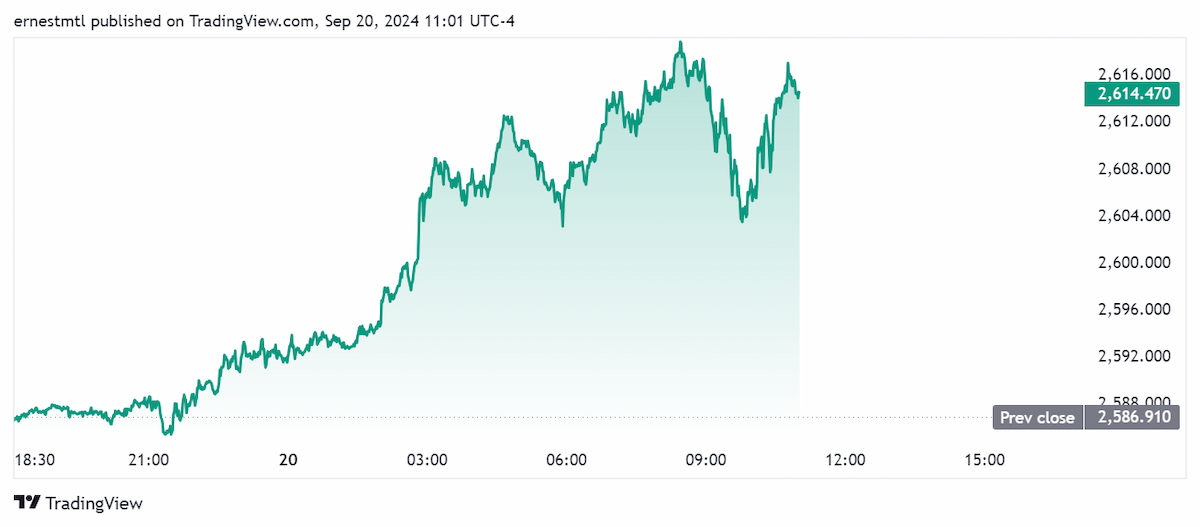
Spot gold set a new all-time high just below $2,620 per ounce during Friday's trading session. It last traded at $2,614.72 for a gain of 1.08% on the daily chart