
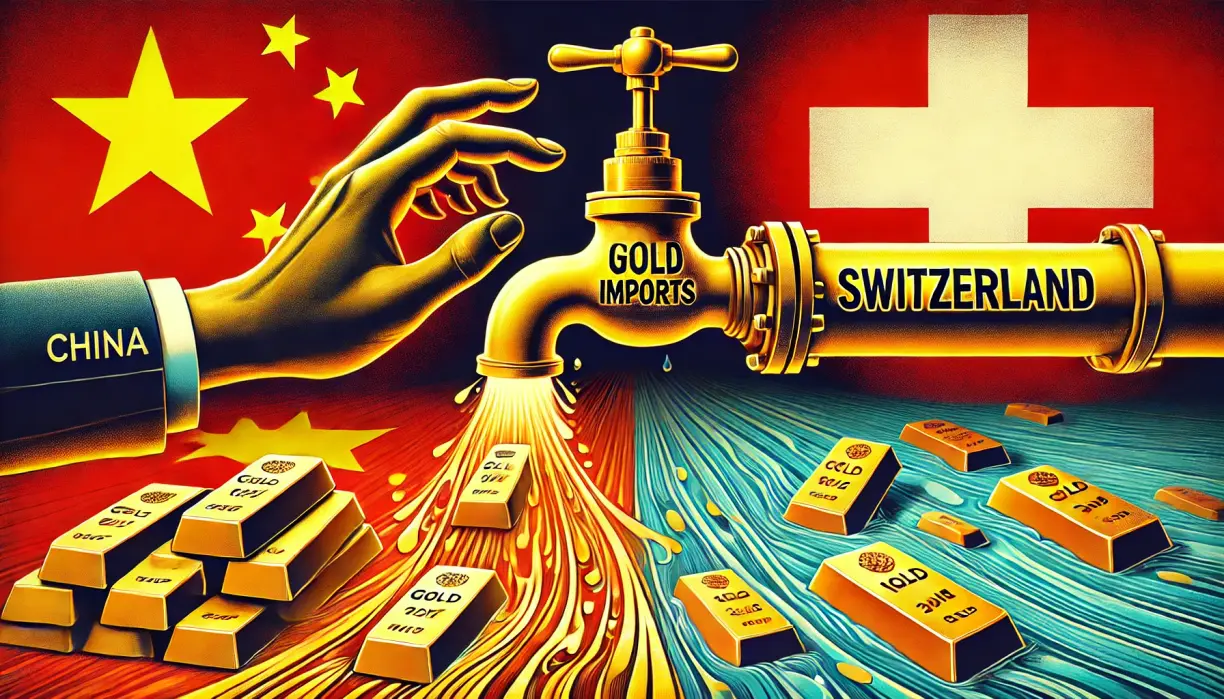
(Kitco News) – While the free trade agreement between China and Switzerland actually has little to do with the Asian superpower’s massive gold imports, they may still provide a powerful lever to influence the next version of the deal.
In a recent analysis in Swiss Info, the English-language portal of the Swiss Broadcasting Corporation, authors Balz Rigendinger and Pauline Turuban wrote that China’s quest for power and influence has not escaped the notice of Swiss politicians.
“In the parliament in Bern, Chinese global ambitions are now discussed and observed more critically than they were in 2013, when the free trade agreement between the two countries was signed,” they said. “Scepticism and concern are rife across all parties. In September, the House of Representatives decided that major Swiss companies could no longer simply be taken over by foreign investors. The bill was unofficially called ‘Lex China’.”
While the leftwing Social Democratic Party and Green Party view Switzerland’s ties with China as already too close, the business community is pursuing ever closer and deeper partnerships. “All figures are heading upwards – but there is still room for improvement,” they wrote. “This explains why Switzerland is now launching the second stage. It started negotiations to update the agreement this week. While the European Union, the US and other Western nations are increasingly taking an anti-China stance, Switzerland is snuggling up more closely to it than many other nations.”
Some experts believe the Swiss free trade agreement was a test run for future agreements with EU members. “China used this agreement to study how free trade agreements work in Europe,” said Asia specialist Patrick Ziltener, who evaluated the China-Switzerland trade agreement for the Sino-Swiss Competence Centre at the University of St Gallen.
Ziltener said the agreement also enabled China to bolster its free trade credentials, as “[A] partnership with internationally respected Switzerland would prove that China was a reliable partner.”
While free trade agreements are often measured by increased trade volumes, the authors said the real value lies elsewhere. “Free trade does not lead primarily to more volume but to more profit,” they wrote. “This is because tariffs are lifted. In 2022, the Swiss economy saved CHF187 million in unpaid customs duties thanks to the agreement, Ziltener calculated.”
In pure volume terms, Swiss exports to China are dominated by gold. “Swiss gold exports to China have more than doubled in the past ten years and account for half the total value of goods,” they said.
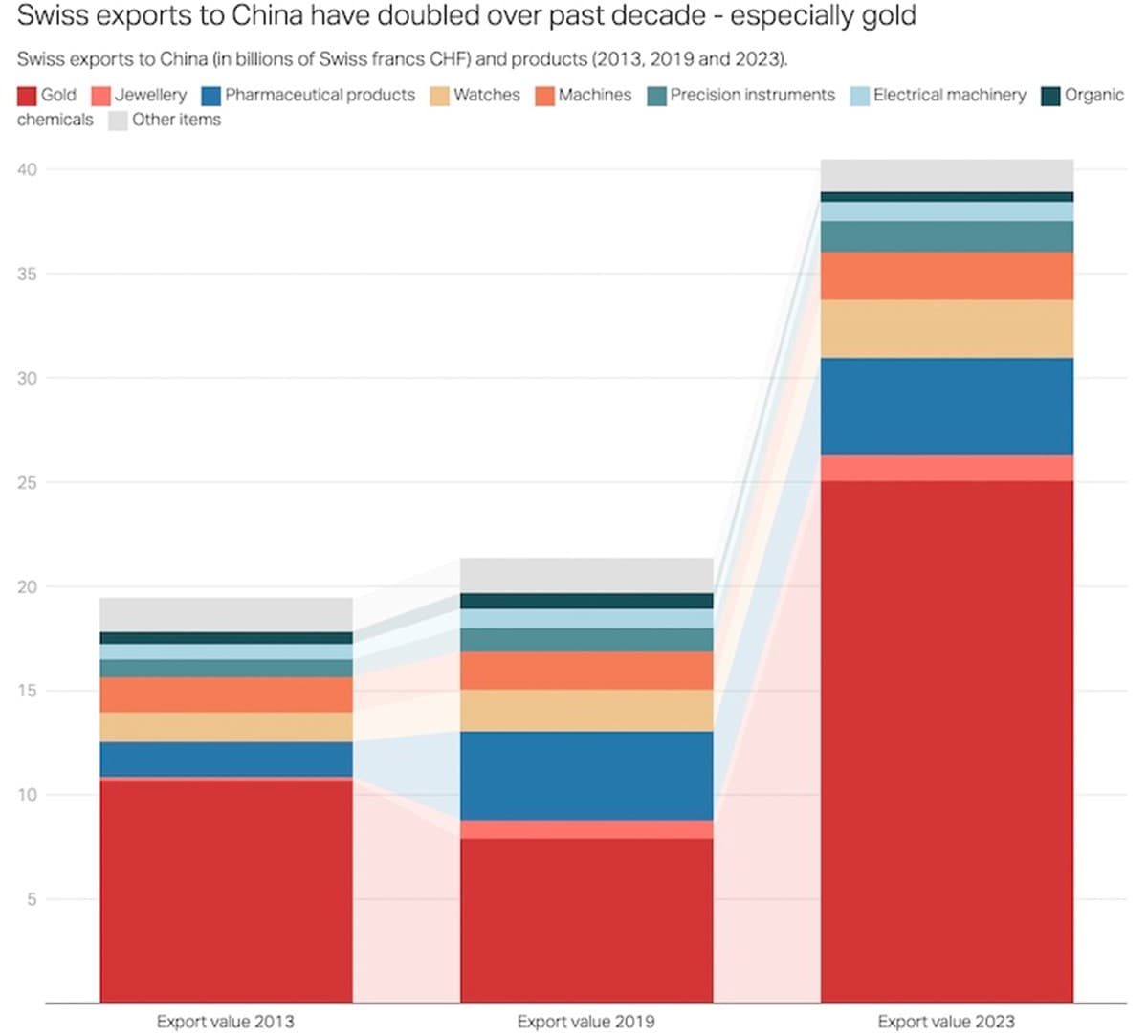
They said the reason for this is China’s massive appetite for gold. “The Chinese central bank was the world’s largest single buyer of gold in 2023,” the authors noted. “According to analysts, it is seeking to make China independent of the dollar. Here, it is curious to note that, while Swiss foreign policy preaches multilateralism, Swiss gold exports are helping China to decouple itself from the global monetary system. Switzerland is home to four of the five largest gold refineries in the world.”
But the Switzerland-China free trade agreement actually has nothing to do with gold. “China does not levy import duties on gold, regardless of origin,” said Swiss State Secretariat for Economic Affairs (SECO) spokesperson Fabian Maienfisch.
The authors then share a chart of Swiss exports to China excluding gold:
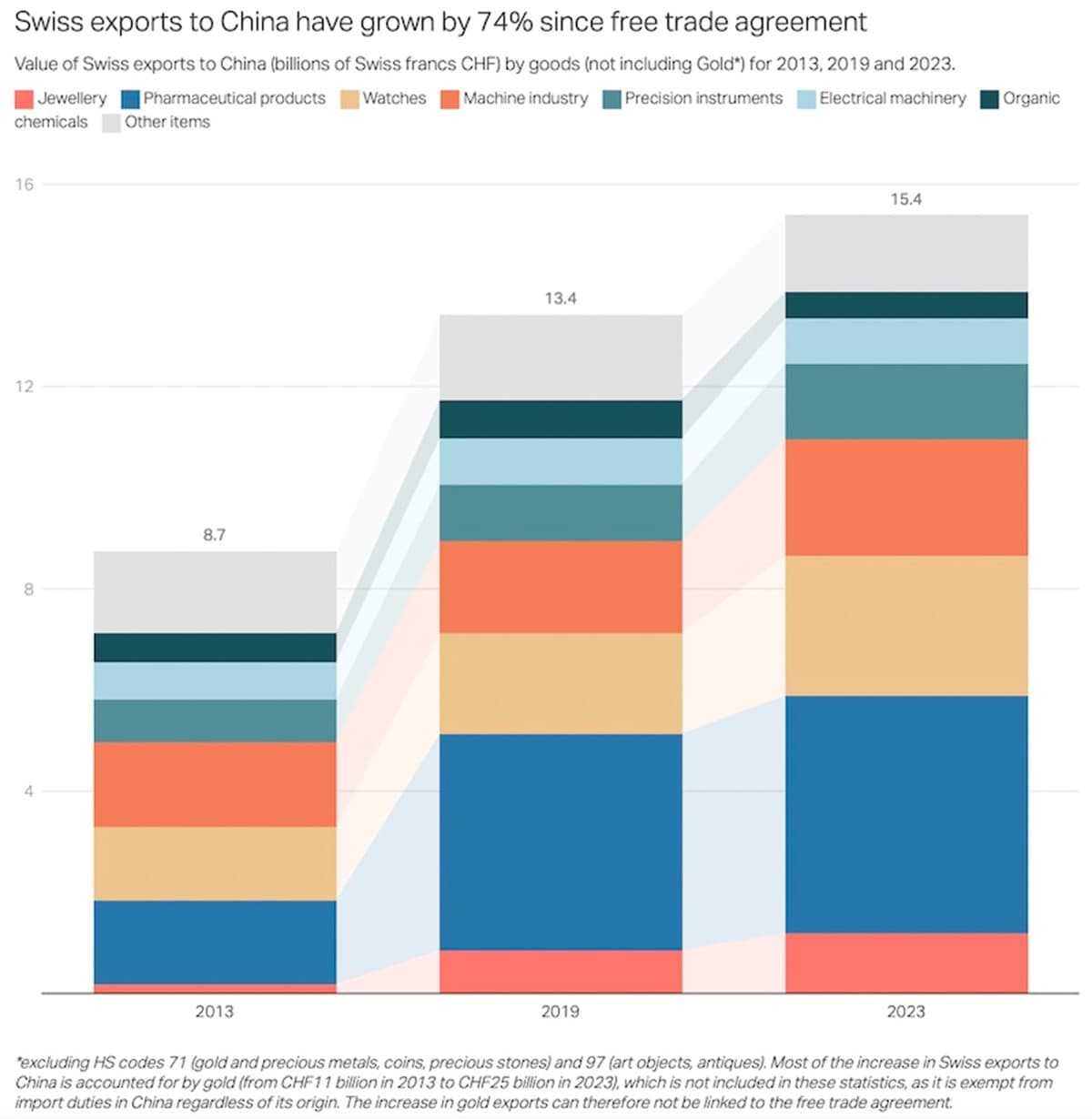
“Swiss exports to China (excluding gold) have increased by 74% to CHF15.4 billion over the past ten years,” they pointed out. “The pharmaceutical, watch and machine industries are particularly China-oriented. The pharmaceutical industry has seen the largest increase.”
So, while gold continues to dominate Swiss-China trade, the impacts of deeper and broader tariff-free trade will be felt in other industries, some of which may prove politically untenable even in a pro-trade environment.
Ziltener expects that “China will want to include the export of labour” in the next iteration of the agreement. “This would mean Swiss work permits for Chinese specialists – which is likely to prove a difficult sell domestically,” he said.
“When all is said and done, however, the agreement with Switzerland guarantees China the political acquiescence of a broadly networked state,” the authors concluded. “It can rely on internationally respected Switzerland and on the fact that this Western country located in the heart of Europe will continue to abstain from an anti-China policy.”
China’s gold purchases from Switzerland may also put them in an especially strong negotiating position, even if the yellow metal is already exempt from tariffs, because the Asian giant still tightly controls their domestic gold market.
The latest customs data from Switzerland showed that China imported no gold whatsoever from the world's largest gold refining and transit hub last month, for the first time since January 2021. China’s ability to turn the bullion tap on and off, even in a ‘free-trade’ environment, could act as a powerful incentive for Switzerland to grant them the concessions they desire in other areas.
