
(Kitco News) – The U.S. Presidential election is less than one month away, and with the race still too close to call, according to mainstream polls, discerning voters are weighing each candidate's policies and how they could impact the economy to help make their decision.
“The next President will face significant fiscal challenges upon taking office, including record debt levels, large structural deficits, surging interest payments, and the looming insolvency of critical trust fund programs,” said the Committee for a Responsible Federal Budget (CRFB) in their report titled The Fiscal Impact of the Harris and Trump Campaign Plans. “Our large and growing national debt threatens to slow economic growth, boost interest rates and payments, weaken national security, constrain policy choices, and increase the risk of an eventual fiscal crisis.”
Notably, neither Donald Trump nor Kamala Harris have proposed a plan to address the unsustainably growing debt. According to the report, a “comprehensive analysis of the candidates’ tax and spending plans finds that both Vice President Kamala Harris and former President Donald Trump would likely further increase deficits and debt above levels projected under current law.”
“Under our central estimate, Vice President Harris’s plan would increase the debt by $3.50 trillion through 2035, while President Trump’s plan would increase the debt by $7.50 trillion,” the report said. “These estimates come with a wide range of uncertainty, reflecting both different interpretations and estimates of the policies.”
On the low end, the CRFB estimates that Vice President Harris’s plan could have no significant fiscal impact, while on the high end, it could “increase debt by $8.10 trillion through 2035.” For Trump, they found his plan “could increase debt by between $1.45 and $15.15 trillion.”
Both candidates have called for a number of policy changes with potentially significant fiscal impact, the CRFB said.
“Vice President Harris would add $3.50 trillion to the projected debt through Fiscal Year (FY) 2035 under our central estimate, as a result of $7.25 trillion of deficit-increasing measures, $4.25 trillion of deficit-reducing measures, and $500 billion of interest costs,” they noted. “President Trump would add $7.50 trillion to the projected debt through FY 2035 under our central estimate, as a result of $10.20 trillion of deficit-increasing measures, $3.70 trillion of deficit-reducing measures, and $1.00 trillion of interest costs.”
The CRFB said they determined these estimates based on “the expected fiscal impact of policies on the candidates’ campaign websites and policies that have been proposed through official campaign announcements, white papers, and social media posts. In many cases, we relied on speeches, discussions with campaign staff, and similar proposals in Presidents’ budgets and elsewhere to help clarify policy details.”
Some of the biggest budget items proposed by Harris include a significant expansion of the Child Tax Credit and other individual tax credits, increased support for housing and health care, lower taxes on tips, and strengthened border security.
“She has also called for spending and tax breaks for child care, education, long-term care, preschool, paid leave, domestic research and manufacturing, and small businesses,” the report noted. “And she has expressed support for extending expiring provisions of the Tax Cuts & Jobs Act (TCJA) for households making under $400,000 per year.”
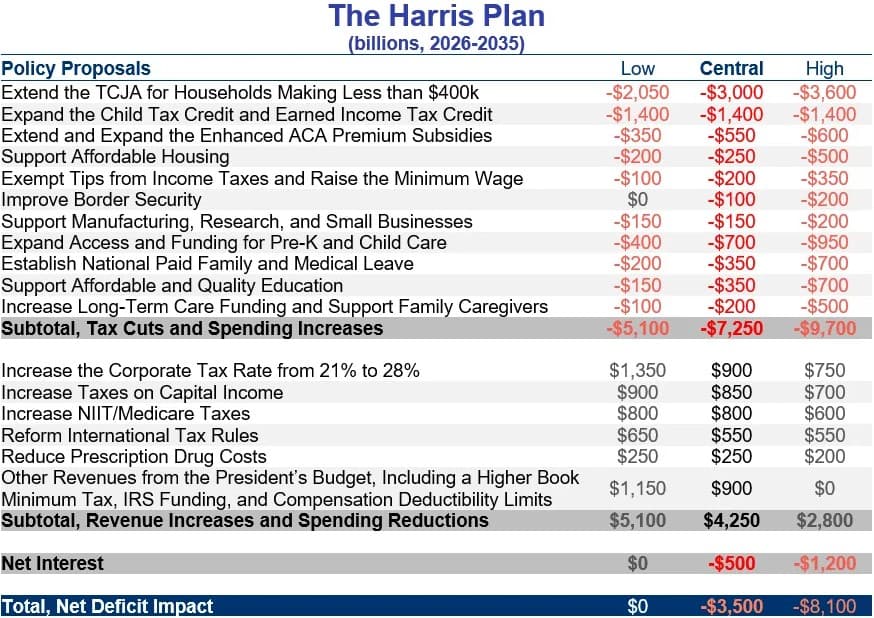
“To help offset the costs of her plan, Vice President Harris has proposed increasing taxes on corporations and high-income households and reducing prescription drug prices,” the CRFB said. “Her campaign also says she supports the revenue-raising provisions in President Biden’s FY 2025 budget, which would further increase taxes on corporations and high-income households.”
For Trump, his major proposals include a modification and extension of the TCJA, further tax cuts for corporations, increased military spending, strengthened border security, expanded deportations and immigration enforcement, and increased support for housing, health care, and long-term care. He has also proposed ending the taxation of tip income, overtime pay, and Social Security benefits.
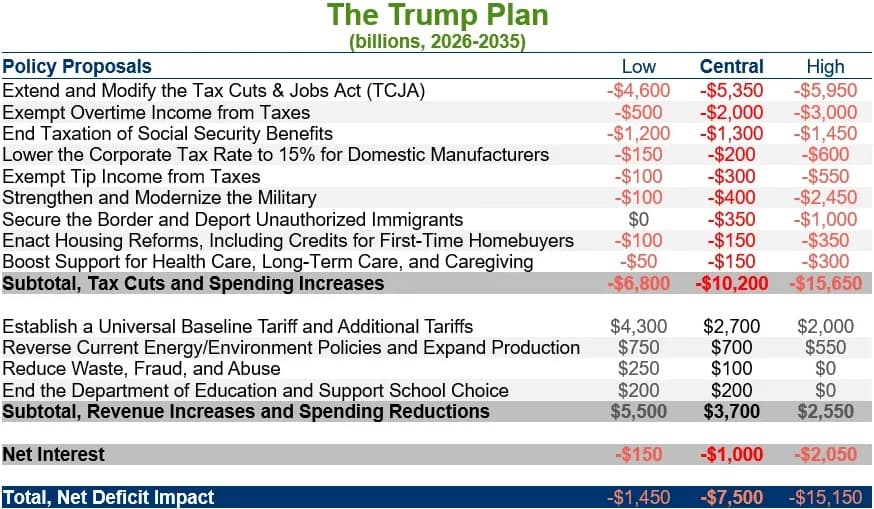
“To help offset the costs of his plan, President Trump would impose new tariffs on imports; repeal energy- and environment-related spending, tax cuts, and regulations; cut fraudulent spending; and end the Department of Education,” the report noted.
“Under our central estimate, both plans would add substantially to the debt,” the CRFB underscored. “Specifically, we find the Harris plan would add $3.50 trillion to the debt over the ten-year period from FY 2026 through 2035 and the Trump plan would add $7.50 trillion to the debt over that same period.”
The report stressed that “These findings involve a high degree of uncertainty, mostly due to questions about the details of how candidates’ policies are designed” and that “even fully detailed and previously analyzed policies have uncertain costs.”
“This is especially true of policies that, if implemented, might significantly alter behavior,” they noted. “In these cases, we look to different scores as well as the available academic literature on behavioral responses. Where possible, we analyze a wide range of behavioral responses. Our ranges also reflect different estimates from different sources and different estimating methods.”
Digging deeper into the details of each candidate's plan, the report said, “The largest sources of uncertainty in Vice President Harris’s plan are her proposals to extend the TCJA for those earning under $400,000 per year, fund higher education, support paid leave and child care, and raise taxes on corporations.”
In Trump’s plan, “The largest sources of uncertainty are his proposals to extend and modify the TCJA, end taxes on overtime, increase defense spending, address immigration, and increase tariffs.”
“Our analysis incorporates policies that we understand to be part of each candidate’s campaign platform and that increase or reduce deficits by at least $50 billion over a decade,” the CRFB said.
Regarding the impact on the national debt, the plans presented by both candidates will see it continue to increase.
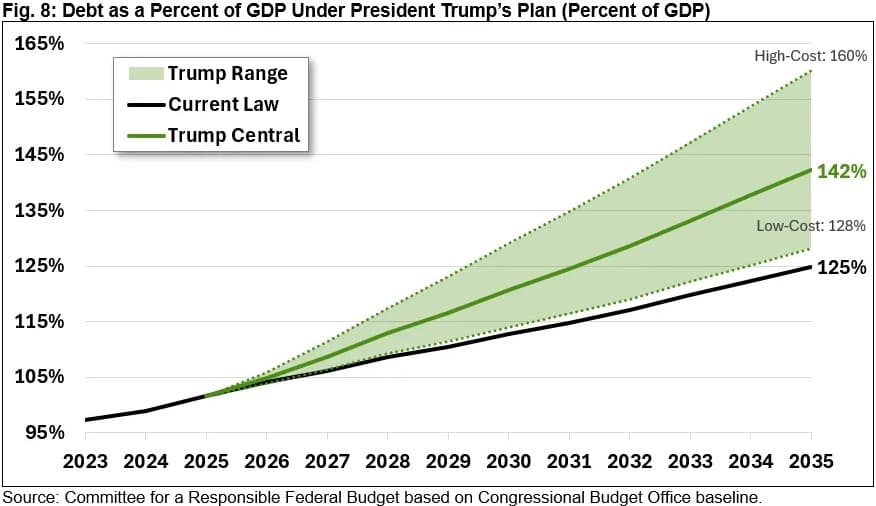
“The national debt currently stands at 99 percent of Gross Domestic Product (GDP) and is projected to grow from 102 percent of GDP at the start of FY 2026 to 125 percent by the end of 2035 based on the Congressional Budget Office’s (CBO) current law baseline,” the report said. “The debt will exceed its record as a share of the economy – 106 percent set in 1946 – in just three years.”
“Debt would continue to grow faster than the economy under either candidates’ plans and in most scenarios, would grow faster and higher than under current law,” the CRFB warned.
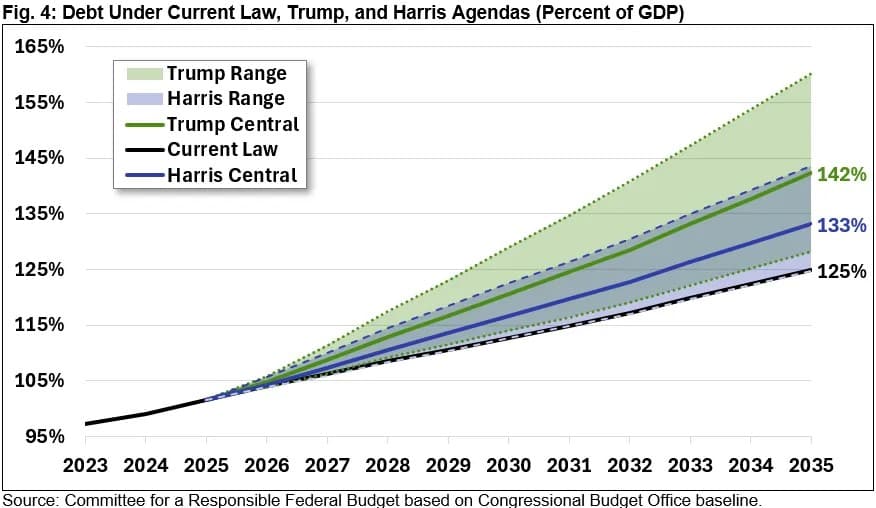
“Under our central estimates, we find that Vice President Harris’s plan would push debt to 133 percent of GDP in FY 2035 – an 8 percent of GDP increase,” the report said. “We estimate President Trump’s plan would push debt to 142 percent of GDP in 2035 – a 17 percent of GDP increase.”
“Debt could be higher or lower under different scenarios,” the CRFB added. “Under our low-cost estimates, debt in FY 2035 would grow to 125 percent of GDP under the Harris plan (as under current law) and would grow to 128 percent under the Trump plan. Under our high-cost estimates, debt would grow to 144 percent of GDP under the Harris plan and 160 percent of GDP under the Trump plan.”
The report noted that these estimates “assume policies are implemented in 2026 – the first year for which the next President will submit a budget proposal – and that lawmakers follow the current law baseline outside of the candidates’ proposals.”
The estimates do not “account for possible changes in GDP resulting from the candidates’ policies, though in some high- and low-cost estimates we account for dynamic feedback effects on revenue and spending,” they said.
While annual deficits are expected to grow “from 6.5 percent of GDP in FY 2025 to 7.0 percent in 2035 under current law,” if Harris’ plan were to be implemented, the CRFB’s central estimate shows that “deficits would reach 8.1 percent of GDP in 2035, with a range of 7.0 to 9.4 percent of GDP in other scenarios – the highest levels reached outside of a war or recession.”
“Vice President Harris has proposed several tax cuts and spending increases through her campaign website, speeches, and white papers,” the report said. “Based on our best understanding of these proposals, we estimate they would add $5.10 trillion to $9.70 trillion to primary deficits from FY 2026 through 2035, with a central estimate of $7.25 trillion.”

“Assuming all policies are implemented beginning in 2026, Vice President Harris’s plan would increase deficits through FY 2035 under our central and high-cost estimates,” the CRFB said. “Higher deficits would result in higher interest payments. Under our central estimate, Vice President Harris’s plan would increase interest costs by $500 billion from FY 2026 through 2035, and under our high-cost estimate, ten-year interest costs would increase by $1.20 trillion. Under our low-cost estimate, the Harris plan would have a negligible effect on deficits and interest costs. These estimates do not account for any effect Vice President Harris’s plans might have on interest rates.”
Based on Trump’s plan, the CRFB estimates that “debt would grow rapidly over time.”
“Under our central estimate, debt held by the public would rise from 102 percent of GDP at the beginning of FY 2026 to 142 percent of GDP by the end of 2035 – 17 percent of GDP above current law projections,” they noted. “Under our low-cost estimate of the Trump plan, debt would grow to 128 percent of GDP through FY 2035 – 3 percent of GDP above current law – while under our high-cost estimate, debt would grow to 160 percent of GDP – 35 percent of GDP above current law.”
As for the deficit, Trump’s plan would see it “reach 9.6 percent of GDP in 2035, with a range of 7.6 to 12.1 percent of GDP in other scenarios – the highest levels reached outside of a war or recession.”
“Assuming all policies are implemented beginning in 2026, President Trump’s campaign plan would increase deficits through FY 2035 under all three of our estimate scenarios,” the report said. “Higher deficits would result in higher interest payments. Under our central estimate, President Trump’s plan would increase interest costs by $1.00 trillion from FY 2026 through 2035. Under our low-cost estimate, ten-year interest costs would increase by $150 billion, and they would increase by $2.05 trillion under our high-cost estimate. These estimates do not account for any effect President Trump’s plans might have on interest rates.”
Based on these findings, the CFRB said, “Whoever wins the 2024 presidential election will face an unprecedented fiscal situation upon taking office.”
“The national debt is projected to reach a new record high as a share of the economy only three years from now, well within the next presidential term,” they said. “Already, the cost of servicing our high and rising national debt has eclipsed the cost of defending our nation or providing health care to elderly Americans. Three important trust fund programs are on track to become insolvent within the next 12 years, putting Americans’ retirement and health care at risk and limiting our ability to continue to update our aging infrastructure.”
Adding to the mounting headwinds, the next President “will also face the return of the debt limit, the expiration of the Fiscal Responsibility Act spending caps, and the expiration of several tax and spending provisions that would prove extremely costly to extend,” the report noted.
“All these factors raise the stakes of the upcoming presidential election,” the CFRB said. “America desperately needs a leader with the wisdom and courage to make correcting our unsustainable fiscal trajectory a major priority. Yet, both the Republican and Democratic candidates for President have put forward campaign plans that would, at best, maintain the status quo and, at worst, add tremendously to our debt and deficits. Neither has a plan to fix the imbalances in the major trust funds.”
“While it’s plausible that the Harris plan could be roughly budget neutral, it is also plausible that her plan could add $8.10 trillion to the debt,” they highlighted. “The Trump plan could add $1.45 trillion to the debt but could also add as much as $15.15 trillion.”
“Even in the best case scenario, neither candidate’s plan would be sufficient to put debt on a downward path and point America toward a more secure and sustainable fiscal future,” the CFRB concluded. “Simply not adding more to the debt is no longer sufficient. Going forward, policymakers should make significant deficit reduction a major focus and priority, especially the Commander in Chief.”
