
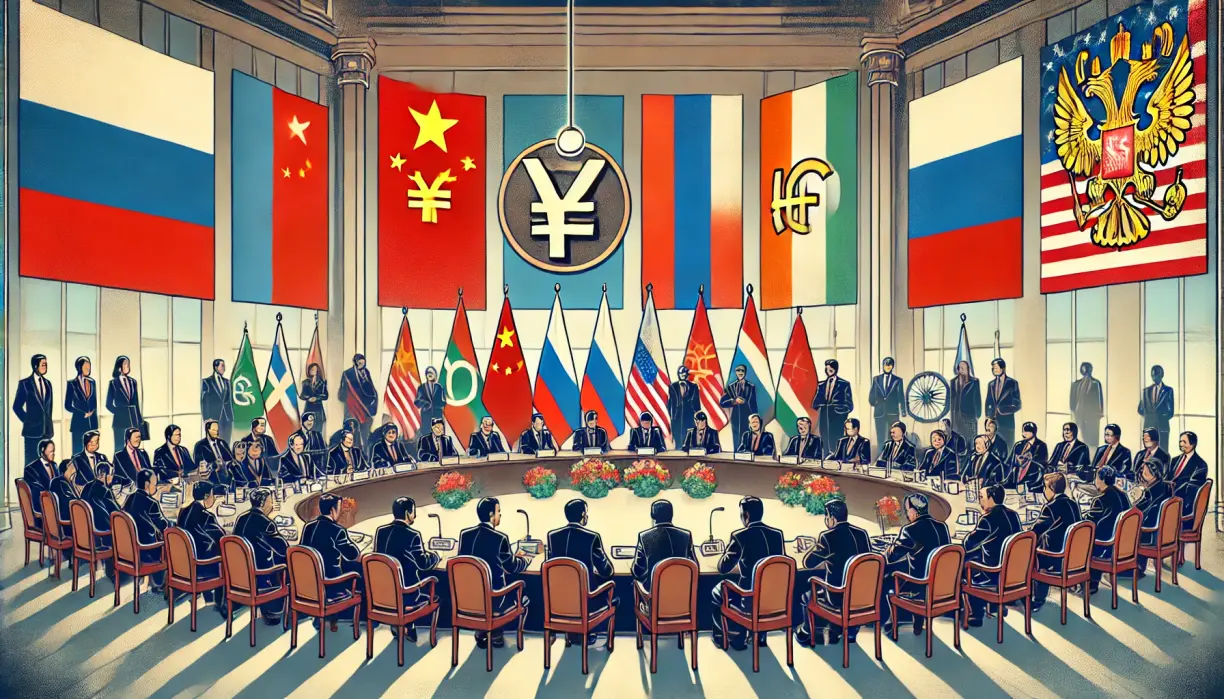
(Kitco News) – De-dollarization has been a popular topic of discussion in recent years and reached new heights last week amid the 16th annual BRICS summit in Kazan, but according to one economist, it's not just the dollar that is facing pressure amid the growing strength of the economic bloc – it’s the entire Western-dominated economic order.
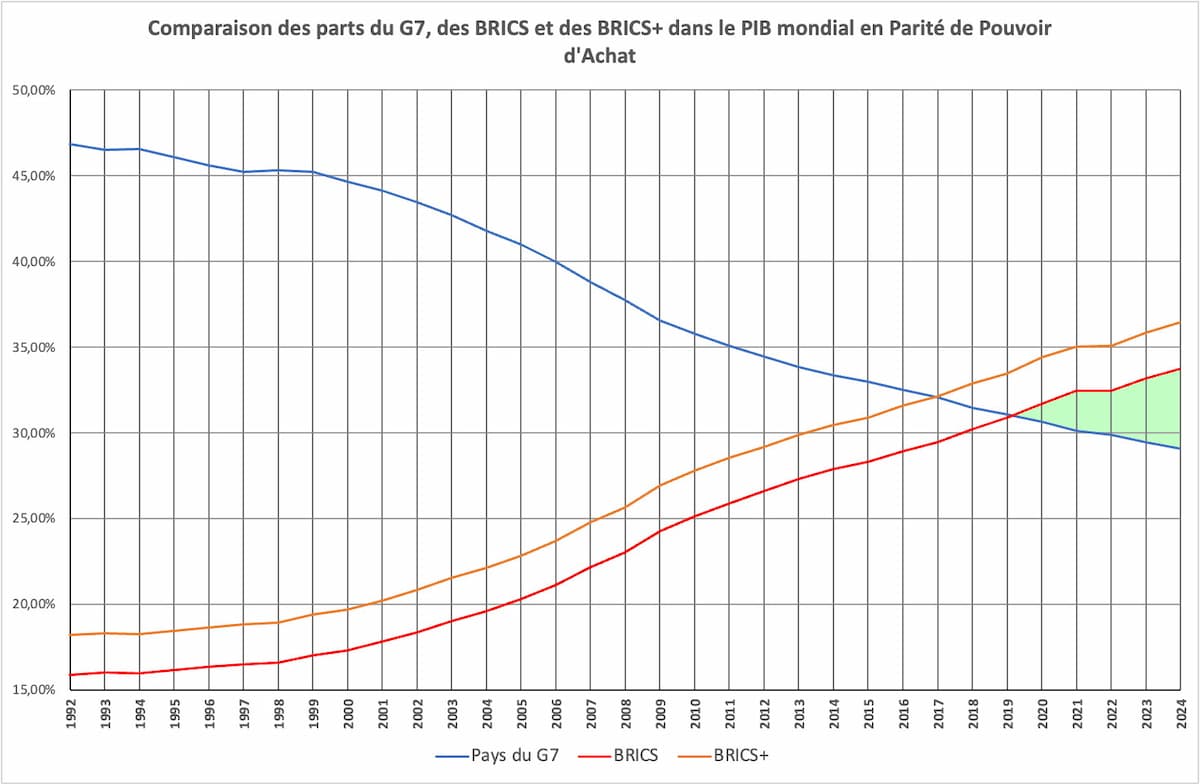
“The conclusion of the 16th BRICS summit held in Kazan from October 22-24 resulted in important decisions,” said Jacques Sapir, a renowned French economist and one of the foremost Western experts on the Russian economy. “It should be noted that BRICS (Brazil, Russia, India, China, South Africa), joined by four new countries (Egypt, Ethiopia, Iran, United Arab Emirates), now represent more than 33% of global GDP compared to the G7's 29%.”
Among the various developments that emerged from the summit, Sapir highlighted three decisions that stand out: “the institutionalization of a ‘partner countries’ category within BRICS, the creation of the BRICS-Clear system to facilitate exchanges between members and partner countries, and the establishment of the BRICS (Re)Insurance Company.”
“The consequences of these decisions will be very significant, not only for BRICS and their associates but also for the Western world,” he said. “The movement toward global ‘de-Westernization’ is accelerating.”
“One of the most emblematic decisions taken at the Kazan summit was the institutionalization of the ‘partner countries’ category within BRICS,” Sapir said. “This creates a ‘BRICS zone’ around the core members. The presence of Indonesia, Malaysia, Thailand, and Vietnam in this ‘partner’ category implies that BRICS, already dominant in Asia due to China and India's membership, could become hegemonic in this region.”
“The second essential decision of the 16th BRICS summit is the creation of BRICS Clear, a settlement and clearing system for both intra-BRICS trade and trade between BRICS and ‘partner’ countries,” he explained. “One of BRICS Clear's key objectives is to create an alternative to the SWIFT system. Within the BRICS Clear system, the use of national currencies as instruments for settling international transactions will be prioritized.”
Under the BRICS clear system, “Transaction clearing will be handled through a ‘stablecoin’ managed by the New Development Bank,” he noted. “The clearing issue is important since trade will be multilateral (22 countries: 9 BRICS members and 13 partner countries).”
“This system draws inspiration from the European Payments Union (1950-1957),” Sapir said. “At that time, transaction calculations and final settlement were done in dollars. In BRICS Clear, a ‘stablecoin’ will serve as the unit of account, with final settlement occurring in local currencies.”
With the level of trade conducted using BRICS Clear expected to rise, Sapir noted that “Trade requires insurance services (for both the contract itself and transportation),” adding that “these insurance services involve reinsurance activities. With the BRICS (Re)Insurance Company, BRICS is building its independence from Western insurance companies.”
“This measure, the third important decision from the Kazan summit, will facilitate intra-BRICS trade, as well as trade with ‘partner’ countries and generally with any country wishing to trade with the ‘BRICS Zone,’” he explained.
“The last two measures (BRICS Clear and the insurance company) decided at the 16th BRICS summit in Kazan will necessarily have significant consequences for the global trade structure and the international use of the Dollar and Euro,” Sapir warned. “The consequences for global trade structure fall into two categories. The first involves trade flow diversion due to preferential conditions for intra-BRICS trade and between BRICS partners.”
He estimated that “The export loss for ‘non-BRICS’ and Western countries will amount to 5-7% of volume for Western countries. While this figure isn't very significant, the proportion could vary greatly by country and have destabilizing consequences for some.”
“The second, more immediate consequence lies in the loss of business for Western insurance and reinsurance companies specializing in trade insurance, which will necessarily be significant,” he added. “The monetary consequences of the massive and relatively rapid de-dollarization process, even though the term ‘de-dollarization’ is rejected by two BRICS countries (India and Brazil) who nonetheless approve and support the BRICS Clear system, will be significant.”
“Intra-BRICS trade and trade with partner countries represents 35-40% of global trade,” Sapir noted. “While some [trade] is already conducted in local currencies, it seems very unlikely that this portion exceeds 20% of intra-BRICS trade and trade with partner countries.”
“This means that 28-32% of global trade, currently conducted in Dollars and Euros, could gradually be transformed within the BRICS Clear framework into trade independent of the Dollar and Euro,” he underscored. “Potentially, the ‘de-dollarized’ portion through BRICS Clear in the coming 5 years would be between 70-80%, thus representing between 19.5% and 25.5% of global trade. Mechanically, the Dollar's share in international transactions would decrease accordingly.”
“If we estimate that the currency share in Central Bank reserves roughly reflects these currencies' use in trade, the Dollar's share could decline from 58% of total identified reserves to around 35-40%,” Sapir warned. “The Euro's share would be much less affected because the Euro is currently mainly used in intra-EU trade and with immediate EU partners where, except for Turkey, the impact of trade with the ‘BRICS zone’ is low.”
“However, the impact would not be limited to the sharp decline of the Dollar and the rise of ‘other currencies,’” he noted. “Indeed, the Dollar amounts held by Central Banks are held in the form of U.S. Treasury bonds.”
Sapir stressed that “The shift from 58% to 34-39% in Central Bank reserves would imply massive sales of Treasury bonds, causing a collapse of the public bond market and significant difficulties for the U.S. Treasury in refinancing United States debt.”
“One can, therefore consider that the implementation of the BRICS Clear system will have significant implications for the stability of the global monetary system and more specifically for the ‘Western’ portion of this global monetary system,” he concluded.
