
(Kitco News) - In the first half of 2024, the gold market was driven by record central bank demand and unprecedented commercial demand in Asia, specifically China. So far, that initial momentum in the gold market has been maintained as Western investor demand picks up growing slack in other segments of the marketplace, according to the latest report from the World Gold Council (WGC).
The WGC’s Gold Demand Trends for the third quarter stated that total gold demand (including over-the-counter (OTC) investment) rose to 1,313 tonnes – a record for a third quarter and up 5% from the same quarter last year.
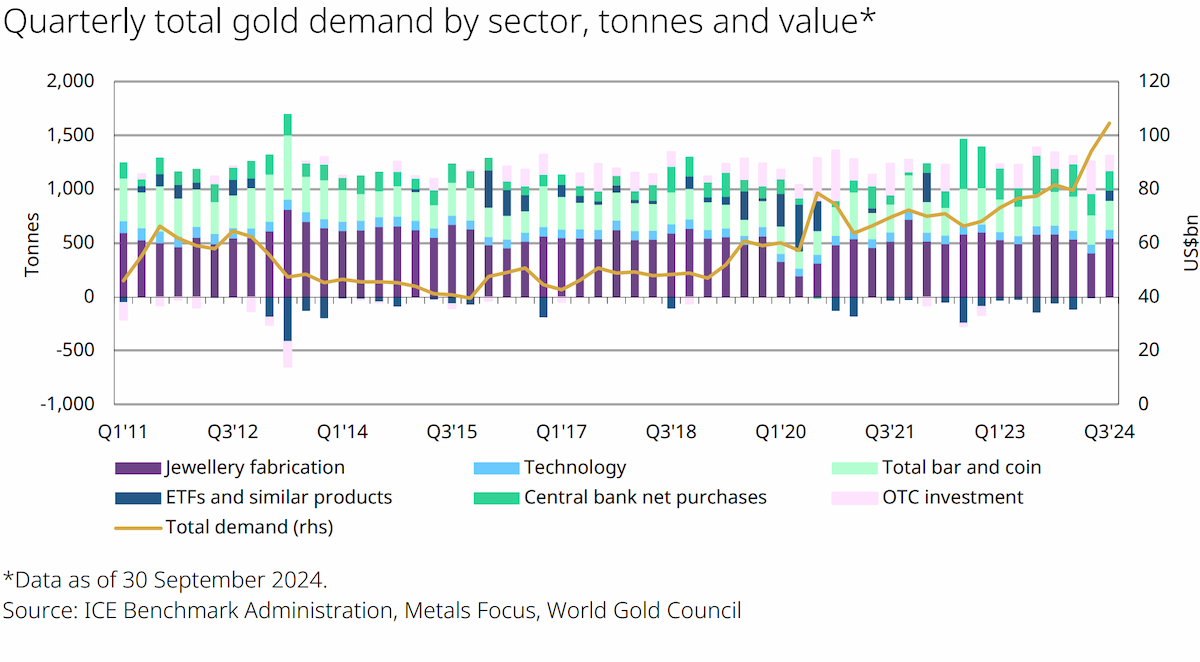
The report noted that investment demand was a critical component of the gold market, as the price hit consecutive record highs nearly every week during the three-month period.
Physical demand for small bars and coins and jewelry consumption struggled in the third quarter as prices saw an average increase of 28%; however, Western investment demand more than made up for this weakness.
The WGC reported that total investment demand increased by 364.1 tonnes in the third quarter, a massive 132% increase from the same quarter in 2023.
While investors were sitting on the sidelines during the first half of the year, they started to emerge as the Federal Reserve embarked on a 50-basis point rate cut in September.
The WGC noted that gold-backed exchange-traded funds (ETFs) were the biggest beneficiaries of the Federal Reserve’s new easing cycle. The report highlighted that after nine months of consecutive outflows, the gold market saw its first net increase in the third quarter.
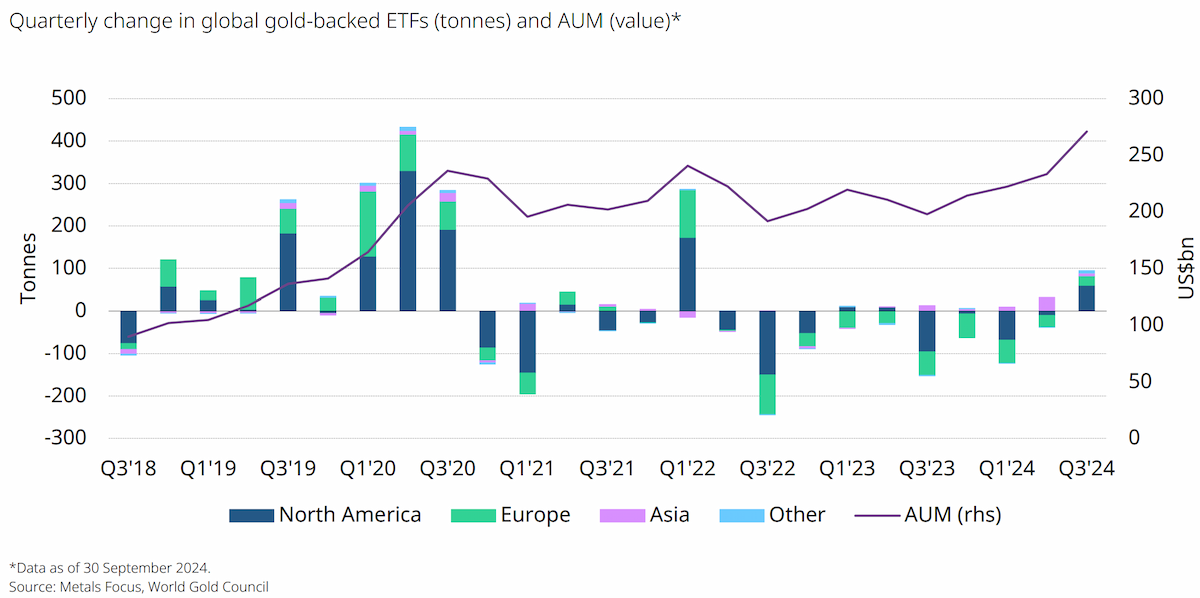
At the same time, ETF demand in the third quarter was able to reverse most of the weakness seen in the first six months of the year. In total, the ETF market saw gold holdings increase by 94.6 tonnes in the third quarter.
“The third quarter reversed much of the first-half weakness, and year-to-date holdings are now just 25 tonnes lower. In US dollar terms, global assets under management (AUM) stand at US$271 billion, and year-to-date flows flipped to positive, at US$389 million,” the WGC said in the report.
While there is still a lot of uncertainty surrounding the consistency of investment demand in the gold market, the WGC noted that there are solid signs that this trend could continue to support the market and prices through year-end.
In an interview with Kitco News, during the London Bullion Market Association’s 2024 Precious Metals Conference, Joseph Cavatoni, Chief Market Strategist for North America at the WGC, said that the Federal Reserve’s easing cycle has completely changed the game for the gold market.
“We're looking at six trillion dollars sitting in money funds, which always lag rate cuts in terms of money moving out because all these investors are waiting for their statement to say their rates are lower,” he said. “When they see that, they will start to deploy that capital elsewhere.”
Cavatoni added that the Federal Reserve doesn’t even need to aggressively cut interest rates for gold to benefit. He explained that a steady easing cycle should be enough to push investors back into gold.
“We are less concerned about the absolute number of rate cuts,” he said. “It's more about the direction in which the rates will go. A steady decline in interest rates is the catalyst that keeps bringing the discussion back to gold as an important investment.”
Cavatoni noted that in this environment, even with prices at record highs and currently within striking distance of $2,800 an ounce, there is still plenty of long-term value in the gold market.
Along with trackable ETF demand, the WGC also observed that investment demand in the over-the-counter (OTC) markets, which is much more opaque, continues to dominate demand in the marketplace.
The report stated that OTC demand increased by 137 tonnes, nearly doubling levels seen during the same quarter last year.
“This was the seventh consecutive quarter in which OTC investment has been positive for gold demand and remains a notable component of the market,” the report said. “The ‘OTC investment and other’ category captures flows in the over-the-counter market, which has been increasingly influenced by demand from high-net-worth investors seeking to hedge against geopolitical and economic risks. The price performance in recent quarters has added fuel to this.”
Higher Prices Cool Jewelry, Bar, and Coin Demand
Although investment demand was a major component for gold in the third quarter, other critical pillars in the marketplace struggled.
Notably, the WGC noted that small bar and coin demand dropped by 9% to 269.4 tonnes in the third quarter. Analysts attributed this slowdown mainly to China, Turkey, and Europe, which outweighed growth in India and several smaller markets in Asia.
At the same time, there has been mixed activity among Western consumers.
“Similar to last quarter, Western investors continued to show strong interest in gold, but this has been countered by heightened selling interest as the price reached record levels, resulting in far lower net levels of demand,” the analysts said.
Chinese demand for gold bullion was particularly surprising, as this sector was credited with driving gold prices to their initial record highs at the start of the year.
“Among the headwinds facing Chinese bar and coin investors in the third quarter was a sizable appreciation in the domestic currency, which reduced safe-haven demand and lowered the need for currency hedges. Furthermore, the recent pause in gold buying announced by the People’s Bank of China (PBoC) also likely curbed investment to some degree,” the analysts said.
Cavatoni emphasized that investors should continue to monitor demand trends in China, as this market is expected to significantly impact the global landscape.
There are many unknowns surrounding the impact that Chinese government stimulus plans and central bank rate cuts will have on gold demand going forward. Some analysts suggest that improved economic activity in China will continue to support bullion demand; however, Chinese investors might shift interest toward equity markets, which now appear to be backed by government and central bank support.
The bullion market is not the only segment of the gold market struggling in a high-price environment.
The WGC reported that jewelry demand in the third quarter declined to 459 tonnes, a 12% decrease from the third quarter of 2023. Excluding pandemic-related volatility in 2020, this was the weakest third-quarter performance on record.
There was a brief moment of optimism in the jewelry market as Indian demand surged during the summer after the government cut its import tax on the precious metal.
However, analysts noted that activity has since fallen back to trend, as consumers continue to face record prices.
“As Q4 progresses with the arrival of the Dhanteras and Diwali festive periods, demand should remain supported, with buying likely to emerge on any corrective dips in the price,” the WGC said in the report.
Central Banks Cool Their Heels in the Gold Market
Higher gold prices are also impacting official sector demand. Although central banks remained net buyers of gold in the third quarter, activity slowed compared to last year and the start of this year.
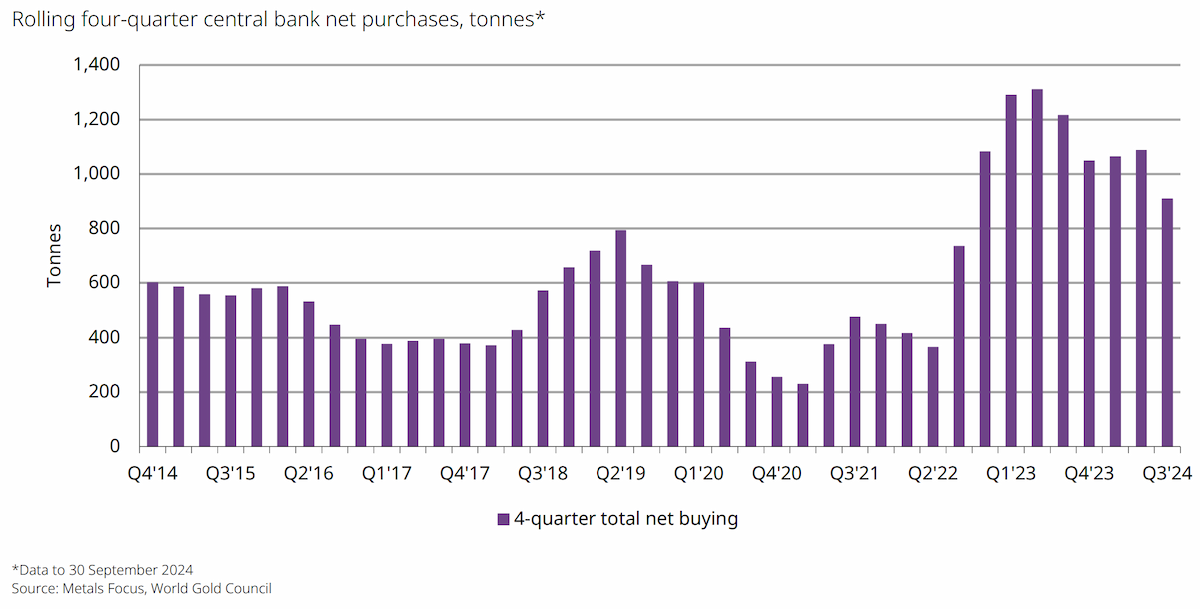
The WGC stated that central bank demand totaled 186.2 tonnes in the third quarter, down 49% from last year.
“Based on statements from some central banks, there are now clearer indications that the sharp increase in the gold price since March has indeed inhibited some buying, as well as encouraged some selling among banks that manage their gold reserves tactically,” analysts said.
Although central bank demand slowed through the summer, analysts expect this trend to remain for the foreseeable future.
“The case remains very strong, due to homegrown inflation challenges, for many of these countries to continue diversifying into gold,” said Cavatoni.
Technology Demand Continues to Grow
Although traditional gold sectors struggled in the third quarter, the technology sector remains a surprising area of demand.
The report stated that technology demand increased to 83 tonnes, a 7% rise from 2023.
“The third quarter is generally the strongest for electronics demand as many major electronics companies launch new products and devices onto the market. This year has been no different, with all major smartphone manufacturers unveiling new products,” analysts said. “Demand in the electronics space strengthened during Q3, though the industry is taking a cautious stance for the remainder of the year.”
