(Kitco News) - While it will take some time for the U.S. economy to feel the effects of the Federal Reserve’s new easing cycle, one organization reports that Main Street is already starting to notice a shift, as financial stress among consumers begins to ease.
On Friday, LegalShield, a legal services company that provides Americans with affordable access to legal advice, counsel, protection, and representation, announced that its monthly Consumer Stress Legal Index (CSLI) dropped by 1.1 points to 66.9 points. The report noted that consumer stress has fallen to its lowest level since June.
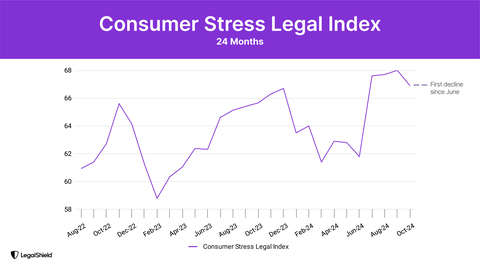
However, the report highlighted that financial stress remains fairly elevated, following the index’s largest one-month increase on record in July.
In an interview with Kitco News, Matt Layton, SVP of Consumer Analytics at LegalShield, commented that although one month of data doesn’t establish a trend, there is hope that “kitchen table economic conditions” are improving.
“Macroeconomic data shows Wall Street has been doing pretty well, but looking at the microeconomic picture, consumers have been experiencing significant challenges, so hopefully, they are now starting to feel some relief,” he said.
Although gold has benefited as a safe-haven asset amid growing economic uncertainty, data from LegalShield shows that historically, gold performs better when consumer financial stress is lower.
Layton added that he has been in contact with teams across the country, and the message he is receiving is that consumers are starting to feel more positive as the labor market remains healthy, inflation has declined, and the central bank has begun reducing rates. He anticipates sentiment will continue to improve as the Federal Reserve is expected to cut rates within the next two months and throughout 2025.
Markets are forecasting that the Federal Reserve will cut interest rates by 25 basis points when it announces its monetary policy decision on Thursday.
Mike Fiffik, managing partner at Fiffik Law Group PC, a LegalShield provider law firm in Pennsylvania, noted that although conditions have improved, consumers still face challenges.
“It’s a mixed bag for consumers, and stress remains elevated throughout the year, driven by essential issues like bill payments. People are seeking help with debt collection, bankruptcy, and financial disputes, and they’re asking us for guidance on which bills to prioritize and how to communicate with creditors when they can’t pay,” he said in the report.
Lower Consumer Stress Points to Democratic Presidential Win
As Americans head to the polls on Tuesday, the CSLI indicated that easing consumer financial stress could benefit the party currently in power. LegalShield highlighted that its index has accurately predicted the last five presidential elections.
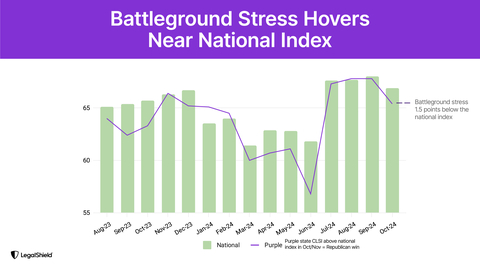
Since 2004, in each presidential election year, when battleground states exhibited higher stress levels in October compared to the national average, a Republican was elected. When battleground states exhibited lower stress than the national average, a Democrat won.
In October, consumer stress in battleground states – Arizona, Georgia, Michigan, Nevada, North Carolina, Pennsylvania, and Wisconsin – dropped by 2.4 points to 65.4, falling 1.5 points below the national index, down from just 0.2 points below the national level in September.
“If this election follows the same pattern as the last five presidential elections, our data indicates a Democrat will win the election,” said Layton in the report. “The index analyzes 35 million data points since 2002, tracking the reasons why everyday Americans contact a lawyer. This consumer behavior has correlated with the victor in every presidential election since George W. Bush’s re-election.”