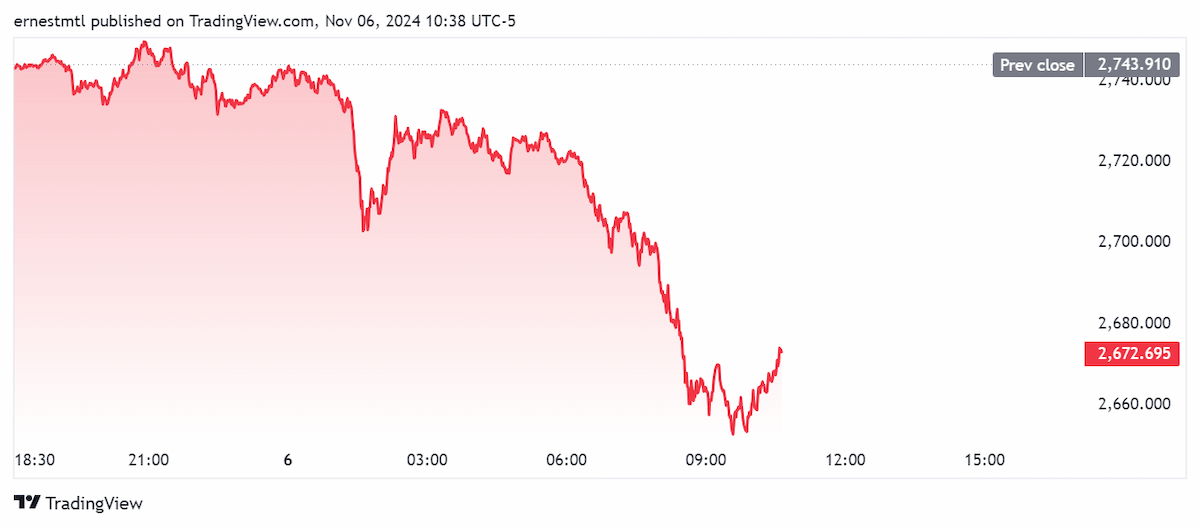

(Kitco News) – Gold has sold off dramatically after Donald Trump’s projected victory drove the U.S. dollar to a four-month high, and the yellow metal now faces a critical test of support with Thursday’s Fed rate decision adding further downside risk, according to analyst James Hyerczyk at FX Empire.
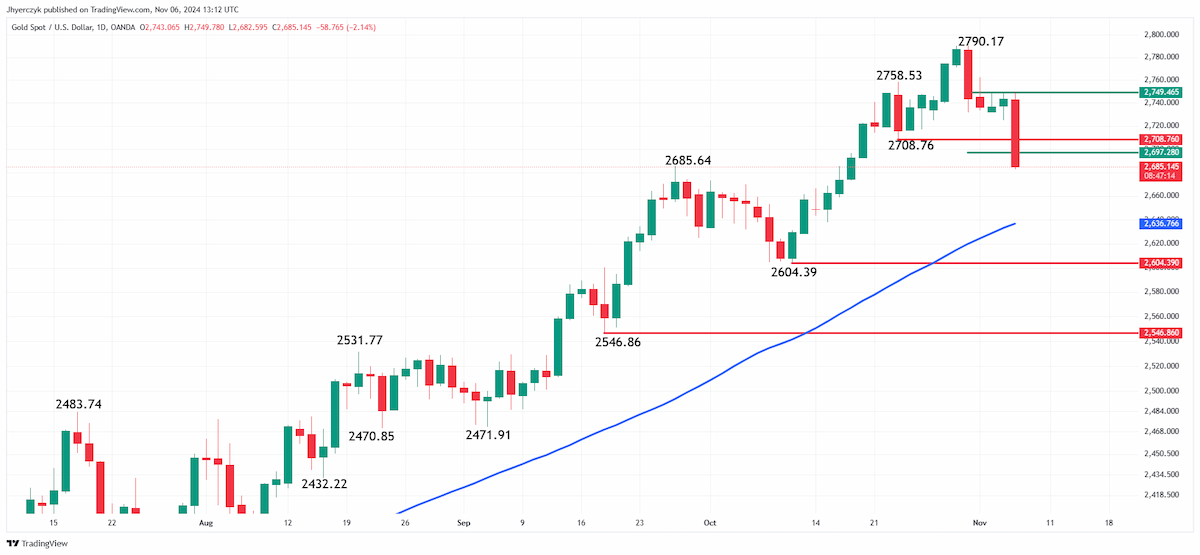
“Gold prices are falling sharply on Wednesday, as traders lock in profits amid a stronger U.S. dollar and surging Treasury yields following Donald Trump’s projected return to the White House,” Hyerczyk wrote. “The sell-off in gold pushed prices through a key technical support level of $2,708.76, shifting the trend downward and further pressured the metal by breaking below the $2,697.28 pivot level.”
“Gold now faces a critical test near the 50-day moving average at $2,636.66 as markets await the Federal Reserve’s policy announcement on Thursday,” he warned.
Hyerczyk said gold is facing significant pressure from a strengthening USD. “Fueled by Trump’s projected victory and Republican gains in Congress, the greenback appreciated 1.4%, while the ICE U.S. Dollar Index marked its strongest level since July,” he noted. “The dollar also saw notable gains against the Mexican peso, Swiss franc, and other major currencies, making gold more expensive for international buyers and reducing its appeal as a non-yielding asset.”
Investors now expect a renewed focus on tariffs and fiscal stimulus from a second Trump administration, both of which could drive the dollar higher. “Analysts like Paul Christopher of Wells Fargo note that potential trade levies might boost domestic business activity, which could strengthen the dollar, pressuring gold prices further,” Hyerczyk wrote.
Treasury yields are also surging on Wednesday as the bond markets begin to price in Trump’s inflationary fiscal policies.
“Bond markets reacted sharply to Trump’s election, with the 10-year Treasury yield leaping to 4.47%, its highest since July,” Hyerczyk said. “Rising yields reduce gold’s appeal by increasing the opportunity cost of holding non-interest-bearing assets like gold. The market also anticipates inflationary pressures from potential fiscal spending and tax cuts, which Republicans could advance in a Congress under their control. According to finance professor Jeremy Siegel, a Republican sweep may bring economic growth policies that drive bond yields higher and elevate inflation concerns.”
Hyerczyk also believes that the spike in Treasury yields makes the Federal Reserve’s rate announcement and statement more risky for gold. “Although markets expect a 25 basis point rate cut, any indication of a pause or slowdown in cuts would further pressure gold, already sensitive to rising rates and a stronger dollar,” he said.
Turning to the technical picture, Hyerczyk said the outlook for the yellow metal is now bearish and the risks are clearly skewed to the downside.
“With a stronger dollar and rising yields, gold faces immediate downside risk, likely extending toward the 50-day moving average at $2,636.66 if the Federal Reserve signals a more cautious stance on future rate cuts,” Hyerczyk wrote. “As the market assesses the Fed’s language and the inflationary risks posed by Trump’s policy agenda, a bearish outlook on gold persists in the near term. If yields continue upward and the dollar maintains its strength, gold could struggle to recover above recent support levels, leading to further downside potential in the days ahead.”
Spot gold fell to a session low of $2,652.40 just after the North American equity open, and last traded at 2672.69 for a loss of 2.60% on the daily chart.