
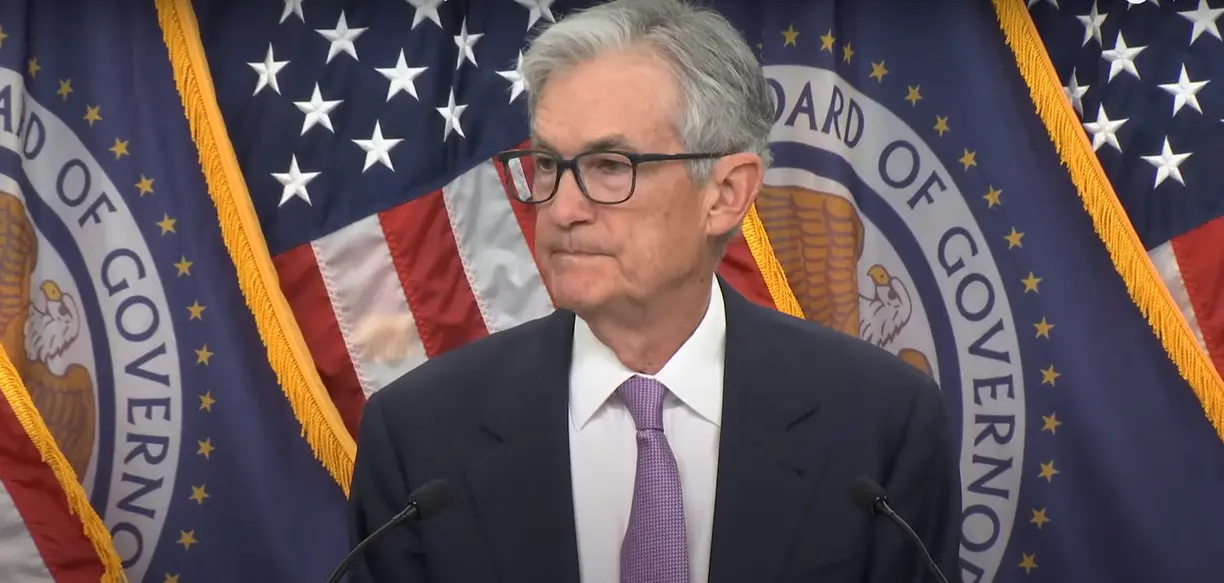
(Kitco News) – Federal Reserve Chair Jerome Powell began his post-FOMC press conference adamant about not talking politics, explaining the logic behind the 25-basis point cut, sticking to familiar themes of progress on inflation and strong employment, and refusing to address questions about Trump’s policy proposals.
But when asked about comments from some of the President-Elect’s advisors that he should resign, Powell’s answers became terse and direct, spiking gold to session highs and setting the stage for a potential confrontation between the FOMC and the incoming administration.
Powell was asked at the outset how “proactive or reactive” the Fed was prepared to be to economic policy changes with the incoming administration.
“In the near term, the election will have no effects on our policy decisions,” he replied. “As you know, many, many things affect the economy and anyone who writes down forecasts in their job will tell you that the economy is quite difficult to forecast looking out past the very near term. We don't know what the timing and substance of any policy changes will be. We therefore don't know what the effects on the economy would be.”
“We don't guess, we don't speculate, and we don't assume.”
The Fed chair added that once the new policies were formulated and were working their way through the legislative process, the central bank would begin to include them in their models of the economy.
But a few minutes later, a reporter raised the issue of his stepping down.
“Some of the President elect's advisers have suggested that you should resign,” said Politico’s Victoria Guida. “If he asked you to leave, would you go?”
“No,” was Powell’s blunt reply.
“Can you follow up on [that]?” she asked. “Do you think that legally you're not required to leave?”
“No,” he reiterated.
Later on, after a number of questions related to the economy and interest rates, another reporter pressed him to elaborate on his terse one-word response.
“Do you believe the President has the power to fire or demote you, and has the Fed determined the legality of a President demoting at will any of the other governors with leadership positions?” asked Andrew Ackerman of the Washington Post.
“Not permitted under the law,” Powell replied.
“Not what?”
“Not permitted under the law,” the Fed Chair repeated.
Powell was also asked about two changes in the language of today’s FOMC statement, where it read “inflation has made progress” rather than “further progress,” and dropping the sentence that “the Committee gained greater confidence that inflation was progressing towards its 2 percent goal.”
“The test of 'gaining further confidence' was our test for the first rate cut,” he explained. “We met that test in September and therefore, we take that out [of the statement]. If you leave it in, then it's brand-new forward guidance, and what do you mean by it? Are you requiring […] we have to say yes or no at every meeting whether we made further progress?”
“The point is, we have gained confidence that we're on a sustainable path down to 2 percent,” he said. “Neither of those is meant to send a further signal. Seeing further progress, it becomes a test. We don't think it's a good time to be doing a lot of forward guidance.”
Powell also fielded several questions about the validity of the September SEP, and whether one full percentage point of cuts was still on the table for 2025.
“Let's talk about the data,” he answered. “In the main, the economic activity data have been stronger than expected. The NIPA revision was stronger, certainly the September employment report was stronger, the October report not stronger, retail sales stronger. Overall, feeling good about economic activity. I think we would factor that in.”
“At the same time, we got one inflation report which wasn't terrible, but a little higher than expected,” he added. “By December we'll have more data, one more employment report, two more inflation reports, and lots of other data reports, and we'll make a decision as we get to December.”
Asked about the FOMC’s level of concern about bond yields, Powell said they’ve seen improvement over the medium term.
“We've watched the run-up in bond rates, and it's nowhere near where it was a year ago,” he said. “Things have been moving around, and we'll see where they settle. I think it's too early to really say where they settle.”
The final question for Powell was whether he thought it would be appropriate for the Fed to intentionally undershoot its 2 percent inflation target for a while to enable people to “catch up.”
“No, that's not the way our framework works,” he said. “We're aiming for inflation at 2 percent. We did not think it would be appropriate to deliberately undershoot. Low inflation can be a problem, too. That's not part of our framework, and it's not something we're going to be looking at in our framework.”
Spot gold saw little reaction to the rate cut itself, and was trading in a narrow range between $2,690 and $2,695 for the early part of the press conference, but after Powell’s pushback against resignation, it shot up to a session-high $2,710.52 per ounce and remained elevated thereafter.

Spot gold last traded at $2,708.16 per ounce for a gain of 1.84% on the daily chart.
