

(Kitco News) – Gold prices continued to slide downhill this week, weighed down by a potent combination of post-election risk-on euphoria, a fresh hawkish tilt from the Fed, a surging U.S. dollar, and a relatively calm geopolitical environment.
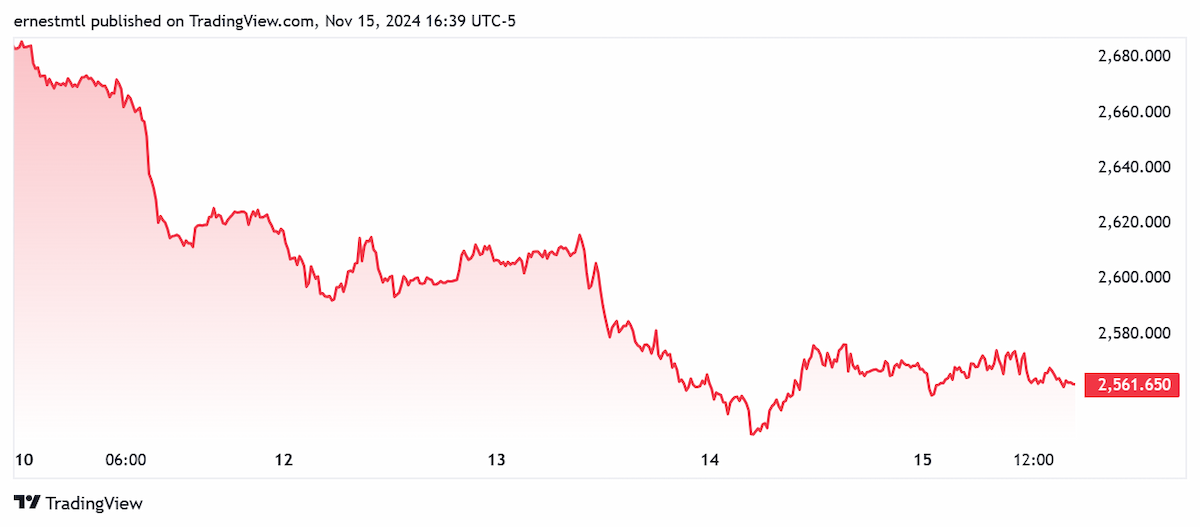
Spot gold kicked off the week trading at $2,683.02, and held above $2,660 per ounce throughout the overnight session before North American traders woke up and smacked the yellow metal down to a daily low near $2,610 per ounce just after 1:00 p.m. on Monday afternoon. Gold then staged a minor recovery up to $2,625 per ounce, before undergoing further declines in the Asian session that drove gold to the then-weekly low of $2,592 per ounce by 5:00 a.m. on Tuesday.
After a run-up to $2,615 per ounce in European trading, the North American open once again drove the yellow metal back below $2,600, albeit briefly. After trading in a relatively narrow range overnight, North American traders once again awoke to push gold from a high of $2,616 just before the North American open all the way to $2,578 per ounce shortly after noon EST.
This time, Asia and Europe did not come to the rescue, as gold continued its steep decline to the weekly low near $2,540 per ounce just after 4:45 a.m. on Thursday. Now it was North America's turn to help the yellow metal out, as traders pushed spot gold from $2,560 per ounce at the open as high as $2,576, whereupon it stalled after a double top at that level, and trended sideways in the $2,560s overnight.
Friday morning brought some volatility to the gold market, but the recent range held as spot gold traded between $2,560 and $2,573 per ounce for the duration of the week.
The latest Kitco News Weekly Gold Survey showed strong bearish sentiment from industry experts, while retail traders also grew more trepidatious about the yellow metal’s near-term prospects.
“Gold correcting as expected,” said Mark Leibovit, publisher of the VR Metals/Resource Letter. “Risk is to 2300. Long-term view to 3700 still intact.”
“A tad oversold here so we may see a bounce,” he added. “Buying on weakness for long-term positions, scalping long side for trades.”
“Up,” said Darin Newsom, senior market analyst at Barchart.com. “The euphoria/hysteria surrounding the latest US presidential election could be nearing its end meaning the reality of the coming market chaos is setting in. Given this, gold could find renewed safe-haven buying from investors as hedges against other market sectors, most notably equities.”
David Morrison, senior market analyst at Trade Nation, said that while the near-term technical picture has improved somewhat, it’s still too early to call the bottom.
“The bulls will be hoping (not the greatest strategy) that the sell-off since last week’s triumph for Donald Trump in the presidential election is now over,” he said. “There’s nothing as yet to suggest that it is. Gold has fallen every day so far this week, in a move which has seen it lose over 5% in just four days. And that doesn’t even consider the losses posted in the week leading up to polling day.”
“But there may be some good news,” Morrison said. “While gold had another losing session yesterday, it did manage to rally strongly off its lows, and that move has continued this morning. It remains incredibly oversold, with the daily MACD down at levels last seen in July 2022. Meanwhile, the pick-up in prices since yesterday has led to a flattening, and even an upturn, in shorter-timeframe MACDs.”
“That doesn’t guarantee that prices will rally from here, let alone tell us whether any bounce is short-lived or more protracted,” he cautioned. “But it is a start. Yet gold has a lot more to do to convince investors that the highs aren’t already in.”
“Up,” said James Stanley, senior market strategist at Forex.com. “Gold was hit hard this week, and I think that was profit taking from the broader move. There was a show of support at 2550 in spot on Thursday and so far through Friday, that’s held. I think the 2500 level could come in as key next week if it does trade but I’m not of the expectation that a Trump administration is going to bring less debt, so I think the fundamental headwinds are still bullish for gold.”
“It was just massively overbought, and this pullback makes sense given that backdrop, and with attention going to Bitcoin it seems flows were being directed elsewhere,” Stanley added. “But, with Bitcoin close to 100k I think gold begins to look more attractive, especially with some key supports nearby.”
“Flat,” said Adrian Day, president of Adrian Day Asset Management. “Probably need a little time for gold to find a base.”
Sean Lusk, co-director of commercial hedging at Walsh Trading, was dissecting the different drivers of gold’s decline, beginning with the soaring greenback.
“You had a big resurgence in the dollar that just really shot higher,” he said. “You had weakness in energies. You've had a more deflationary environment since the election. With the dollar going crazy and bond yields continuing to rise, putting pressure upon futures, even though you had this euphoric trade in the S&P, finally, you had some disconnect between your normal inversions here, higher dollar, higher yields, weaker gold. It finally started to happen, despite what the stock market has been doing.”
“Listen, we thought a correction was coming,” Lusk said. “I thought it was going to happen before the election, and they would take some money off the table. The surprise was it came after, with the Trump victory. That sent the dollar up. But I think more importantly, you've had a sea change at the Fed where they've become not as dovish, a little more hawkish. They're going to be totally data dependent, and [Powell] is taking some further out cuts off the table.”
Lusk noted that the December contract has lost $260 of value from its Halloween high. “That's a huge drop in a short amount of time,” he said. “There's a shift change here. That's just not a correction.”
He now expects there will be a lot of talk about central banks coming back into the market and buying at lower prices. “But there is just tremendous flow into our markets here, and our dollar,” he said. “The Europeans continue to weaken, it's putting pressure on the euro and they're buying the dollar back against it, extending it to new highs. At least for now, this is totally a deflationary-type trade that we're seeing, and it's not just in metals either. We've seen it in other sectors here, food and energy specifically. That's where the corrections will take place.”
Lusk believes that when demand returns to the gold market, probably toward the end of the year, it will be driven by Europe and the developing world.
“I think gold may go sideways to lower here for a little while longer unless something else enters in the market geopolitically, or somebody says something, or you get some rogue bad number somewhere, or the saber-rattling starts again, that would obviously cause some buying to come back in here,” he said. “But I just feel that nothing's changed in the bigger picture. The recent euphoria off of the election, that's going to fade, it always does. Then, where would you rather be? Are you selling S&Ps up at 6,000 or are you buying them there? That's really the big question. Those are big levels. We should see pullbacks.”
Lusk also expects to see more stimulus from China and the EU. “The feeling over time, maybe not now but in a month from now, is that the central banks are going to start to look at this and say ‘what do we need to do here? Especially if we have to keep injecting stimulus and promoting all these dovish measures to stimulate growth, we're going to have to back it up in some way, shape, or form.’ And then there could be some interest in gold moving forward.”
This week, 12 analysts participated in the Kitco News Gold Survey, and once again only a small minority of Wall Street sees potential for gold to make gains in the near term. Only three experts, or 25%, expected to see gold prices rise during the week ahead, while six analysts, or 50%, predicted another price decline for the precious metal. The remaining three analysts, representing 25% of the total, expected to see continued consolidation with a downward bias.
Meanwhile, 181 votes were cast in Kitco’s online poll, with Main Street sentiment sliding further into pessimistic territory, though still significantly above the industry experts. 78 retail traders, or 43%, looked for gold prices to rise next week, while another 71, or 39%, expected the yellow metal to trade lower. The remaining 32 investors, representing 18% of the total, expected gold to trend sideways in the near term.

Next week’s economic calendar is on the light side once again, with the focus squarely on the housing sector. Markets receive U.S. housing starts and building permits for October on Tuesday, MBA mortgage applications on Wednesday, and existing home sales for October on Thursday. Other highlights include the Philly Fed manufacturing index on Thursday, with market participants watching to see if the Philadelphia area saw the same dramatic surge in activity as nearby New York state, and finally, University of Michigan consumer sentiment for November.
There will also be a number of central bank speakers to watch out for as markets attempt to gauge the speed and depth of upcoming rate cuts, including the Fed’s Goolsbee on Monday, and Hammack with Goolsbee again on Thursday.
Marc Chandler, managing director at Bannockburn Global Forex, noted that gold prices fell for the third consecutive week, and their nearly 4.5% loss was the most in three and a half years. “It fell through the $2600 area in spot which I thought would provide a lower-risk entry, and did not find a bid until closer to $2537,” he said. “It stabilized ahead of the weekend.”
“Not coincidentally, the dollar’s upside momentum also stalled before the weekend,” Chandler added. “I look for the consolidative phase to carry into next week. Gold may have potential back into the $2600-$2625 range.”
Adam Button, head of currency strategy at Forexlive.com, thinks gold has given back more than enough of its gains, and he expects it to settle into a range somewhat above the current levels as the market waits to see what the new year – and the new U.S. administration – brings.
“Everyone is looking out to 2025 now and evaluating where they think strong growth will be,” he said. “And it's difficult to imagine an upside surprise in growth next year anywhere but the U.S. That's what it comes down to right now. You're pricing in some help from Congress in some way or another, and the tariffs are a big risk to everything, you could argue they will be problematic in time, but initially, growth in the U.S. next year looks better than everywhere else.”
“Part of that is massive deficit spending, no doubt,” he added, “and that's the kind of thing that will eventually be transformative for gold, but you know in the short term, deficits don't matter. You can't run seven percent deficits forever. When that's reeled in at some point, the U. S. dollar, the economy doesn't outperform anymore. And alternatively, if you try to inflate it away, that's also good for gold.”
“If you zoom out on the gold trade in the last year, it’s pretty impressive,” Button said. “I think that most people would say that even if you consolidate between $2,500 and $2,700 for a year, gold still looks good. Maybe, you could get down to $2,400. $2,400 is where I'd be a little bit more aggressive, but I could understand $2,500.”
“Gold isn't going to make new highs before the inauguration date,” he added. “And it’s not particularly vulnerable either, from here. I think you took out that election premium, maybe overshot it a bit. So probably bounce back to $2,600, $2,650 is probably as aggressive as I'd want to be. But let's wait and see what Trump's policies are around trade and then see how people retaliate.”
Alex Kuptsikevich, senior market analyst at FxPro, sees technical support rising to meet the gold price, but believes it could still fall further in the near term.
“Gold has been under consistent selling pressure since the end of October, as investors take profits following a prolonged rally,” he noted. “This week alone, gold prices have fallen nearly 5%, marking the steepest weekly decline in almost three years. From its peak, the metal has now lost over $250 or approximately 9%, making this the most sustained downturn since the start of the month.”
He pointed out, however, that despite this sharp pullback, “gold's recent rally since last October means that even a drop to $2,400 would represent only a correction, bringing the price back to the 200-day moving average. At the current pace of decline, gold could reach this level before the end of the year.”
In terms of the technical picture, Kuptsikevich said that a significant bearish signal has emerged on the weekly charts, “a sharp drop after gold exited the overbought zone, accompanied by the RSI (Relative Strength Index) turning down from levels above 80. This kind of reversal at extreme levels often signals a shift in momentum.”
“To understand the implications, we can look to historical precedents,” he said. “The last two instances of a sharp bearish reversal from overbought conditions at all-time highs occurred in 2009 and 2011.”
He noted that in 2009, “gold saw a 15% peak-to-trough loss before renewed buying pushed the price to fresh all-time highs. This bull market lasted nearly two years, with only brief pauses.”
Then, in 2011 gold’s initial drop was almost 20%. “While gold rebounded 17% afterwards, the bull market's backbone had already broken,” he said. “Over the next four years, gold lost 45% of its peak value.”
Kuptsikevich said that in both cases, the 50-week moving average acted as medium-term support during the sell-offs. “Currently, this moving average is at $2,330 but is trending upward and could reach $2,400 by the end of the year,” he said. “A decisive break below this level may trigger an even deeper decline.”
“I see gold headed down,” said Michael Moor, Founder of Moor Analytics. “In a higher timeframe, we are still in an overall bull trend from November 2015, and likely in the later stages. Part of this is a prediction I made of $151 minimum, $954 (+) maximum from $2,148.4 – of which we have attained $653.4 so far. These are ON HOLD. In a lower time frame, this week we have been seeing a continuance and fulfillment of downside predictions from last week, namely: The trade below 27730 (+4 tics per/hour) warned of decent pressure — we have seen $231.5. The trade below 27539 (+2 tics per/hour) has brought in $212.4 of pressure. The trade below 27141 (+2 per/hour) projects this downward $29 minimum, $95 (+) maximum — we have attained $172.9.”
“On 11/6 we also left a medium bearish reversal above, which I said warns of pressure for days — we have come off $134.8 from the 26763 close,” Moor added. “A further downside possibility: Decent trade below 25457 (+.7 of a tic per/hour starting at 5:00 am) will project this downward $42 minimum, $275 (+) maximum, but if we break below here decently and back above decently, look for multi-day strength to come back in.”
And Kitco Senior Analyst Jim Wyckoff expects to see continued weakness from gold prices next week. “Steady-lower as charts have turned near-term bearish,” he said.
At the time of writing, spot gold last traded at $2,561.65 per ounce for a loss of 0.12% on the day and 4.55% on the week.

