
(Kitco News) – The latest uptick in escalation between Russia and Ukraine has investors on edge as the threat of nuclear war comes into play, causing many to look for additional ways to preserve their wealth.
According to a report commissioned by the Silver Institute, the gray metal is an ideal investment in these trying times as it serves as a reliable “hedge against inflation, currency devaluation, and systemic financial instability.”
The report, “Silver’s Strategic Edge: Navigating the Tectonic Shift in Global Markets,” which was produced by Capitalight Research Inc., states that “silver offers a unique blend of stability and growth potential as a tangible asset with significant safe-haven appeal and growing use in industrial applications. Silver has a low correlation with equities and bonds, unlike traditional assets, making it an excellent diversification and risk-reduction tool.”
“Institutional investors looking to strengthen their portfolios through diversification should consider the compelling advantages of investing in silver,” the report said. “The increased fragility in the geopolitical environment along with the deteriorating government fiscal position enhance silver’s allure as an investment to hedge against inflation and currency devaluation. These underlying long-term factors have been building at a glacial speed for decades.”
“However, eventually, the underlying tectonic pressure starts to shift, which in the current environment is bullish for silver,” the authors wrote. “In addition, silver’s increasing demand from electronics, renewable energy, and automotive sectors has strengthened it as a beneficiary of long-term rising industrial trends.”
The report noted that global silver demand is projected to reach over 1.2 billion ounces in 2024, spotlighting “The metal’s enduring appeal and strategic importance for institutional portfolios.”
“This demand surge is driven not only by the above factors but also by the continued strength of industrial offtake, which is expected to reach a new record in 2024, along with a recovery in jewelry and silverware demand,” they added. “Furthermore, the expected increase in demand is met with supply constraints which are expected to decrease supply by 1% to 1.0 billion ounces, thereby increasing the deficit to 265.3 million ounces in 2024.”
By integrating silver into their investment strategy, the authors noted that investors can “not only capitalize on its industrial utility but also leverage its historical role as a safe haven asset, ensuring a balanced and resilient portfolio.”
“Since March 2020, the price of silver has significantly outperformed many other commodities, driven by a combination of industrial demand, investment interest, and macroeconomic factors,” they said. “The post-Covid environment fueled a surge in investment demand for silver as a hedge against inflation and economic uncertainty. Additionally, silver’s critical role in the booming renewable energy sector, particularly in solar panel production, and the growing use in electronics further bolstered its price.”
The authors wrote that the metal's dual demand as both an industrial metal and a precious metal means that it “benefited from both economic recovery, which boosted industrial usage, and ongoing financial market uncertainties, which maintained strong investment inflows.”
“This multi-faceted demand profile helped silver outperform other commodities that might rely more heavily on a single demand source, such as industrial use alone or as a hedge against inflation,” they said. “The notable exception of silver’s outperformance is in comparison to oil prices which climbed close to 190% from March 2020 to mid-November 2024.”
One factor that has helped boost silver prices recently is the ongoing trend of de-dollarization, which became a focal point during this year’s annual BRICS conference in Kazan, Russia.
“The movement of countries and large international investors away from US dollars as the premiere reserve currency has been an underlying event for many years,” the report said. “However, the political aftermath of sanctions of the West on many Russian government officials and oligarchs after the invasion of Ukraine was the start of a shifting of the tectonic plate towards other currencies and monetary assets that have no counterparty risk.”
“Historically, silver, along with gold, have been the primary monetary reserve assets,” the authors wrote. “Silver has been used as money for over two thousand years, and recent history shows it has been an important safe haven asset for investors.”
Also factoring into the equation were the generous stimulus packages implemented during the Great Financial Crisis of 2008 and the COVID-19 pandemic, which flooded markets with liquidity.
“There are several long-term implications of the massive amounts of liquidity injected in the financial system as part of the Quantitative Easing and fiscal programs during the Great Financial Crisis [and the COVID pandemic],” the report said. “While the measures taken by central banks and governments were essential for stabilizing the global economy, they also led to significant long-term implications, including market distortions, increased inequality, and higher debt levels. These consequences continue to shape economic policies and financial market dynamics today.”
Another tailwind for silver was the start of interest rate cuts by the U.S. Federal Reserve, which has historically led to rising silver prices.
“Monetary easing cycles are generally positive for the Silver Price,” the report said. “Since 1981, silver has risen in 6 out of the 7 easing cycles for an average gain of 16.8% over the easing cycles, the average gain over the seven tightening cycles has been 10.9%, with the price declining in three of the seven cycles.”
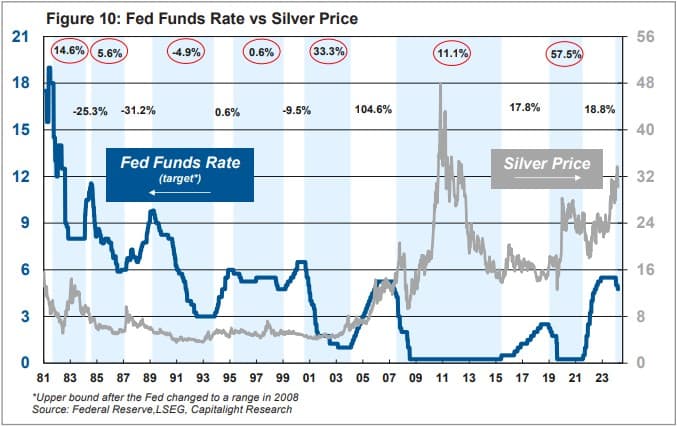
“The major outlier was the 104.6% gain during the June 2004 to September 2007 tightening cycle – much of this gain is attributed to strong industrial demand coming from Asia (specifically China) and revived investor demand due to the problems emerging in the financial sector,” the authors noted. “Silver has risen during both the easing and tightening cycles since 2000.”
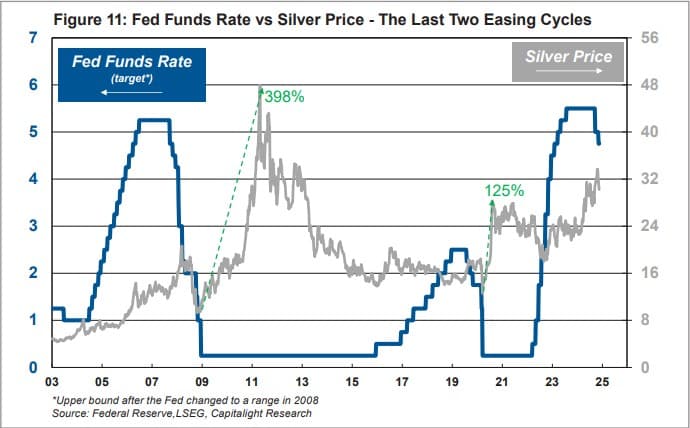
“Looking closer at the last two cycles, it is important to note that a caveat is that if recession does take hold, the price of silver is likely to decline before surging higher,” they warned. “Recessions are not positive for the silver price. However, central banks’ response to lower interest rates and quantitative easing is very positive. Once central bank easing fully kicked in, the silver price surged for several quarters of the last two Fed interest rate easing cycles!”
Looking at the potential long-term silver supercycle, the report noted that “Compared to short-term fluctuations, which are influenced more by microeconomic factors, supercycles differ in that they tend to span a much longer period of time. Price upswings during these periods may last 10 or even 20 years, generating 20 to over 40-year complete cycles.”
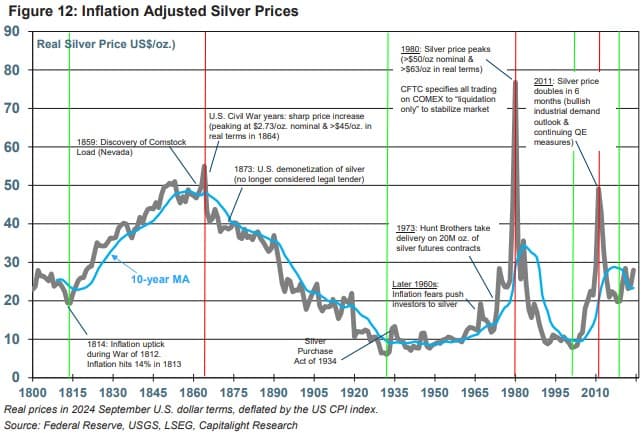
“If the current bull market continues to evolve into the next metals super cycle as we expect, then investment demand and industrial demand, particularly for metals critical to green energy technologies such as electric vehicles, solar panels, and energy storage systems, will continue to increase for the next several years,” the report said.
“In addition, this cycle is likely to be amplified by significant supply constraints,” the authors added. “Stricter regulatory environments, longer permitting timelines, and outright restrictions on exploration and mine development in various regions are limiting the ability of producers to meet rising demand.”
“As a result, we can expect heightened price volatility throughout the cycle as the industry struggles to bridge the gap between supply and demand,” they warned. “The slow pace of new mining projects, along with geopolitical risks and environmental concerns, could lead to prolonged supply shortages. This presents investment opportunities for projects that can successfully navigate regulatory challenges, particularly in regions that are more favorable to exploration and mining activities.”
The authors wrote that “silver stands out as a highly strategic asset for institutional investors due to its dual role as an industrial metal and a safe haven during periods of market instability. With its low correlation to traditional assets such as equities and bonds, silver offers powerful diversification benefits.”
“Historically, silver has proven its value during times of economic and geopolitical crises, serving as a reliable hedge against inflation, currency devaluation, and systemic financial instability,” they added. “In the context of the modern global landscape, this role has become even more pronounced. Silver, which has served as a form of monetary reserve for over two millennia, is once again emerging as a store of value in a world where traditional reserve currencies like the US dollar are facing challenges to their dominance.”
“The current global environment is experiencing a tectonic shift driven by several factors, including growing geopolitical tensions, heightened economic fragility, and the deteriorating fiscal positions of many governments,” they concluded. “These pressures are reshaping the global financial system, with investors increasingly seeking assets that are immune to counterparty risks and political interventions.”
