

(Kitco News) – Cryptocurrency proponents have been flying high since the election of Donald Trump as he is expected to usher in a new era of regulatory clarity and openness to digital assets, and according to one analyst at S&P Global, Trump’s plans for a strategic Bitcoin (BTC) reserve could reshape the future of crypto in traditional financial markets.
“U.S. legislative proposals have stalled so far,” noted Andrew O’Neill, Digital Assets Managing Director at S&P Global Ratings, who provided the background that has led to Trump’s pro-crypto advocacy. “In July 2024, the House approved a ‘financial innovation and technology for the 21st century’ bill (FIT21), which on the crypto side sought to delineate the areas of coverage of each U.S. regulator.”
“However, this bill has yet to clear the senate,” he noted. “Proposals also exist for regulating stablecoins, but none has come to a vote in the House. Earlier this year, the House and Senate voted to repeal SAB 121, but this was vetoed by President Biden, and the rule remains in place.”
“As a result of SAB 121, there is little competition for crypto custody services in the U.S.,” O’Neill said. “Indeed, the custody of Bitcoin and Ether held in ETFs is highly concentrated, with a small number of crypto companies rather than traditional custodians.”
But the system as it exists today is likely to change, he suggested, as the “U.S. election results will likely shift the legislative and regulatory environment for crypto.”
“With the caveat that campaign rhetoric doesn't always translate into policy actions, these developments may accelerate blockchain innovation in financial markets and could increase predictability for crypto businesses,” O’Neill said. “A proposed bill to build a strategic Bitcoin reserve already shifts the narrative for that asset, even if the proposed bill's prospects are unclear.”
And Trump won’t be alone in his push to provide a clearer regulatory structure around cryptocurrencies as “The Republicans' sweep of the White House, Senate and Congress sets the foundation for legislative and regulatory momentum,” he noted. “Policy discussions to date have been highly partisan relative to other countries, although this was beginning to change in the build-up to the election.”
O’Neill said these developments are significant because up to this point, “The U.S. has lagged behind other major markets in advancing crypto regulation” and has instead adopted a regulation-by-enforcement approach, but that is expected to change after Trump is inaugurated.
“Shifting the regulatory approach from enforcement-led to rule-making could increase predictability,” he suggested. “Crypto companies in the U.S. risk fines and enforcement actions relating to the listing of unregistered securities. This is due to the absence of regulatory clarity on which crypto assets are securities.”
“Another activity lacking clarity is the ‘staking’ of crypto assets (locking assets in a smart contract to earn yields),” he added. “Some entities have ceased to offer this service as part of a settlement with the regulator, while others continue to argue their case in court.”
O’Neill noted that in the lead-up to the launch of spot Ethereum (ETH) exchange-traded funds (ETFs), the Securities and Exchange Commission (SEC) required all applicants to remove any language related to Ether staking. “Although Ether exchange-traded funds emerged in the U.S. in 2024, these don't allow staking and therefore don't allow investors to access staking yields,” he said.
As for what is expected once Trump takes office, O’Neill said that analysts at S&P “expect developments relating to stablecoin legislation and custody early in 2025.”
“The lack of a regulatory framework for stablecoins in the U.S. has constrained the uptake of financial market use cases, such as tokenization in financial markets (the creation of traditional financial assets as tokens on a blockchain),” he noted. “Although the tokenization of money-market funds accelerated in 2024, regulatory clarity could spur investor confidence and help scale up these applications.”
“More broadly, the lack of U.S. participation in global regulatory coordination efforts has impeded blockchain innovation in traditional financial markets,” he added. “We believe the stronger involvement of the U.S. may allow already well-tested use cases to scale commercially, both domestically and globally.”
O’Neill said he also expects the market for crypto asset custodians to broaden.
“The Security and Exchange Commission rule ‘Special Accounting Bulletin (SAB) 121’ requires entities holding crypto assets in custody for their clients to report these assets on their balance sheet with a corresponding liability,” he noted. “This makes it prohibitively expensive for U.S. banks to provide custody for crypto assets if the new administration reconsiders the proposed repeal of SAB 121, which Biden vetoed in July 2024.”
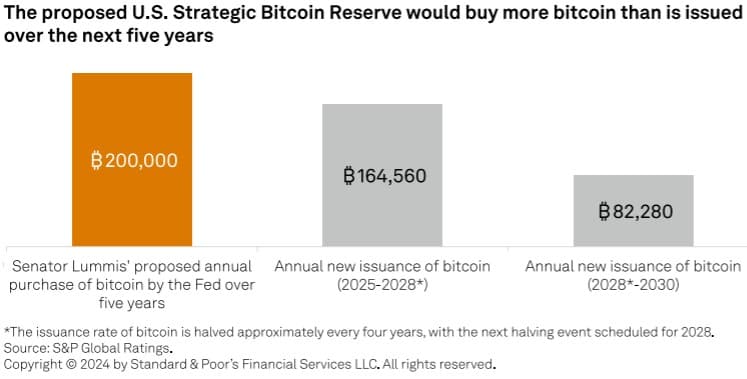
And regarding Trump’s plans for a strategic Bitcoin reserve, which was the impetus for Senator Cynthia Lummis (R-WY) to propose a bill that would require the Federal Reserve to accumulate 1 million Bitcoins over five years, equivalent to about 5% of the total Bitcoin supply, O’Neill noted that “Supporters of the proposal argue that Bitcoin's fixed supply can mitigate the risk of currency debasement and help manage national indebtedness in the long term.”
To fund the Bitcoin purchases, Lummis has suggested revaluing and selling some of the gold held by the Treasury to avoid adding to the government deficit.
“The proposal, if passed, would significantly affect Bitcoin demand (and therefore its price), given Bitcoin's fixed issuance schedule and because these purchases alone would exceed newly issued Bitcoin over the period,” O’Neill said.
“The proposal could encourage other nations to follow suit,” he concluded. “Regardless of whether the proposal advances, the narrative has shifted around Bitcoin as an asset in traditional financial markets.”
