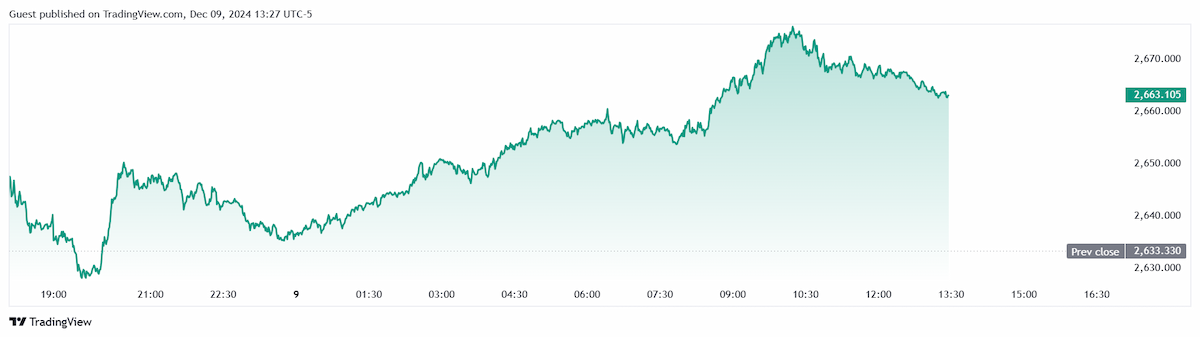

(Kitco News) – Gold’s short-term outlook is showing mixed signals with firm resistance at key levels, but this week’s CPI data and the ECB rate decision could be the catalyst that breaks the yellow metal out of consolidation, according to Fawad Razaqzada, market analyst at StoneX Group.
Razaqzada wrote that the strong dollar and geopolitical uncertainties are continuing to weigh on gold, while technical signals suggest caution.
“Gold and silver rose in the first half of Monday’s session,” he noted. “A shift in China’s monetary stance provided a welcome boost for Chinese stocks and this helped to provide a positive backdrop for all China-related assets, from miners to key commodity prices. Meanwhile, geopolitical upheaval from the Middle East to South Korea and France also helped to fuel a bit of a rebound in gold and oil prices.”
Razaqzada said interest-rate decisions from major central banks and U.S. CPI and PPI inflation data will dominate this week’s economic news, while China is gearing up for a stimulative 2025.
“China’s top leaders announced they will embrace a ‘moderately loose’ strategy next year, in a sign of greater easing ahead that will likely be hailed by investors hungry for more stimulus,” he said. “On top of this, ECB policymakers will set interest rates this week for the first time since governments in Paris and Berlin both collapsed over budget talks.”
The ECB, the Bank of Canada and the Swiss National Bank are also expected to ease policy this week. “If we hear more dovish signals than expected from these central banks, then that could help assets with low or zero yields such as gold – especially if geopolitical uncertainties remain elevated,” he noted.
Razaqzada noted that despite rising nearly 1% by the mid-morning European session, gold was still contained within its existing two-week-old ranges.
“The range-bound conditions follow a retreat from record highs in late October,” he said. “This pullback ended a nine-month winning streak, leaving November in the red. Many investors are probably waiting for a deeper correction before jumping back into the market, resulting in modestly bearish sentiment in the near-term gold forecast. As the focus shifts to the upcoming US Consumer Price Index (CPI) report and the Federal Reserve’s final meeting of the year, gold’s price action will likely hinge on these pivotal events.”
Looking at the currency environment, Razaqzada said that U.S. dollar strength may hold gold back.
“While the procyclical currencies rebounded amid China stimulus optimism, the Dollar Index was still holding near its recent highs,” he wrote. “The greenback’s sharp rally since September has significantly impacted gold prices, making the metal costlier in major gold-consuming regions like India and China. These two countries alone account for over half of the global jewelry market, according to the World Gold Council. The dollar’s strength, paired with a rotation toward riskier assets like tech stocks and cryptocurrencies, has also diminished gold’s appeal.”
He said that today’s recovery “may be a sign that perhaps the consolidation phase might be nearing an end,” but added that “a confirmed breakout is needed.”
Mixed economic data is also adding to the uncertainty for gold prices, Razaqzada said, with Friday’s employment report further muddying the waters.
“While headline job growth exceeded expectations, a 355K drop in household survey employment and a rise in the unemployment rate to 4.2% dampened optimism,” he said. “Stronger-than-expected wage growth (up 0.4% month-over-month) failed to offset concerns about broader economic weakness. As the Fed pivots its focus towards employment and away from inflation data, the upcoming CPI report may not prove so pivotal for the next moves in gold after all – unless we see a rather hot print.”
Turning to the technical picture, Razaqzada said gold is sending mixed signals here as well. “A recent sell-off, exactly two Mondays ago now, formed a bearish engulfing candle, reinforcing resistance at $2708-$2725,” he said. “Yet, the lack of bearish follow-through is concerning for the bears.”

[The above] range, a former support zone, now acts as a potential barrier to upward momentum,” he said. “Complicating the technical picture further, gold is also forming a falling wedge pattern, typically a bullish signal over the long term. However, near-term resistance within this pattern may limit immediate upside potential.”
Razaqzada shared a number of key levels to monitor. “A daily close above [$2668] may signal a bullish reversal, ending a two-week consolidation,” he said. “$2708-$2725 [is the] next major resistance area in the event we see a bullish breakout from a falling wedge.”
Key support levels include $2580. “Falling below this base could open the door to further declines toward $2500-$2530, a critical support zone,” he said. “Long-term support [is] at $2440-$2400. This range aligns with the 200-day moving average and remains a backstop if selling pressure intensifies.”
“The gold forecast for the short term remains mixed as traders weigh competing influences, including the dollar’s strength, geopolitical uncertainties, and upcoming US inflation data,” Razaqzada concluded. “While long-term trends remain supportive, short-term technical resistance and loss of momentum suggest caution. The US CPI data release or ECB’s rate decision this week could provide the catalyst gold needs to define its next trajectory, although in all likelihood traders instead may wait until the Fed’s rate decision in the following week.”
Gold prices have continued to build on their earlier strength, with spot gold hitting a session high of $ 2,676.48 at 10:15 am EST, and last trading at $2,663.10 for a gain of 1.13% on the daily chart.