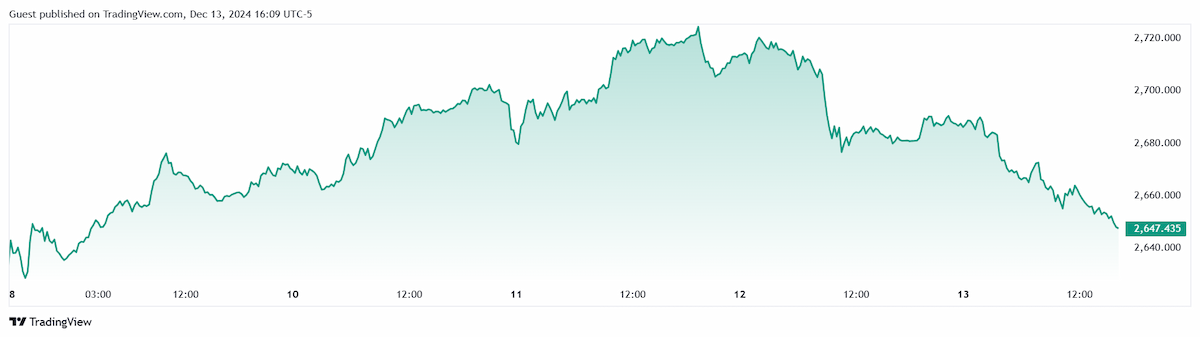
(Kitco News) – Gold started the week strong, with spot gold up nearly $100 from the weekly low at one point, but hot inflation numbers and U.S. dollar strength drove the precious metal lower as the week progressed.
Spot gold kicked off the week trading at $2,633 per ounce, and hit the weekly low of $2,627 early Monday morning. From there, the yellow metal embarked on a steady climb that lasted most of the week and had many precious metals traders feeling pretty bullish, albeit with one worried eye trained on the inflation data to come.
Monday morning saw the gold price trading around $2,656 per ounce as of 8:15 a.m. EST, and spot gold gained a quick $20 in the next two hours, topping out at $2,676 by 10:00 a.m. Eastern. After selling off to retest the $2,660 level, gold trended in a relatively narrow range until early Tuesday morning, when spot gold managed to break definitively above near-term resistance at $2,677 per ounce, before shooting above $2,700 by 8 p.m. EST and establishing a new higher range with that resistance now converted to support.
The release of relatively inline CPI data on Wednesday morning pushed gold prices higher still, and by 1 a.m. EST on Thursday evening, spot gold set what ultimately proved to be the weekly high of $2,726.28 per ounce. Following a quick dip back down to test support near $2,705 per ounce, spot gold seemed content to trade within a $20 range above the $2,700 level.
But Thursday morning’s release of the Producer Price Index report at 8:30 a.m. EST proved to be gold's undoing, as the hotter-than-expected inflation data drove the yellow metal sharply lower, with the spot price hitting the previous key level of $2,676 per ounce two hours later. This level held, however, and gold looked poised to hold most of its gains as it traded in a narrow $10 range for the rest of Thursday.
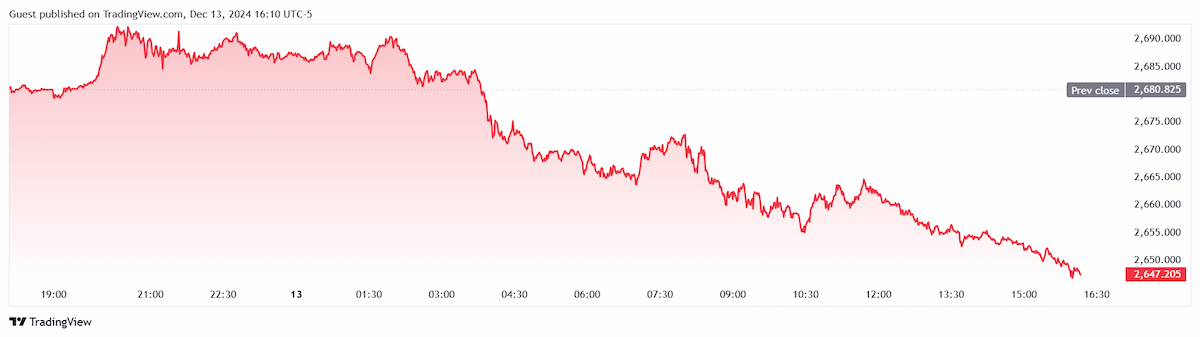
But Friday morning brought further weakness, with spot gold breaking below $2,676 support shortly after 3:45 a.m. EST, and the yellow metal spent the North American session declining steadily lower as the weekend approached.
The latest Kitco News Weekly Gold Survey showed industry experts perfectly balanced between bullish and bearish attitudes with a plurality of respondents neutral, while retail traders’ bullish sentiment was unchanged from the prior week.
“Gold rallied $85 in the first three days of this week, encouraged perhaps by news that the PBOC added gold to its reserves for the first time in several months,” said Marc Chandler, managing director at Bannockburn Global Forex. “The yellow metal reached $2726 in the spot market Thursday, its best level in [over a month] before reversing lower. Some linked the sell-off to the firmer US PPI. Still, gold is finishing higher on the week, snapping a two-week decline.”
“Since the end of October, this is only the second weekly advance,” Chandler added. “A hawkish cut by the Fed — a rate cut, but less rate cuts anticipated next year, and enough word cues to support speculation of a pause early next year — maybe sets up a re-test on $2600.”
“Higher, said Adam Button, head of currency strategy at Forexlive.com. “The PBOC is back buying and the seasonal winds are strong.”
“Next week could be DOWN amid optimism on the Trump presidency’s effect on the economy and the dollar,” said Adrian Day, president of Adrian Day Asset Management. “A Federal Reserve rate cut next week is already priced in, and we suspect that Fed Chairman Jerome Powell may try to sound a little hawkish in his comments.”
“But beyond next week, very bullish as all the reasons people have been buying gold over the past two years – from central banks concerned about weaponization of the dollar to concerns about U.S. and European stagflation – remain,” Day added.
Sean Lusk, co-director of commercial hedging at Walsh Trading, was marveling at the continued strength of the stock market as the year drew to a close.
“It just goes to show you, they just have nowhere else to put the money,” he said. “They just continue to buy dips and drive it up. As long as you're not shutting down your economy, or there's no major destruction in the banking sector.”
Lusk said that he believes gold’s selloff was driven by the disappointing PPI report, but there’s a deeper worry behind it. “I just think they're looking for any reasons to dump the longs, take some profits here,” he said. “It seems to me that it might be a possibility, with the continued flight into the dollar, there's a few headwinds for metals here near-term. Energies aren't doing anything. There's nothing else [in commodities] propping you up. The only thing that's really had a sustainable track higher here has been the cattle markets and coffee, and those are scarcity and weather concerns.”
Lusk said there’s been a sea change in commodity pricing since the U.S. election. “Now, you could say Bitcoin's been a real winner, no doubt about it,” he said. “Has that taken some of the allure out of gold? Maybe not, but this uptick in the dollar certainly has.
“There's a lot of anticipatory things that have entered the market,” he added. “There's been a lot of talk about tariffs, but I think Mexico, Canada, and the United States are going to get a deal done. They might have to move some stuff around and renegotiate some prior deals, but at the end of the day, I think they'll be able to work together. China may see increased tariffs on a few things, but those were never really taken away by the Biden administration. The real tariff issue is going to probably be with the Europeans.”
As for gold’s performance for the remainder of the year, Lusk sees U.S. dollar strength and seasonal weakness combining to cap the yellow metal’s upside.
“Coming into, November and the first two, three weeks of December is a poor performance,” he said. “A lot of physical demand globally backs off; you're priced into a lot of stuff. The dollar and crypto have been the big winners, gold has taken a back seat, but we haven't fallen that far. It wasn't too long ago we were below $2,000 an ounce. We're due for a setback, a correction, a profit-take, an unwind, these are necessary sometimes, and healthy, really, but in the grand scheme of things, I don't know where you would want to be?”
Lusk believes the dips will continue to be bought, and gold will begin to gain once again in the early months of 2025. “This market should be supported on breaks anywhere down below $2,500, I would imagine,” he said. “All this is seasonal weakness, this part of the year, and then they rebuy it after Christmas going into Valentine's Day because physical demand returns.”
“You do have some uncertainties,” he warned. “As soon as we flip from Biden to Trump, there's going to be a lot more noise, and the media has nothing else to do than just try to scare the hell out of everybody again. Then in other parts of the world, you have governments unwound, you have some uncertainties. So that's why I think it's going to be bought here.”
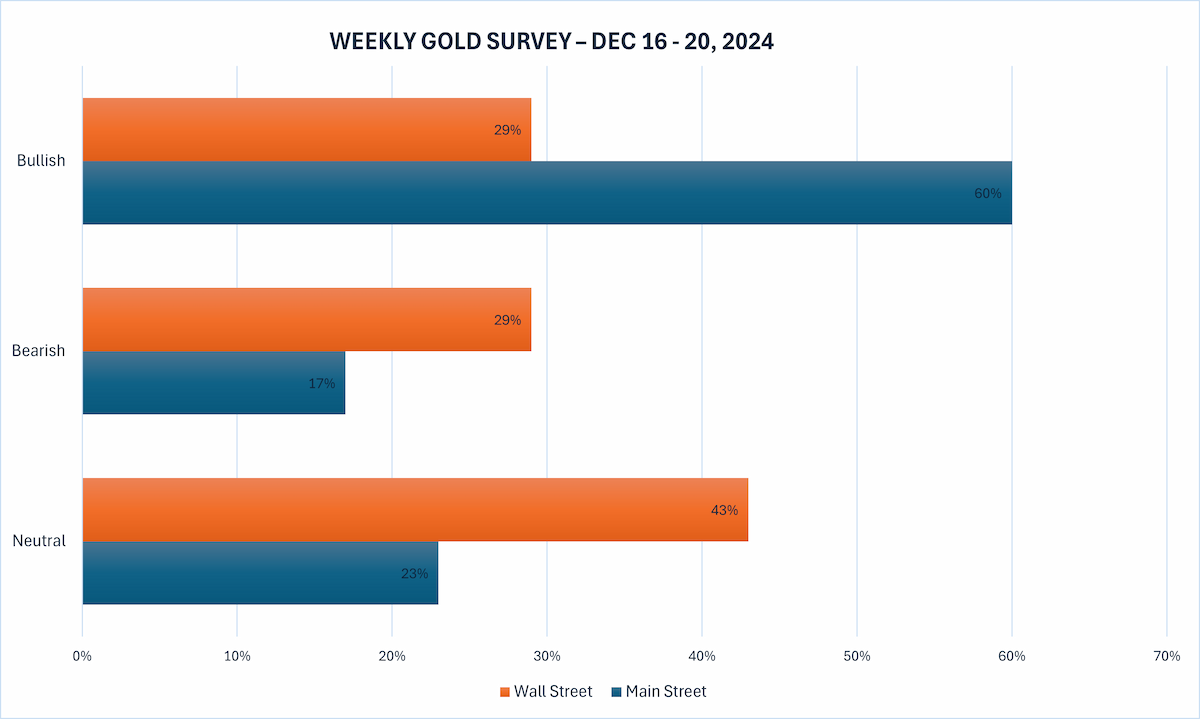
This week, 14 analysts participated in the Kitco News Gold Survey, with Wall Street sentiment now divided evenly between optimists and pessimists on price and many opting for the sidelines. Four experts, or 29%, expected to see gold prices rise during the week ahead, while another four predicted price declines. Six experts, representing 43% of the total, expected gold to remain rangebound or chose a wait-and-see approach.
Meanwhile, 144 votes were cast in Kitco’s online poll, with Main Street maintaining its mainly bullish stance on the yellow metal after this week’s up-and-down performance. 87 retail traders, or 60%, looked for gold prices to rise next week, while another 24, or 17%, expected the yellow metal to trade lower. The remaining 33 investors, representing 23% of the total, expected gold’s recent consolidation to continue in the near term.
The single biggest economic news event next week will be the Federal Reserve’s final interest rate decision for 2024 on Wednesday afternoon, and while markets are fully priced in for a 25 basis-point cut, the real focus will be on the verbiage of the monetary policy statement and Powell’s press conference for clues as to the central bank’s bias moving forward. The Bank of England will deliver its interest rate decision on Thursday.
Economists will also get an updated reading on the health of the U.S. consumer with the release of Retail Sales for November on Tuesday and the Personal Consumption Expenditures (PCE) Index on Friday.
Other significant data include the release of the Empire State Manufacturing Survey and S&P flash PMI on Monday, and Final U.S. Q3 GDP, Philly Fed manufacturing survey, November existing home sales, and weekly jobless claims on Thursday.
Mark Leibovit, publisher of the VR Metals/Resource Letter, is predicting a final push higher for gold prices in 2024. “I am holding long positions and expect a year-end rally,” he said.
Darin Newsom, senior market analyst at Barchart.com, expects gold prices to trend sideways next week, but that doesn’t mean the days will be devoid of drama, as this week proved.
“Last week I was looking for gold to go sideways and we got that,” he said. “Then we got that piece of chaos over the weekend, with Assad getting overthrown. Was it completely unrealistic for this to happen? It was always a possibility, but it didn't seem like a strong likelihood at least going into the last week, and then the suddenness of it… to me, that's what spiked the gold market, more so than anything else.”
“There's this vacuum now created in a major player in the Middle East,” Newsom added. “Now, who's going to take over? Is it going to be ISIS? Is Israel going to use this to their advantage? What role is Russia going to play, and BRICS? What about the United States? Particularly with an administration change here, so many uncertainties.”
“I think that's what brought the buyers back into gold,” he said. “But then as the week went along, before we knew it, gold was back down into its previous sideways range.”
Newsom said even the Federal Reserve isn’t putting too much stock in the inflation numbers these days.
“Let's be honest, those things are the comic relief of the financial world,” he said. “I don't think anyone takes them very seriously. The Fed doesn't look at it, and if they do, they've already made their decision about what's going to happen. It might be part of the whole pie that's consumed when it comes time to make a decision on the Fed funds rate, but I don't see either the CPI or PPI being all that important. They can be heavily influenced by one or two triggers, and I just don't think it's a good reflection of the overall market.”
“That being said, gold did come back down,” Newsom acknowledged. “Was it tied to PPI? Sure, let's say that it was. But I think what folks are doing now is they're looking forward. If we see an interest rate cut this time, most likely we'll see another 25-basis-point cut, I don't think it's going to affect the dollar all that much.”
“Longer-term, interest rates are going to have to go back up, because inflation is going to heat up again,” he said. “That's what tariffs and trade wars do, they heat up inflation. To combat that, we're going to have to see higher interest rates. The dollar is going to stay stronger. And if that's the case, even though we're going to see inflation in goods and services, we may see some actual commodity prices start to come under pressure. Unless there's a supply and demand situation, or unless there is increased chaos around the world, that's going to happen.”
“We also know this administration will bring with it another level of chaos, globally,” Newsom added. “And so I think gold's not going to fall apart as we go into 2025. It might go lower, but it's going to continue to find buyers because, frankly, we don't know what's the next headline, what's the next social media post, or what anything's going to be the next day. We're going to have to get back into that routine and see how long it takes to evolve.”
“I look for gold to come down a little bit,” he concluded. “Inflation is going to go up, the dollar is going to firm as long as it's allowed to, and this is going to become the norm: increased volatility, increased chaos. Meaning investors are going to stay interested in gold.”
“I am bearish here,” said Michael Moor, Founder of Moor Analytics. “The trade above 26670 (+1.6 tics per/hour) brought in $94.3 of the strength warned about, and the trade above 26706 (-1.3 tics per/hour) projected this upward $22 minimum, $40 (+) maximum — we attained $90.7. These are ON HOLD. The trade back below 27459 (+3.5 tics per/hour) has now brought in $72.8 of pressure warned about in yesterday's analysis.”
“In a higher timeframe, we are still in an overall bull trend from November 2015, and likely in the later stages,” he added. “Part of this is a prediction I made of $151 minimum, $954 (+) maximum from $2,148.4 — of which we have attained $653.4 so far. These are ON HOLD. In a Medium time frame, the trade below 27730 brought in $231.5 of the pressure warned about. This is OFF HOLD.”
And Kitco Senior Analyst Jim Wyckoff expects gold to remain in consolidation next week. “Sideways and choppy as technical posture has deteriorated a bit,” he said.
At the time of writing, spot gold last traded at $2,647.53 per ounce for a loss of 1.24% on the day but a gain of 0.19% on the week.