
(Kitco News) – Despite high bond yields and fewer Fed rate cuts on the horizon, gold prices are holding up relatively well, but silver prices face significant downside risk if a likely U.S. recession materializes in the second quarter, according to precious metals analysts at Heraeus.
In their latest precious metals update, the analysts noted that while China’s resumption of gold purchases at the end of the year got a lot of attention, Poland actually led all central banks in 2024.
“The People’s Bank of China purchased 5 tonnes of gold in November plus 9.3 tonnes in December, marking a consistent return to buying to finish 2024 after a six-month hiatus,” they wrote. “However, Poland has led central bank gold purchases in 2024, with cumulative year-to-date purchases of 89.5 tonnes compared to China’s 33.9 tonnes, as of November. The top four countries for central bank gold demand in 2024 – Poland, Turkey, India and China (in that order) – accounted for 72% of total central bank demand, which totalled 270.8 tonnes to November. Of these, Turkey and India made net purchases every month in 2024, with Poland consistently buying since April.”
“While China’s return to gold purchases is a positive indicator for continued demand into 2025, India, Turkey, and Poland appear to be more reliable drivers of demand,” they added. “These countries are likely to keep using gold as a reserves diversifier as their currencies continue to weaken against the US dollar, whereas the yuan has rallied since October."
Heraeus also pointed out that bond yields have been on the rise in the new year, but gold appears to be unfazed.
“After peaking at 4.68% in April 2024, 10-year bond yields dropped to 3.61% by September but have since recovered to earn 4.67%, coinciding with Trump’s election victory,” the analysts said. “This rise aligns with much lower expectations for Federal Reserve (Fed) rate cuts due to concerns over future inflationary policies sparking cautious rhetoric from Fed officials. The market now reports the probability of no further rate cuts before the end of July 2025 as nearly 25%.”
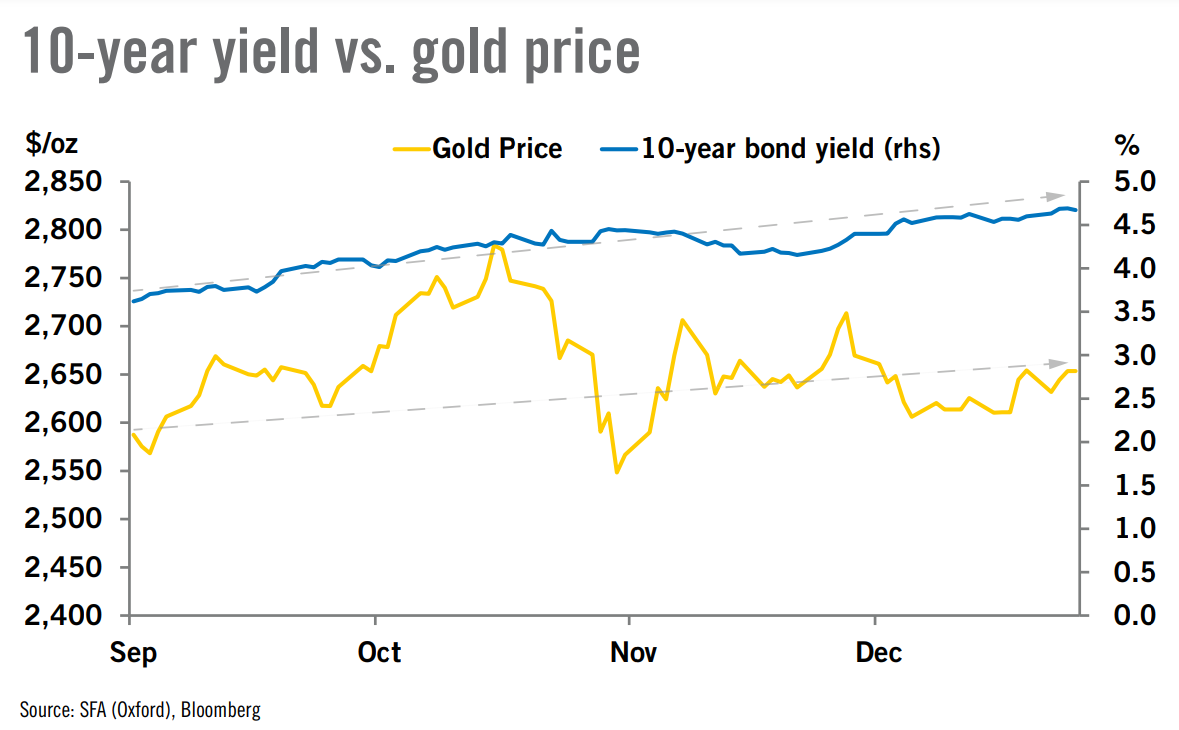
“While higher bond yields typically curb gold’s attractiveness as a non-yielding asset, inflation concerns, and geopolitical uncertainty continue to support its safe-haven appeal,” they noted. “As yields rose by nearly 1% last week, gold also increased by more than 2%. The historical dynamic between bond yields and gold remains aberrant.”
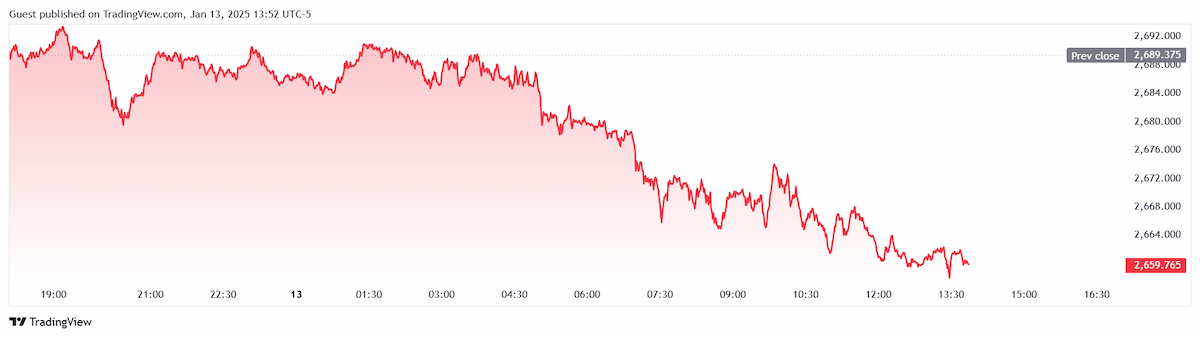
Gold prices dropped steadily on Monday. Spot gold last traded at $2,659.77 per ounce, a loss of 1.10% on the session.
Turning to silver, Heraeus said that the very real risk of recession in the second quarter may drive silver prices firmly below $30 per ounce.
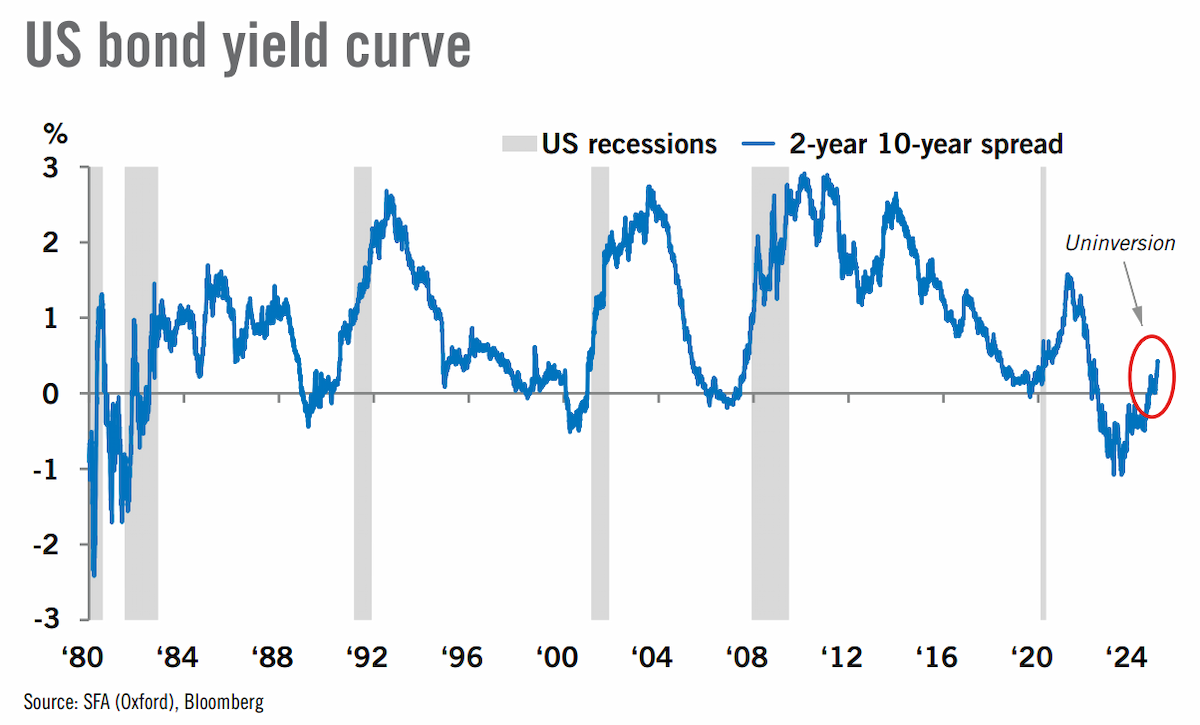
“Various economic indicators have been pointing towards a recession in the US for more than a year,” the analysts wrote. “However, GDP growth figures have yet to show a slowdown in the US economy. In 2024, US GDP growth averaged 2.57% over the first three quarters, and US growth is forecast to reach 2.6% year-on-year in 2025. However, the Treasury yield has un-inverted, which tends to be a reliable recession indicator. Based on the historical lag between un-inversion and the onset of recession, the US could be in recession from Q2’25.”
“This is a potential downside risk for industrial silver demand, which (excluding recession risk) has the potential to reach record highs, largely driven by solar manufacturing demand,” they added. “However, if a recession in the US causes industrial consumption to contract, silver demand is at risk of falling year-on-year. Silver tends to underperform gold during recessions owing to its large industrial demand component, in contrast to gold, which is primarily a store of value. Under a recession scenario, the silver price could struggle to maintain its level above $30/oz in 2025.”
The analysts also think traders are now coming to terms with the possibility of Trump 2.0 ushering in new tariffs on precious metals. “Exchange of futures for physical (EFP) premia in silver are abnormally high, implying market participants are choosing to take delivery of physical metal now in order to avoid any potential tariff on future deliveries,” they noted. “This has coincided with the front month silver futures contract bidding-up to a more than 10-year high of $0.60/oz over the spot price.”
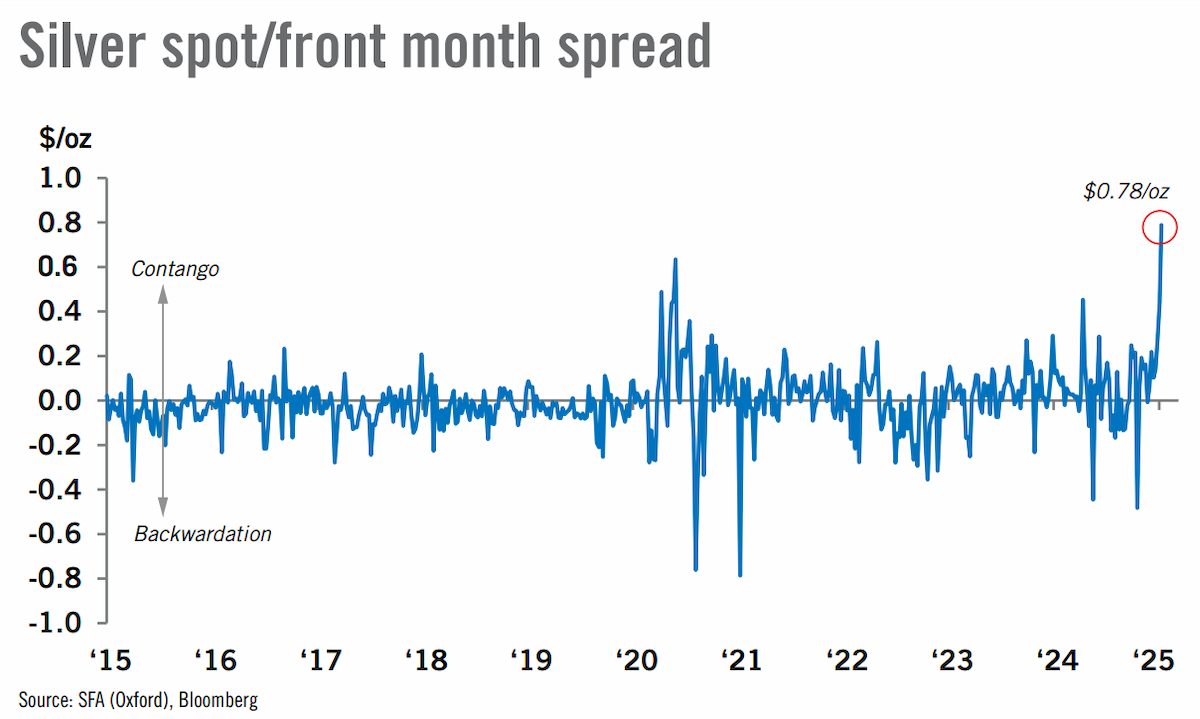
“While additional tariffs on bullion are by no means a certainty yet, the possibility is feeding into this volatility,” the analysts wrote. “This dynamic could be driving the outflows of silver from London vaults, totalling 714 tonnes over the last month, into the US, though trade data is needed to confirm this.”
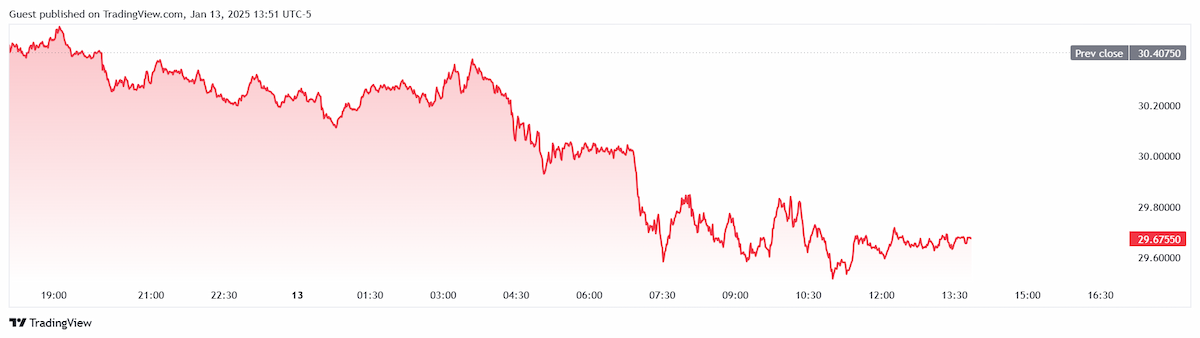
Silver prices have seen a steep decline in Monday’s trading. At the time of writing, spot silver last traded at $29.675 per ounce for a loss of 2.41% on the daily chart.