
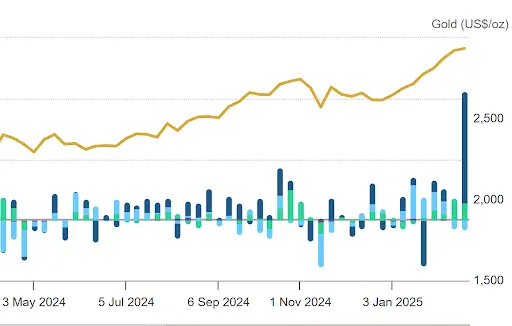
(Kitco News) - Gold’s climb to the $3,000 level may be slowing, but it hasn’t stopped, and it appears investors are finally getting the message as demand for exchange-traded funds has surged higher.
Data from the World Gold Council shows that last week, 48 tonnes of gold valued at $4.6 billion flowed into North America-listed gold-backed ETFs, the biggest one-week surge since early April. The renewed investment demand came as gold prices posted their eighth consecutive weekly gain while setting a new record high.
The gold market continued to inch higher on Monday, with spot gold last traded at $2,941.40 an ounce, up 0.21% on the day.
Some analysts have said that it may only be a matter of time before investment demand pushes gold to $3,000 an ounce.
“At 84.2 million ounces on Feb. 20, total known gold ETF holdings have recovered to the highest level since the start of 2024,” said Mike McGlone, senior commodity strategist at Bloomberg Intelligence. “It's not surprising to expect a shift to gold ETF inflows in 2025, especially if there's a bit of a reversion in the rapidly rising U.S. stock market and high interest rates.”
In a comment to Kitco News, Chris Mancini, Associate Portfolio Manager of the Gabelli Gold Fund (GOLDX), said that Western investors are jumping into ETFs to hedge against economic disruption or inflation caused by tariffs. He added that investment demand has room to move higher.
“Gold is serving as a hedge against the dollar and other currencies losing their purchasing power,” he said. “Tariffs might accelerate this process as the prices of goods across the world increase. Also, if global central banks (including the Fed) reduce interest rates or print money as a way to combat economic weakness, prices will likely rise, increasing gold’s appeal to investors.”
Some analysts note that investment demand highlights a critical breakdown in traditional market dynamics. Historically, gold prices have struggled in a high-interest-rate environment because of elevated opportunity costs as a non-yielding asset.
However, gold has managed to rally 12% in the first two months of the year, even as the Federal Reserve has said that it is in no hurry to cut interest rates. Analysts have noted that although the Federal Reserve is holding rates steady for the foreseeable future, inflation pressures continue to rise, driving real rates lower.
Analysts have explained that gold’s negative correlation with interest rates and the U.S. dollar has broken down because the market is being driven by central bank demand.
"The biggest factor driving gold to $3,000 per ounce is the massive coordinated buying by BRICS central banks,” said David Miller, CIO and senior portfolio manager at Catalyst Funds. “After the U.S. and EU weaponized the SWIFT banking system in 2022 to seize Russian Central Bank assets, none of the other BRICS countries trust that the same thing won't be done to them if they do something the U.S. and EU don't like. This has led to over 1,000 net metric tons of gold buying by these central banks in both 2023 and 2024. The move to $3,000 in gold prices is telling us that gold has begun to replace the dollar as the new world reserve currency."
Although gold remains well supported, some analysts note that the precious metal’s slowing momentum suggests risks of a correction are growing.
“The metal continues to look overbought when measured by the daily MACD. While it’s true that markets can remain overbought, or oversold, for long periods of time, it’s also true that eventually, prices adjust to resolve the situation,” said David Morrison, senior market analyst at Trade Nation, in a note Monday. “The resolution could be a substantial and protracted pullback in prices. But it can also mean a long period of consolidation, where prices effectively move sideways, staying within a range, until the MACD and other technical indicators return to more reasonable levels. So, there’s quite a bit of uncertainty around the gold price currently.”
However, despite the growing risks, Mancini said that investors should keep an eye on the long-term trend.
“$3,000 gold is telling us that investors are realizing that owning a physical asset that you can hold has more value during uncertain geopolitical and economic times,” he said. “It’s telling us that the state of geopolitics and the world economy is becoming more uncertain.”
