

(Kitco News) – The unprecedented movement of gold inventories across the Atlantic is fully justified given the degree of price uncertainty caused by the threat of tariffs on precious metals, and the potentially catastrophic consequences to traders if they bet on the wrong outcome, according to Greg Frith, Director of Precious Metals Sales and Trading for North America and EMEA at StoneX Group.
In a video published Wednesday, Frith explained that under regular market conditions, the UK’s over-the-counter market and the United States’ paper market are complementary and work seamlessly together on behalf of traders in both countries.
“The London market is an OTC physical metal trading market in the precious metal space, and New York is really a futures, paper, derivative-driven market,” he said. “Typically, a bullion trader will be long physical inventory or physical metal on their account in London from various mines selling gold to them from all over the world into LBMA vaults, or bank vaults, Brinks vaults, etcetera, and then it will typically sell equivalent futures to hedge that position in New York.”
“So they basically are delta neutral, [they] don't have a price risk depending on market moving higher or lower.”
But the post-election precious metals space has been anything but typical, and it’s disrupted the longstanding operating relationship between the two markets.
Frith said that the amount of physical gold that has been moving from London to New York is staggering. “2000-tonnes plus in December, almost every single flight was booked across the Atlantic with all the shipping logistic providers,” he said. “You couldn't even get metal on a flight because they were so booked up for the next two, three months.”
Another issue that adds cost and complexity to this sudden shift is the contract differentials for physical delivery: While the standards of purity between the two markets are the same, the weight of the gold bars is not.
“In London, the OTC gold market typically is backed by a 400-ounce gold bar, or a brick as you would normally say,” Frith said. “Now you have to take that 400-ounce bar, refine it at a Swiss refinery or any LBMA London good-delivery-approved refinery, and then you'll have to ship that across the Atlantic into New York [because] you can only deliver 100-ounce CME good-delivery bars or ‘four-nine’ [99.99%] purity kilo bars.”
“Obviously, there's only a certain amount of refinery capacity that can do this,” he added. “There are some LBMA refineries around the world. There's Metalor in Singapore, there's Valcambi in Switzerland. There's Argor-Heraeus in Switzerland, and then there's refineries in the U.S. such as Asahi and Metalor as well. These refineries are now backed up by approximately six weeks – some of them even longer – and the refining rates obviously have gone through the roof.”
Frith said the end result is a short-term shortage of precious metal moving into New York as U.S. futures traders attempt to eliminate the risk of their corresponding physical gold being tariffed.
“A lot of these traders that are short futures on COMEX are trying to build up as much physical inventory as they possibly can before potential tariffs come in,” he said.
And the policy uncertainty is only prolonging the process, as each new flip-flop and delay creates further risk to traders’ positions.
“They were supposed to be announced on the first of February, then it could be March, could be April,” Frith said. “No one really knows, is it a threat of tariffs, is it not tariffs? The likelihood is gold will probably not be tariffed because it's a monetary asset in America, and you would expect it not to attract tariffs. But in the current environment we're seeing with the Trump administration, everything's on the table.”
Frith said that given the degree of uncertainty and the impact on precious metals positions if gold were to be tariffed, preemptively moving tonnes of bullion into the United States is the smart move.
“It's actually sound risk management for traders and for market participants to load up on inventory in New York,” he said. “That's caused a real squeeze in London temporarily, whereby we've seen the forward curve that was traditionally a contango flip into a backwardation, and metal's been in short supply in London.”
Gold prices are seeing strong buying activity during Thursday’s trading, with spot gold hitting a fresh all-time high of $2,985.29 per ounce at 12:44 pm EST.
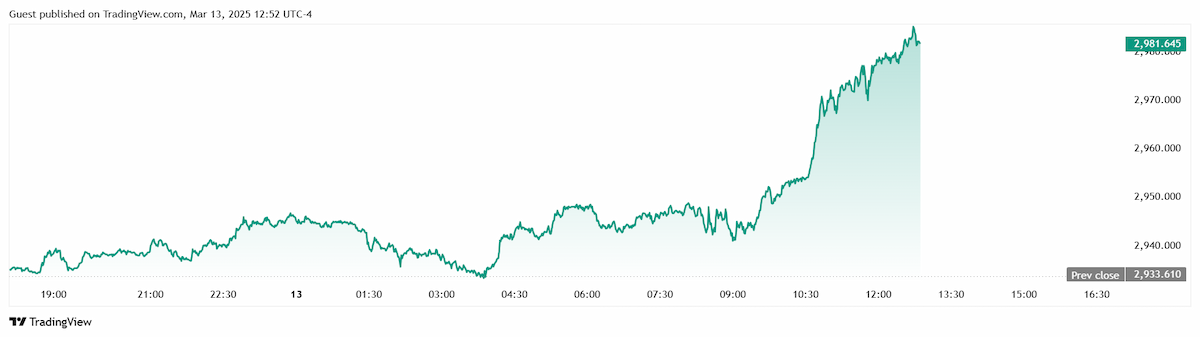
Spot gold last traded at $2,981.62 per ounce for a gain of 1.64% on the session.
