

(Kitco News) – Gold and other reserve currencies – but not the euro or renminbi – are steadily eroding the U.S. dollar’s position as the world’s preeminent reserve asset, according to Wolf Richter, analyst and publisher of Wolf Street.
“The status of the US dollar as the dominant global reserve currency has helped the US fund its twin deficits, and thereby has enabled them: the huge fiscal deficit every year and the massive trade deficit every year,” Richter wrote in an article published Monday. “The reserve currency status comes from other central banks (not the Fed) having purchased trillions of USD-denominated assets such as Treasury securities, other government securities, corporate bonds, and even stocks. The dollar status as the dominant reserve currency has been crucial for the US, and as that dominance declines ever so slowly, risks pile up ever so slowly.”
Richter cited the latest COFER data from the IMF, which showed the greenback lost more ground as the top global reserve currency in 2024.
“Total holdings of USD-denominated securities by other central banks (not the Fed) fell by $59 billion to $6.63 trillion at the end of 2024, from $6.69 trillion at the end of 2023,” he noted. “And the dollar’s share declined to 57.8% of total allocated exchange reserves at the end of 2024, the lowest since 1994, down by 7.3 percentage points in 10 years, as central banks have been diversifying their holdings for years to assets denominated in currencies other than the dollar, and into gold.”

Meanwhile, the foreign exchange reserves of central banks denominated in all currencies, USD included, rose to $12.36 trillion in 2024 from $12.35 trillion in 2023.
“Excluded from the total are any central bank’s assets denominated in its own currency, such as the Fed’s holdings of Treasury securities and MBS, the ECB’s holdings of euro-denominated bonds, and the Bank of Japan’s holdings of yen-denominated assets,” he said.
And the U.S. dollar’s share of reserves is not being lost to the euro. “The euro has been the #2 global reserve currency, with holdings at $2.27 trillion at the end of 2024,” Richter noted. “Its share has been around 20% for years, with a low of 19.1% in 2016 and a high of 21.3% in 2020. In Q4, the euro’s share was 19.8%.”
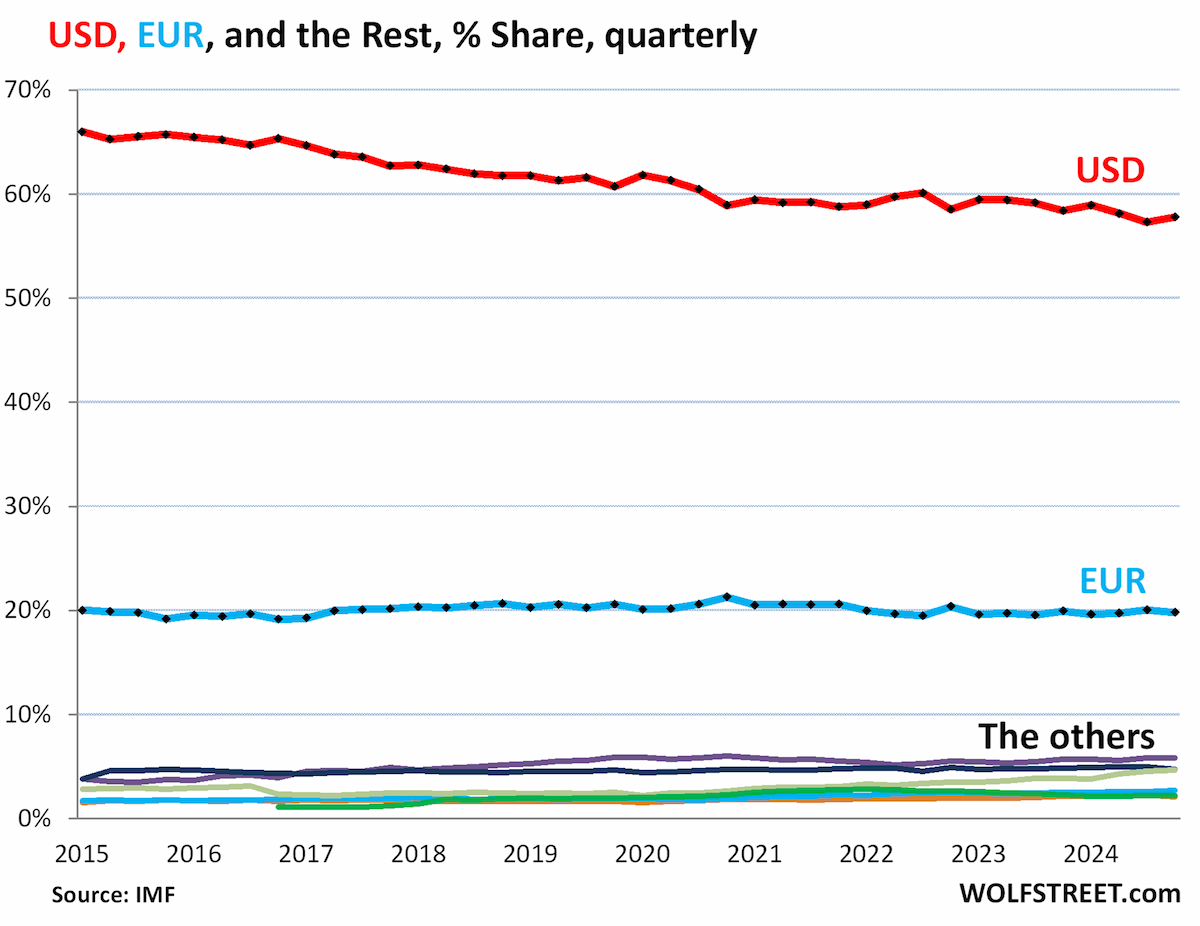
So the dollar has actually lost reserve share to other non-euro currencies, including ‘nontraditional reserve currencies,’ as the IMF calls them. “The colorful tangle at the bottom of the chart represents the largest of these other reserve currencies,” he said.
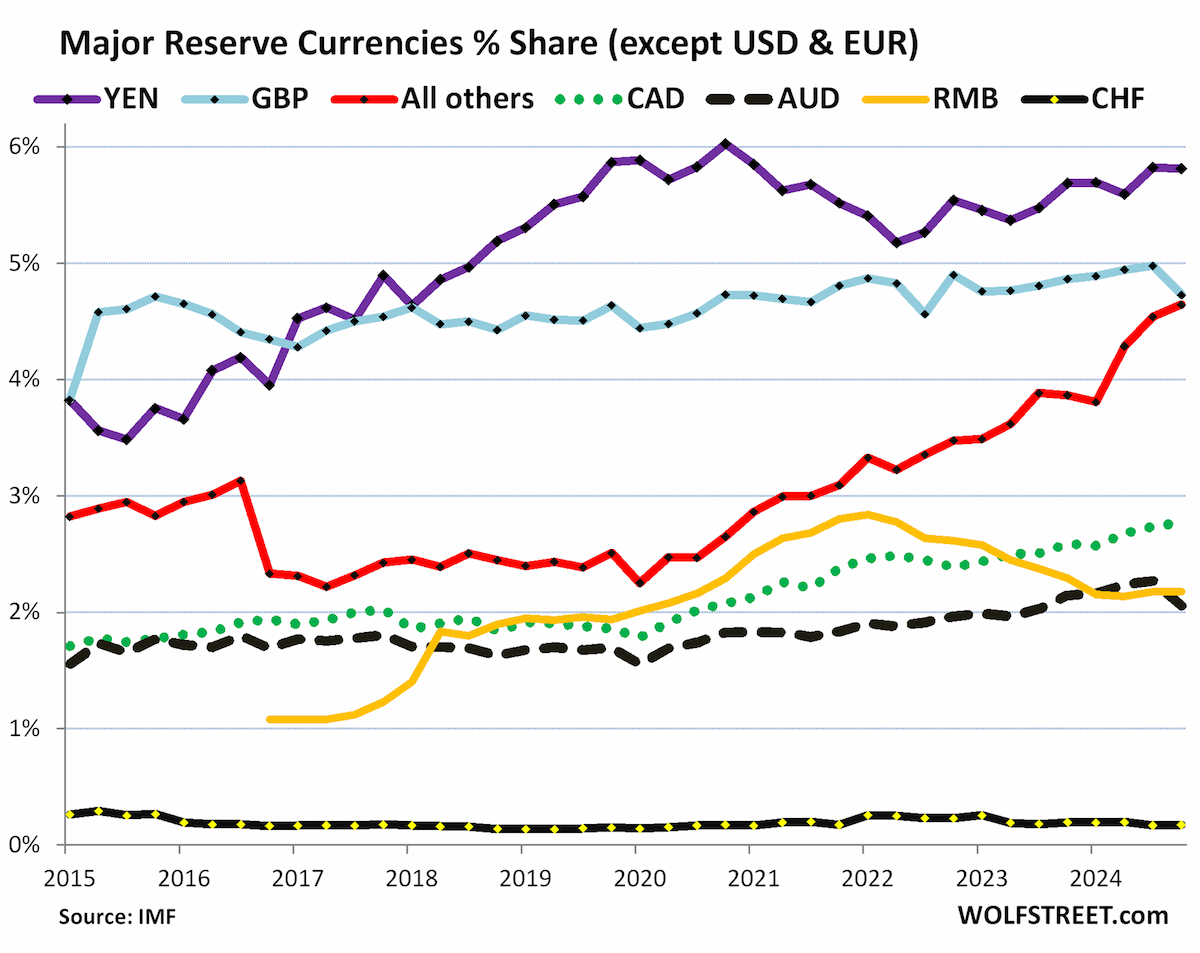
Richter pointed out that even as nontraditional reserve currencies have made inroads, the Chinese renminbi has actually lost share.
“China is the second largest economy in the world, but its currency, the renminbi, plays only a small role as a reserve currency,” he said. “And it has lost ground against the USD and other currencies since 2022. Central banks have not been enamored with RMB-denominated assets due to China’s capital controls, the RMB’s convertibility issues, and other complexities.”
According to the IMF data, the top nontraditional reserve currencies are the Japanese yen (5.8%), British pound (4.7%), Canadian dollar (2.8%), Chinese renminbi (2.2%), Australian dollar (2.1%), and Swiss franc (0.2%). All other currencies total 4.6% of global foreign currency reserves.
The other major beneficiary of the dollar’s decline as a reserve is gold. After forty years spent decreasing their gold holdings, central banks began building up their bullion reserves again around 20 years ago.
“Gold bullion is not a ‘foreign exchange reserve’ asset of central banks and is not included in the data above,” Richter noted. “Gold is a ‘reserve asset’ not involving foreign exchange.”
He noted that the top four central banks by gold reserves (U.S. 8,133 tonnes, Germany 3,352 tonnes, Italy 2,452 tonnes, and France 2,437 tonnes) have not changed their holdings in at least 20 years.
“But there has been a lot of movement below the top four, especially with Russia and China, which are now the #5 and #6 largest holders,” he added. “And they did move the needle: Russia: 2,333 tonnes, little changed since Q2 2022. But between 2005 and 2022, Russia, one of the largest gold producers, had added nearly 2,000 tonnes. China: 2,280 tonnes. In 2024, it added 44 tonnes. It started piling on gold in 2009 and by 2015 had tripled its holdings.”
Combined, Russia and China have added 3,626 tonnes to their holdings since 2005, he noted, while smaller holders like Poland, India, Kyrgyzstan, and Uzbekistan added large amounts of gold last year.
“According to the IMF figures not updated for 2024, central banks’ gold holdings have surged by roughly 200 million troy ounces (6,221 tonnes) from 2006 to 1.16 billion troy ounces, driven largely by China and Russia,” Richter wrote. “The increases in China and Russia alone represent nearly 60% of the total increase since 2006.”
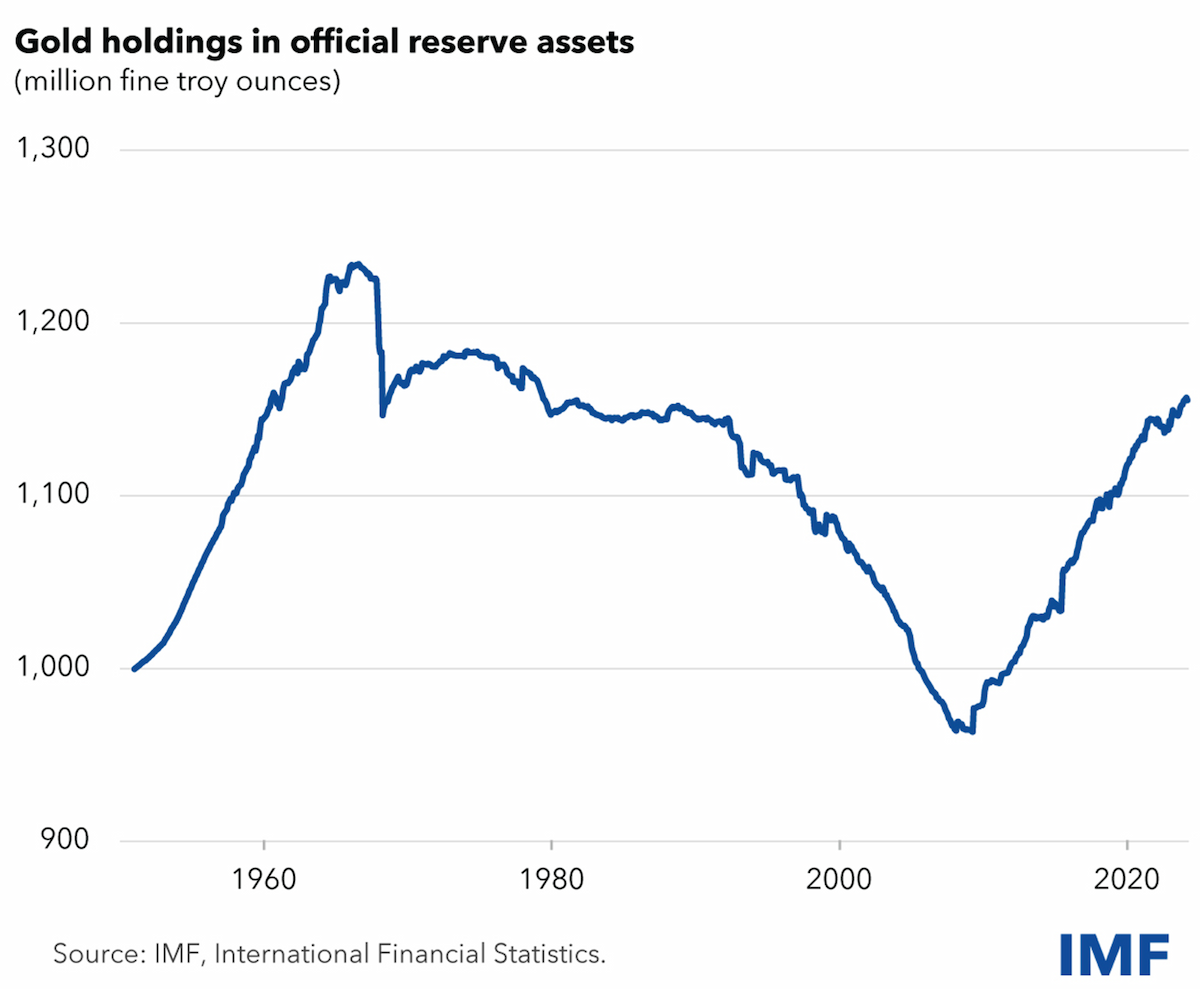
“In dollar terms, these gold holdings at today’s price amount to $3.65 trillion,” he said.
