

(Kitco News) – Bitcoin’s recent divergence from gold prices is being driven by key factors that were different during the period when the two assets moved in tandem, according to Jim Iuorio, Managing Director of TJM Institutional Services
“From November 2022 to November 2024, gold and bitcoin moved in a relatively tight correlation, with gold gaining 67% while the more volatile bitcoin surged nearly 400%,” Iuorio wrote in a recent article for CME Group. “Analysts widely believed that the two assets would continue to move in tandem, given their shared status as hedges against weak global currency policies.”
But this relationship appears to be breaking down in 2025. “As of late March, gold has risen 16%, while bitcoin has fallen by more than 6%,” he noted. “To understand this divergence, it is essential to examine the distinct factors influencing each asset.”
Iuorio pointed out that Bitcoin's dramatic appreciation over the past three years was primarily driven by institutional adoption. “Major participants such as BlackRock, VanEck and Fidelity have increased their exposure to the cryptocurrency market, while countries like El Salvador have embraced bitcoin as a key financial tool,” he said. “The U.S. government has also unveiled preliminary plans for a strategic crypto reserve, further solidifying bitcoin's position.”
“The introduction of new financial instruments, such as CME Group’s Bitcoin Friday futures, which offer contracts as small as 1/50th of a coin, has made it easier for retail investors to participate in the crypto market,” he added. “These developments have not only driven up demand but also enhanced bitcoin's durability through broader institutional entrenchment.”
But Bitcoin’s performance has weakened significantly in the last few months. Iuorio attributes King Crypto’s slide to two key factors.
“First, much of the positive news that fueled its rise had already been priced in by the time Bitcoin reached its peak of $109,000 in mid-January,” he said. “The adage ‘buy the rumor, sell the fact’ often holds true in financial markets, where speculators buy into an asset ahead of anticipated news and then sell once the news is confirmed. This can lead to a simultaneous rush to liquidate long positions, driving the asset's price in the opposite direction.”
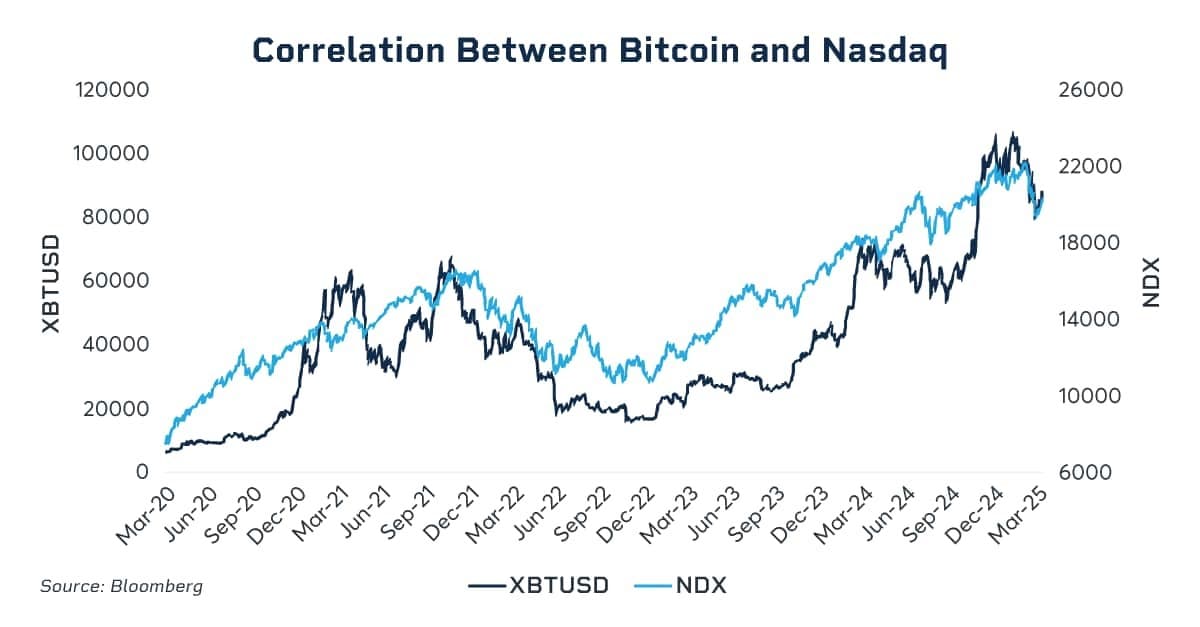
The second factor Iuorio points to is Bitcoin’s strong correlation with the Nasdaq, which he calls “a relationship that remains confounding to many traders but easily explained by others.”
“Many institutional trading desks often group volatile assets like the Nasdaq and bitcoin into the same portfolio, assuming a Nasdaq traders’ expertise in handling volatility equips them to manage bitcoin’s price swings,” he wrote. “Consequently, a sharp decline in the Nasdaq often triggers sales of Bitcoin to cover margin requirements.”
Turning to the gold price, which has moved in the opposite direction of Bitcoin during the first quarter, Iuorio said that the yellow metal’s outperformance has been driven by “a combination of economic uncertainty, rising inflation expectations and a shift in central bank policies.”
“Economic uncertainty has traditionally pushed investors toward gold as a safe haven, a trend that has clearly gained traction,” he wrote. “Additionally, the Federal Reserve's potential shift toward easing monetary policy, rather than tightening, has further bolstered gold's appeal.”
But a key driver of gold's recent gains – and one which was not present during Bitcoin’s last bull run - is burgeoning central bank demand, led by China, India and Russia.
“According to the World Gold Council, these central banks have been purchasing over 1,000 metric tons of gold annually over the past three years,” he said. “This accumulation reflects a strategic move away from holding reserves solely in U.S. dollars – a response to actions taken following Russia's invasion of Ukraine, which froze dollar-denominated assets and excluded Russia from the SWIFT payment network.”
Iuorio suggests that this gradual shift may have accelerated in the last few months due to the Trump administration’s aggressive trade and tariff policies, which are pushing key U.S. trading partners to diversify their reserves. “While the change is modest, it is significant: the share of dollar reserves among global central banks has dropped from over 60% in 2022 to 57% today,” he said.
Gold’s gains could also be coming from Bitcoin's losses, at least in part. “The total market capitalization of cryptocurrencies, estimated at around $2.8 trillion, has pulled money away from the more traditional dollar hedge of gold,” Iuorio wrote. “It would stand to reason that if bitcoin was in a period of weakness, perhaps investors seeking safety and stability might turn to gold, which has a history spanning thousands of years as a reliable store of value.”

Iuorio said the different histories of the two assets also cannot be overlooked. “Gold has been a store of value since ancient Egypt in 4000 BC, while Bitcoin's history dates back only to 2011,” he said. “Many argue that Bitcoin still has a long way to go before it can be considered a mature asset on par with gold. However, others contend that Bitcoin's rapid development in the digital age is unprecedented and that it is maturing at an accelerated pace.”
He concludes by saying that while both the top crypto and the yellow metal are viewed as hedges against uncertainty, “their distinct drivers and historical contexts have led to a breakdown in their previously tight correlation.”
“The recent divergence between gold and bitcoin highlights the complex interplay of economic, political and market forces,” Iuorio said.
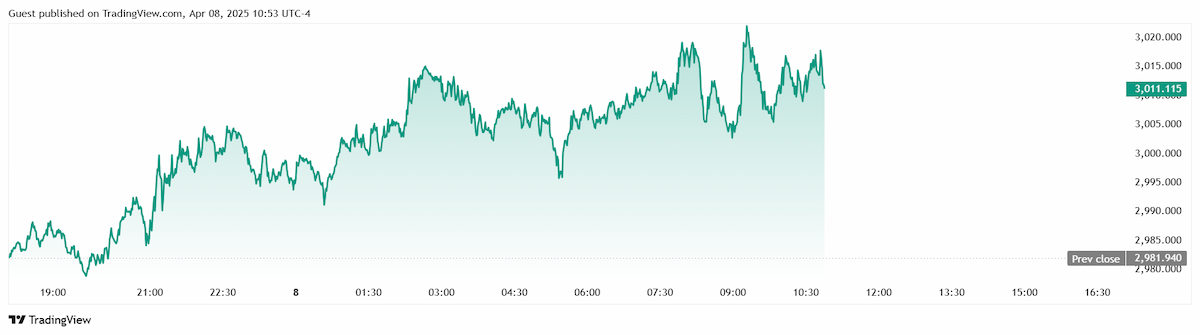
Gold prices have posted solid gains during Tuesday’s trading, with spot gold holding comfortably above the $3,000 level at the time of writing, last trading at $3,010.48 per ounce for a gain of 0.96% on the daily chart.
Meanwhile, Bitcoin is sliding to session lows, last trading at $78.651 for a loss of 0.61% on the session.

