
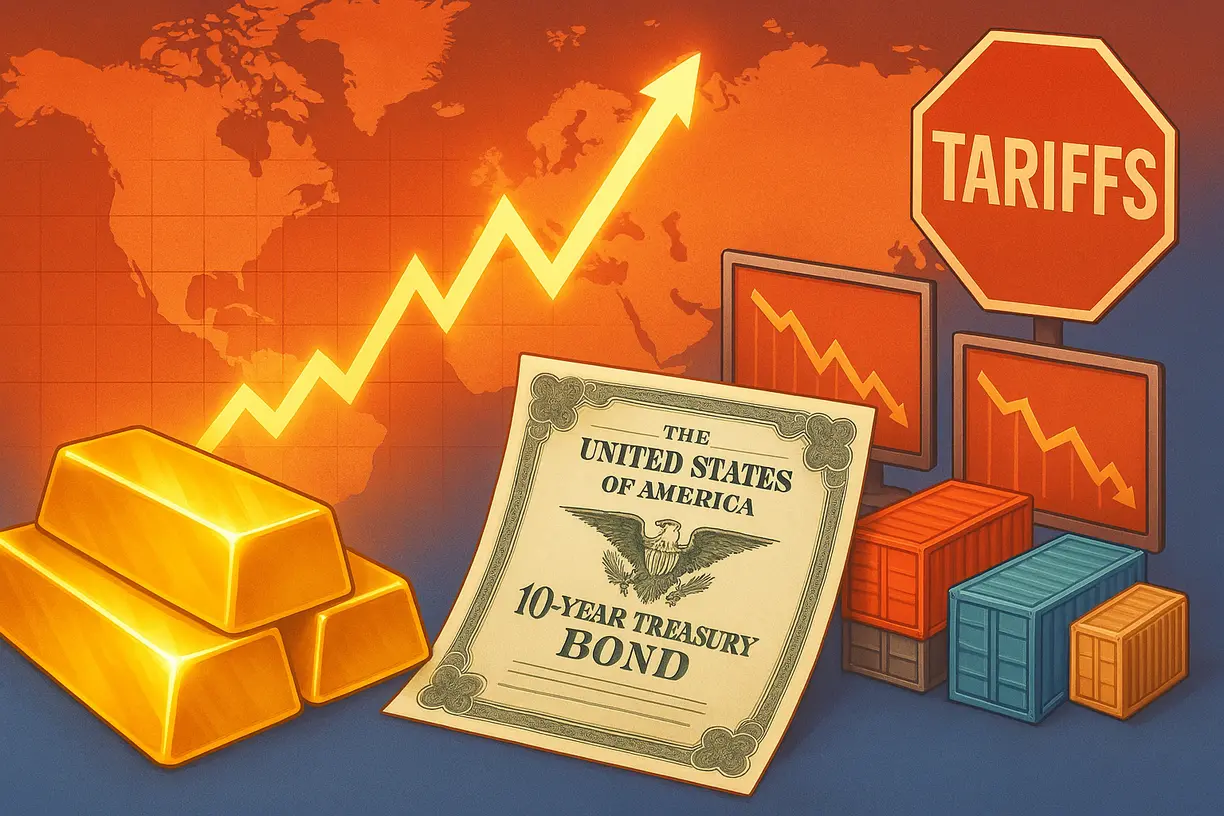
(Kitco News) - Gold is once again demonstrating its value as a safe-haven asset as both U.S. long-dated bonds and equities sell off as the global trade war continues to escalate due to President Donald Trump’s significant import tariffs.
Gold prices have managed to push solidly back above $3,050 an ounce as the U.S. bond market sees its worst sell-off in decades. May gold futures last traded at $3,078.30 an ounce, up more than 3% on the day.
In the latest trade war development, the U.S. government has started a tit-for-tat battle with China, which has hit America with an 84% import tax in retaliation for the U.S. increasing its Chinese import fees to a total of 104% on Tuesday.
Meanwhile, the European Union has also approved a fresh set of retaliatory duties on U.S. imports, ranging from 10% to 25% on more than $24 billion worth of U.S. goods. The European tariffs are expected to come into effect on April 15.
While equity markets have been free-falling since Trump’s initial announcement last week, analysts note that recent selling in the U.S. bond market should be more concerning for investors.
Although 10-year bond yields are off their overnight highs near 4.5%, they are still significantly elevated at 4.36%, up from 4.26% on Tuesday.
Lawrence Gillum, Chief Fixed Income Strategist for LPL Financial, said that a perfect storm is brewing in bond markets, and it’s creating a historic selloff.
“Sticky inflation, a patient Fed, potential foreign buyer boycotts, hedge fund deleveraging, rebalancing out of bonds into cash, and an illiquid Treasury market are all reasons why Treasury yields continue to move higher,” he said in a note. “Of the aforementioned reasons for the selloff, though, we would argue the larger cause is the unwinding of the basis trade and not foreign investors selling bonds to retaliate against tariffs since the selloff really began in earnest after the “fake news” about a 90-day delay in tariffs sent equity prices soaring. The bottom line, though, is that Treasury securities have not acted like haven assets yet.”
David Morrison, Senior Market Analyst at Trade Nation, highlighted concerns about the selloff in the bond market as yields have risen at their fastest pace in roughly 20 years.
“A benign explanation would be that investors have gone from expecting the Fed to cut interest rates (so yields fall) in response to falling economic growth, to increasing them as tariff-led inflation takes hold,” he said. “But even then, such a swift change in emphasis seems highly unusual. Instead, it could be something far more serious, including forced liquidations from overleveraged bond players (similar to the LTCM disaster in the 1990s), or an indication that recent market stresses have damaged the plumbing on which the financial markets are based.”
Meanwhile, gold prices have managed to recover from their recent selling pressure. Ole Hansen, Head of Commodity Strategy at Saxo Bank, said that he expects safe-haven demand to continue to support gold prices in the near term.
“Gold is currently the ultimate safe haven, together with JPY, EUR, and CHF, as worries about U.S. fiscal stability and rising inflation render U.S. Treasury bonds useless as a haven investment,” he said.
Hansen added that the current environment also supports gold’s long-term uptrend, as central banks continue to diversify away from the U.S. dollar.
“Even if we do see a lowering of tariffs, the damage to the bond market will be more permanent with fiscal debt worries and central banks ' demand being two major pillars of continued support,” he said.
In a comment to Kitco News, Alex Tsepaev, Chief Strategy Officer at B2PRIME Group, said that while gold prices will remain volatile, it's only a matter of time before they retest new all-time highs.
“In my opinion, gold will soon revive its rapid growth and even reach $3200. The current situation—high geopolitical tensions and the consequent economic instability—boosts the demand for gold. Moreover, there is increased discussion about the upcoming recession in the United States. As a hedging asset, this negative sentiment only feeds investors' appetite for gold. As long as these factors persist, interest in gold will only grow,” he said. “We are witnessing not a temporary shift amid uncertainty, but a persistent tendency.”
Some analysts have said that with bond markets selling off, the Federal Reserve might have to take extraordinary actions to calm markets, potentially announcing new quantitative easing measures along with additional rate cuts.
In this environment, analysts have said that gold would have an easy path to new record highs.
