
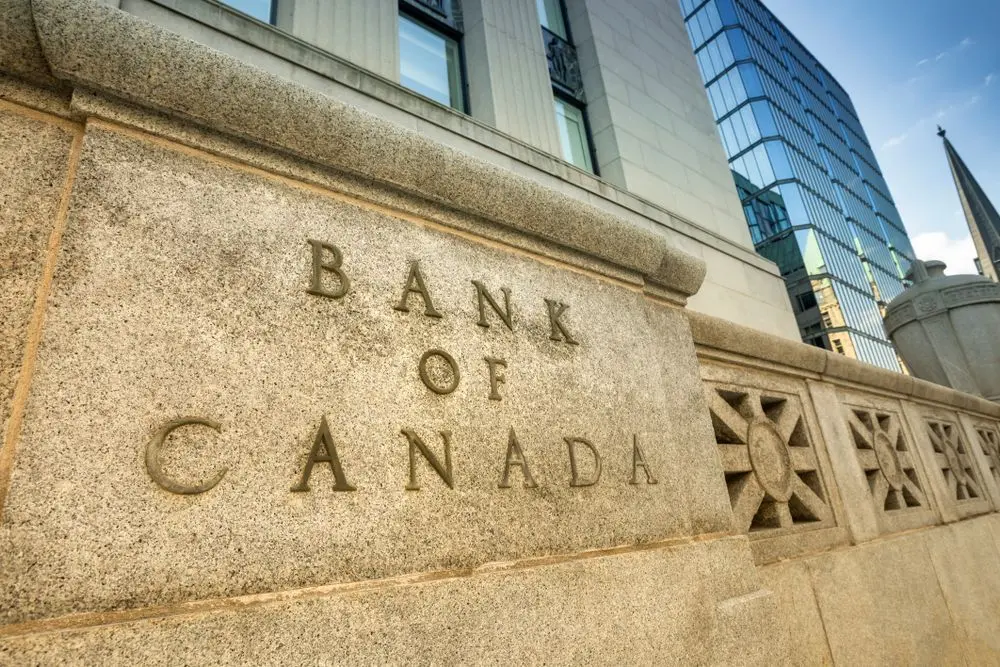
(Kitco News) – Spot gold rose above C$4,600 per ounce after the Bank of Canada held interest rates unchanged while warning about the impacts of a trade war with the United States.
As was widely anticipated, Canada’s central bank maintained its overnight bank rate at 2.75%. At the same time, the BoC signaled that trade tensions with the U.S. have made the policy environment far more uncertain.
“The major shift in direction of US trade policy and the unpredictability of tariffs have increased uncertainty, diminished prospects for economic growth, and raised inflation expectations,” the central bank said in its statement. “Pervasive uncertainty makes it unusually challenging to project GDP growth and inflation in Canada and globally.”
Spot gold gained against the Canadian dollar in the minutes after the rate announcement, last trading at C$4,601.18 per ounce for a gain of 2.10% on the day.

The BoC offered two potential scenarios regarding U.S. trade policy in the April Monetary Policy Report (MPR). “In the first scenario, uncertainty is high but tariffs are limited in scope,” it said. “Canadian growth weakens temporarily and inflation remains around the 2% target. In the second scenario, a protracted trade war causes Canada’s economy to fall into recession this year and inflation rises temporarily above 3% next year.”
“Many other trade policy scenarios are possible,” the central bank added. “There is also an unusual degree of uncertainty about the economic outcomes within any scenario, since the magnitude and speed of the shift in US trade policy are unprecedented.”
The BoC said the Governing Council will proceed cautiously, “with particular attention to the risks and uncertainties facing the Canadian economy. These include: the extent to which higher tariffs reduce demand for Canadian exports; how much this spills over into business investment, employment and household spending; how much and how quickly cost increases are passed on to consumer prices; and how inflation expectations evolve.”
“Monetary policy cannot resolve trade uncertainty or offset the impacts of a trade war,” they concluded. “What it can and must do is maintain price stability for Canadians.”
Speaking to reporters after the announcement, Bank of Canada Governor Tif Macklem said that U.S. tariffs will be particularly impactful on Canada’s economy because the negative impact on the U.S. economy will further harm Canada.
“Our economy is so integrated with the United States, the impacts are particularly strong,” he said. “The other element that's important for Canada in particular, because our economy is so linked to the United States, is actually what happens to the US economy. These U.S. tariffs, they're not good for the US economy either. In fact, in scenario two, the U.S. economy goes into a recession."
"If the U.S. economy goes into recession, that's going to further weaken demand for Canadian goods and services," Macklem said. "This is a huge deal for countries like Canada that are closely integrated with the United States."
