
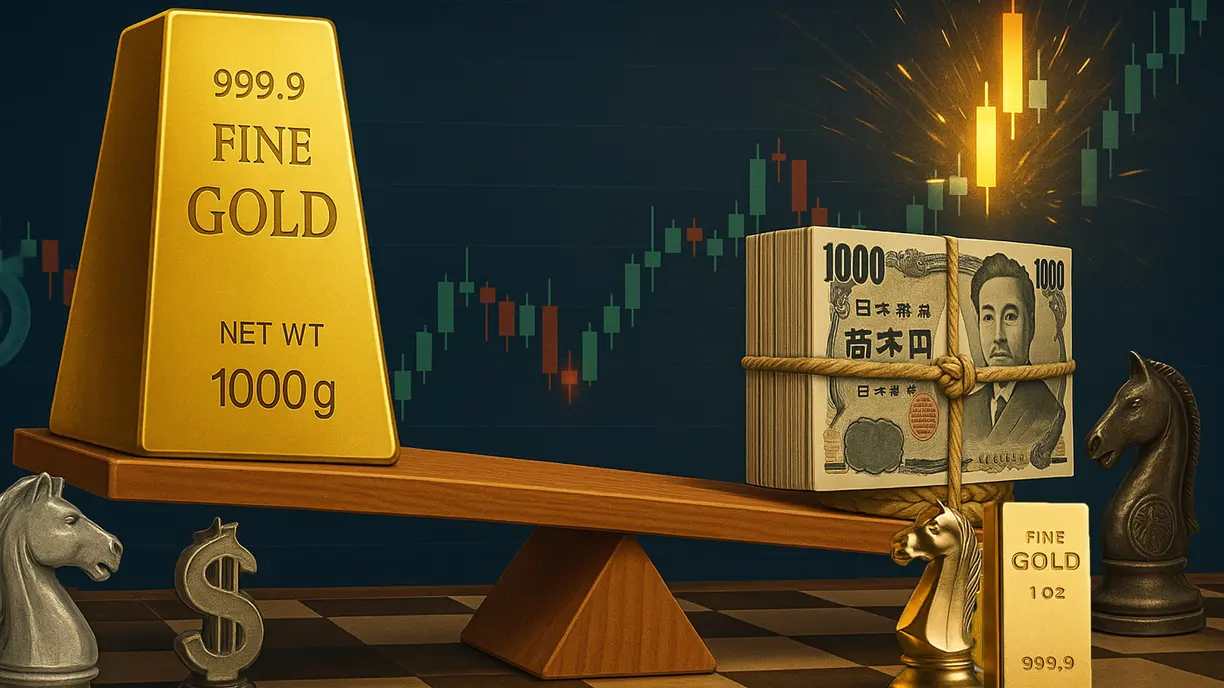
(Kitco News) - While unsustainable U.S. debt is causing some concern in the marketplace — and supporting gold — the entire global treasury market is in turmoil as the Japanese yen carry trade unwinds.
Yields on Japan’s long-dated 30-year bonds rose to a record high of 3.2% on Wednesday, following the government’s worst bond auction in decades.
Although Japanese yields remain low compared to U.S. bonds—with 30-year Treasury yields currently around 5%—Fawad Razaqzada, Market Analyst at City Index and FOREX.com, described the selloff as a “seismic shift” in the global marketplace.
“With inflation finally baring its teeth and the Bank of Japan slowly tiptoeing toward policy normalisation, the once-lucrative yen carry trade – borrow yen at zero and plough it into anything yielding more – could be coming undone again as we saw last summer,” he said.
In this environment, Razaqzada warned gold investors to “bucke up, something’s about to snap.”
The yen carry trade has been a significant force in financial markets since 1999, when the Bank of Japan began slashing interest rates. Investors borrowed yen at zero interest and used the capital to invest in higher-yielding assets.
While the trade peaked in 2024 as the Bank of Japan began raising interest rates, it’s estimated that the global economy has roughly $1 trillion in exposure. Rising inflation and higher bond yields are now causing this decades-long trade to unwind.
“The scale of these carry trades has been enormous,” said Axel Rudolph, Market Analyst at IG, in a note Wednesday. “As these positions unwind, we could see substantial currency fluctuations, with the yen strengthening against currencies of countries that have been recipients of Japanese investment. A sudden withdrawal of this capital could trigger liquidity problems and asset price declines in these markets, potentially cascading into broader financial instability.”
Rudolph also speculated that the unwinding of the carry trade could be a factor in rising U.S. bond yields as the U.S. 30-year bond trades at its highest level in two years.
Razaqzada said this environment bodes well for gold as a safe-haven asset.
“It should mean even higher demand for haven assets. Usually, the yen and gold move in tandem, so the recent developments in the Japanese bond market are potentially supportive for gold, even if higher yields have historically been associated with rising opportunity costs for non-interest-bearing assets,” he said.
Last year, gold prices rallied nearly $200 through August and September—from $2,400 to $2,600 an ounce—when the carry trade initially began to unwind.
Razaqzada noted that the unwinding of the carry trade could represent the first link in a chain of falling dominoes in the global treasury market.
“Japan, with its own crisis unfolding, holds a whopping $1.1 trillion in U.S. Treasuries,” he said. “If Tokyo is forced to defend its currency or shore up domestic markets by offloading these holdings, U.S. yields could spike just as America’s credit rating has taken a knock. In short, the world’s two largest debt markets are dancing on a knife’s edge.”
Looking at gold technicals, Razaqzada said investors need to watch initial support between $3,245 and $3,275 an ounce.
“Resistance comes in at $3,360, marking the short-term bearish trend. Above it, $3,400 and then the all-time high of $3,500 are the next key levels,” he said.
