
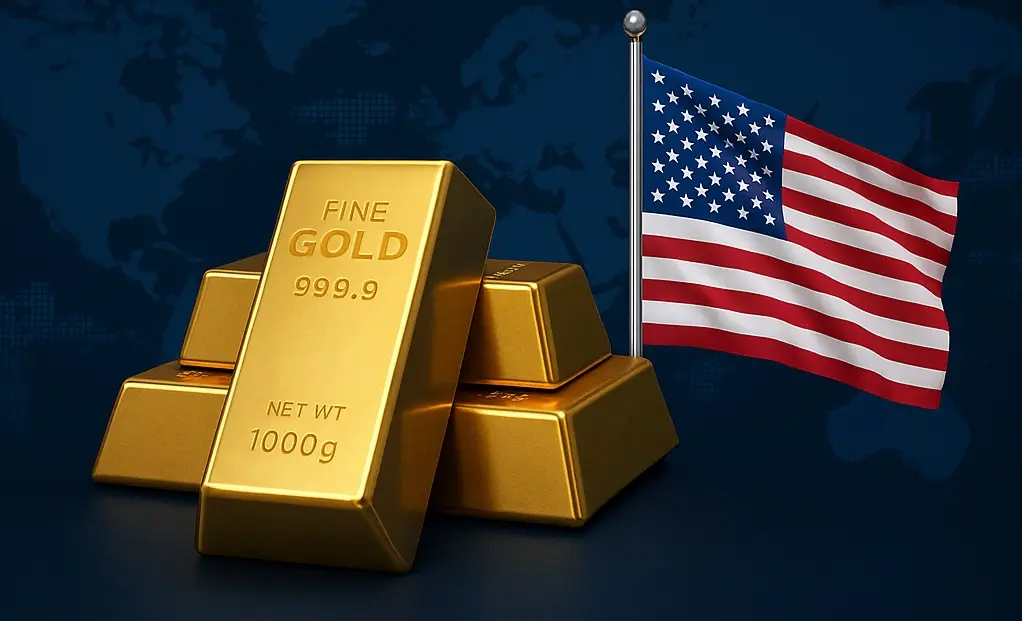
(Kitco News) - As President Donald Trump escalates the trade war with the threat of a new 50% tariff on European imports, a Washington-based think tank warns that such policies could drive nations toward gold.
In a recent opinion piece, Kimberly Donovan, Director of the Economic Statecraft Initiative, and Maia Nikoladze, Associate Director at the Atlantic Council, argued that countries—especially emerging markets—are turning to gold as a global currency to sidestep potential U.S. sanctions.

They also noted that governments concerned about provoking the U.S. are adopting gold-linked technologies to safeguard their economies.
“Countries are experimenting with gold-backed digital assets and trading systems that bypass the dollar-based financial system,” they wrote. “While many of these efforts are economically motivated, gold is also being used by U.S. adversaries to evade sanctions and finance activities that threaten U.S. national security. The rise of gold-backed currencies, coupled with sanctioned regimes’ growing use of alternative payment systems, could create major blind spots for U.S. financial intelligence and sanctions enforcement.”
Their comments come amid surging central bank demand for gold, which has dominated the market over the past three years. Since 2022, central banks have added over 1,000 tonnes to their reserves. While the pace has eased in 2025, World Gold Council data shows central banks purchased 243.7 tonnes in Q1—24% above the five-year average.
The economists pointed to Russia as a key example. Under heavy Western sanctions following its invasion of Ukraine, Russia appears to have fully embraced gold. Though the central bank’s official reserves haven’t grown significantly since 2020, the Finance Ministry is believed to be buying from domestic producers off the books. In 2021, it doubled gold’s share in the National Wealth Fund to 40%.
“Gold also plays a major role in Russia’s illicit trade,” they wrote. “For instance, the UAE—a BRICS+ member and global gold hub—and Turkey have exchanged cash for Russian gold. Lanta Bank and Vitabank, both based in Russia, received 21 shipments of currencies totaling $82 million from the UAE and Turkey in exchange for gold.”
But it’s not just gold as a reserve asset that should concern the U.S. and the G7. Donovan and Nikoladze argue that technological innovation could amplify gold’s role in global finance.
Governments are now emulating crypto firms. Earlier this month, Kyrgyzstan’s Finance Ministry announced plans to launch a gold-backed stablecoin, USDKG, in Q3 2025. Backed by $500 million in gold reserves—with plans to grow that to $2 billion—USDKG will be pegged to the dollar but fully backed by gold. Unlike stablecoins such as Paxos Gold or Tether Gold, it won’t track gold’s price. Instead, holders can redeem it for gold, other crypto assets, or fiat currency.
The goal is to streamline cross-border remittances, which account for a third of Kyrgyzstan’s GDP.
Kyrgyzstan’s move comes amid sanctions for facilitating transactions for the Russian bank Promsvyazbank. Donovan and Nikoladze warn that USDKG would operate outside U.S. financial oversight.
Unlike dollar-based stablecoins, gold-backed cryptos don’t rely on the U.S. financial system.
“Given Russian interest in exploiting Kyrgyzstan’s financial system to import restricted technologies, USDKG will likely appeal to sanctioned actors for its ability to bypass U.S. banking entirely,” they said.
To maintain its influence over global finance, the U.S. must reassert its role as a provider of stability, the economists concluded.
“That means reducing reliance on tariffs and economic pressure that push countries toward alternatives like gold,” they wrote. “At the same time, the U.S. should promote dollarization in vulnerable economies like Kyrgyzstan’s through financial support and deeper trade and investment ties.”
