(Kitco News) – Even as the U.S. dollar declined and the Treasury yield curve steepened, the Federal Reserve remained adamant that economic activity and the labor market remained strong and policy intervention was unnecessary, according to the minutes of the May Federal Open Market Committee meeting.
The minutes from the May 6-7 meeting painted a dramatic picture of economic and financial turmoil in the United States. “Amid significant market volatility over the intermeeting period, longer-maturity Treasury yields rose, broad equity price indexes changed little on net, credit spreads widened, and the dollar depreciated,” the report stated. “[M]arket participants appeared to interpret recently announced trade policy changes as a negative supply shock that could restrain domestic activity relative to foreign activity in the near term, and respondents to the Open Market Desk's Survey of Market Expectations “had materially lowered their gross domestic product (GDP) forecasts and raised their inflation forecasts for this year while significantly increasing the probability they placed on a recession occurring within the next six months.”
The minutes noted that the U.S. dollar “depreciated substantially against most major currencies, as the trade-weighted broad dollar index declined over 2 percent,” even as the Treasury yield curve “steepened materially, as short-term Treasury yields declined about 20 basis points over the intermeeting period while longer-term yields increased on net.”
“Measures of Treasury market liquidity deteriorated immediately after the announcement of higher-than-expected tariffs on April 2 and partially recovered later in the period,” the minutes said. “The deterioration in liquidity, however, was commensurate with the historical relationship between measures of market volatility and liquidity, and the Treasury market continued to function well.”
But despite the market turmoil, FOMC members noted that the available data “indicated that economic activity had continued to expand at a solid pace and labor market conditions continued to be solid,” even though “inflation remained somewhat elevated.”
The Trump administration’s trade tariffs figured prominently in the FOMC’s discussions. “Participants assessed that the tariff increases announced so far had been significantly larger and broader than they had anticipated,” the minutes said. “Participants observed that there was considerable uncertainty surrounding the evolution of trade policy as well as about the scale, scope, timing, and persistence of associated economic effects. Significant uncertainties also surrounded changes in fiscal, regulatory, and immigration policies and their economic effects. Taken together, participants saw the uncertainty about their economic outlooks as unusually elevated.”
“Overall, participants judged that downside risks to employment and economic activity and upside risks to inflation had risen, primarily reflecting the potential effects of tariff increases,” the report said.
In their discussion of financial stability at the May meeting, FOMC members “noted vulnerabilities to the financial system that they assessed warranted monitoring.”
“Some participants discussed the heightened volatility seen across a range of asset markets over the first half of April, noting that markets had continued to function and were able to accommodate a surge in trading volumes despite lower measures of liquidity,” the minutes said. “Several participants observed that resilience in the Treasury market was of special importance and had been a focus of attention for a number of years. Some participants commented on a change from the typical pattern of correlations across asset prices during the first half of April, with longer-term Treasury yields rising and the dollar depreciating despite the decline in the prices of equities and other risky assets. These participants noted that a durable shift in such correlations or a diminution of the perceived safe-haven status of U.S. assets could have long-lasting implications for the economy.”
In their discussion of monetary policy, Fed members noted that while inflation remained somewhat elevated, “recent indicators suggested that economic activity had continued to expand at a solid pace” while “labor market conditions had remained solid in recent months.”
“In this context, and amid a further increase in uncertainty about the economic outlook and a rise in the risks of both higher unemployment and higher inflation, all participants viewed it as appropriate to maintain the target range for the federal funds rate at 4-1/4 to 4-1/2 percent,” the minutes stated. “Participants agreed that uncertainty about the economic outlook had increased further, making it appropriate to take a cautious approach until the net economic effects of the array of changes to government policies become clearer.”
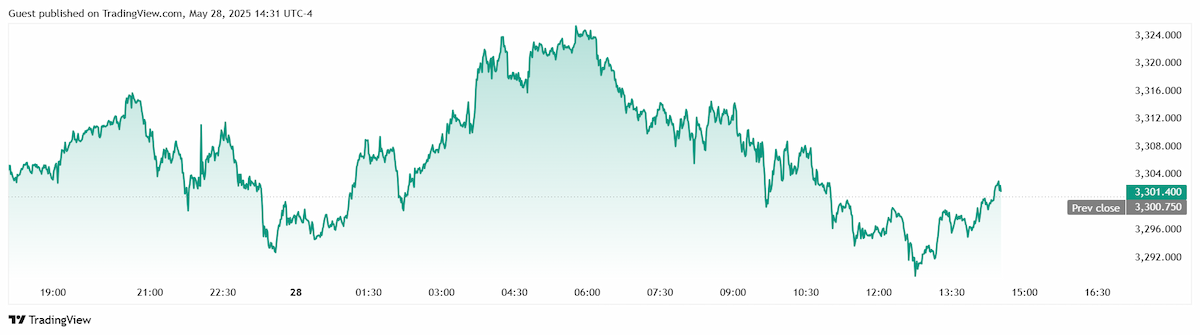
Gold prices turned positive and retook the $3,300 level following the 2 p.m. EDT release, with spot gold last trading at $3,301.70 per ounce for a slight gain of 0.03% on the session.