
(Kitco News) – Even though economic anxiety has helped drive gold to record highs, and the long-term bullish drivers remain in place, the yellow metal’s massive rally calls for caution on the part of investors, according to a report from Fidelity.
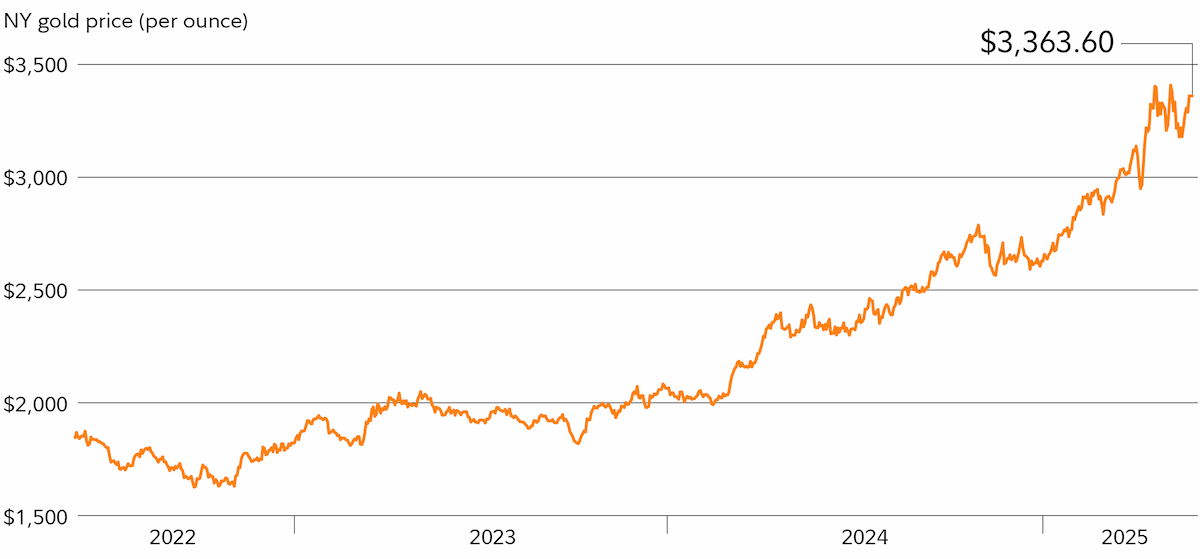
“The beginning of this latest golden age for gold stretches back to the fall of 2022, when it was trading near $1,670 per troy ounce. Since then, gold prices have roughly doubled,” the report noted.
While demand has been strong across the board during the current rally, gold purchases by central banks outside of the Organization for Economic Cooperation and Development (OECD) have been particularly significant.
“There’s been a shift away from the dollar by some central banks that’s helped increase gold purchases to over 1,000 metric tonnes per year from 2022 to 2024,” said Boris Shepov, co-manager of the Fidelity Select Gold Portfolio (FSAGX). “For instance, the largest central bank buyer of gold in 2024 was Poland, who bought 90 metric tonnes. I see elevated gold purchasing by these non-OECD countries as likely to continue.”
Fidelity also pointed to China, the world’s largest consumer of gold, where gold demand reached an 11-month high despite near-record bullion prices. “Total Chinese gold imports hit 127.5 metric tonnes in April, according to customs data,” the report noted. “The domestic demand was so strong that China’s central bank was prompted to ease restrictions on bullion inflows.”
Ongoing concern about the health of the U.S. and global economies is also pushing gold prices higher over the longer term. “Lingering recession worries over the past couple years contributed to ‘safe-haven’ gold buying that helped gold surmount the technically significant $2,000 price level (which many chart users think acted as a resistance point for much of the early 2020s),” Fidelity said. “As US recession risks have grown—the latest of which was US GDP swinging to a contraction in Q1 and credit rating agency Moody’s cutting the US credit rating from ‘Aaa’ to ‘Aa1’—the rally has accelerated, pushing gold past $3,000.”
The report noted some historical parallels between the current rally and others over the past 50 years, but it also highlighted some key differences.
In the late 1970s, widespread inflation propelled gold prices from around $100 to over $800 by the end of 1979. “Gold prices climbed largely due to investors’ expectation that real assets might hold their value better than others amid historically high inflation,” the report said. “While the late 1970s inflation was driven by an energy crisis, the inflationary regime of the past several years has been more widespread.”
During the runup to the 2008 financial crisis, investors fled riskier investments for perceived safe-havens like gold and the U.S. dollar. “ this most recent gold boom, the US dollar has actually weakened—especially so this year,” the report noted. “Gold and the dollar have historically had a mostly inverse relationship: Gold tends to fall when the dollar strengthens and it tends to rise when the dollar weakens.”
The post-financial crisis years in the 2010s saw gains for gold, but the environment was atypical. “After stocks hit rock bottom in March 2009, they began a bull run more than a decade long as economic conditions gradually improved,” Fidelity said. “At the same time, gold prices also steadily climbed: Gold increased from under $900 in 2010 to over $1,500 by the beginning of the 2020—perhaps coinciding with a substantial increase in global money supply over the same period.”
And when the COVID-19 pandemic struck in the spring of 2020, gold prices shot higher in the following months, but peaked in August 2020 before trending sideways for a couple of years. “Global money supply increased dramatically during the pandemic and the pace of that growth substantially slowed in recent years,” the report noted.
By contrast, the current gold bull market has shown sustained momentum through multiple all-time highs. “Gold prices started to gain steam in the fall of 2022, and once they surmounted $2,000 in late-2023, a mostly uninterrupted run has pushed the precious metal’s price well past $3,000,” Fidelity wrote. “It’s now trading near record highs above $3,300, as of late May 2025.”
Ryan Oldham, who co-manages FSAGX with Shepov, believes that given gold’s dramatic recent gains, investors should manage their short-term expectations.
“I do think investors should be careful at these prices, as gold may be a little ahead of the real-rates-driven fundamentals,” Oldham said. “To me, there are two primary countervailing forces at work: Inflation and real rates on one side and a potential US dollar reorientation among some investors on the other.”
Shepov also thinks it’s important for gold investors to maintain perspective. “I think the long-term path for gold prices is higher,” Shepov said. “Increasing money supply and fiscal deficit issues are long-term gold drivers. But it’s important to remember that gold can be a volatile asset that routinely experiences 10% to 15%+ corrections.”
