

(Kitco News) – Global central banks bought a net 12 tonnes of gold in April, 12% lower than the previous month and also below the 12-month average of 28 tonnes, the World Gold Council (WGC) announced on Tuesday.
“What could be behind this recent decline in monthly purchases? It may, in part, be a response to the rapid appreciation in the gold price since the start of the year,” suggested Krishan Gopaul, WGC Senior Analyst, EMEA, in the report. “While the rally to multiple new record highs is unlikely to deter central banks from buying gold – as they tend to be more strategic in nature – it could explain some of the deceleration in the pace of monthly net buying.”
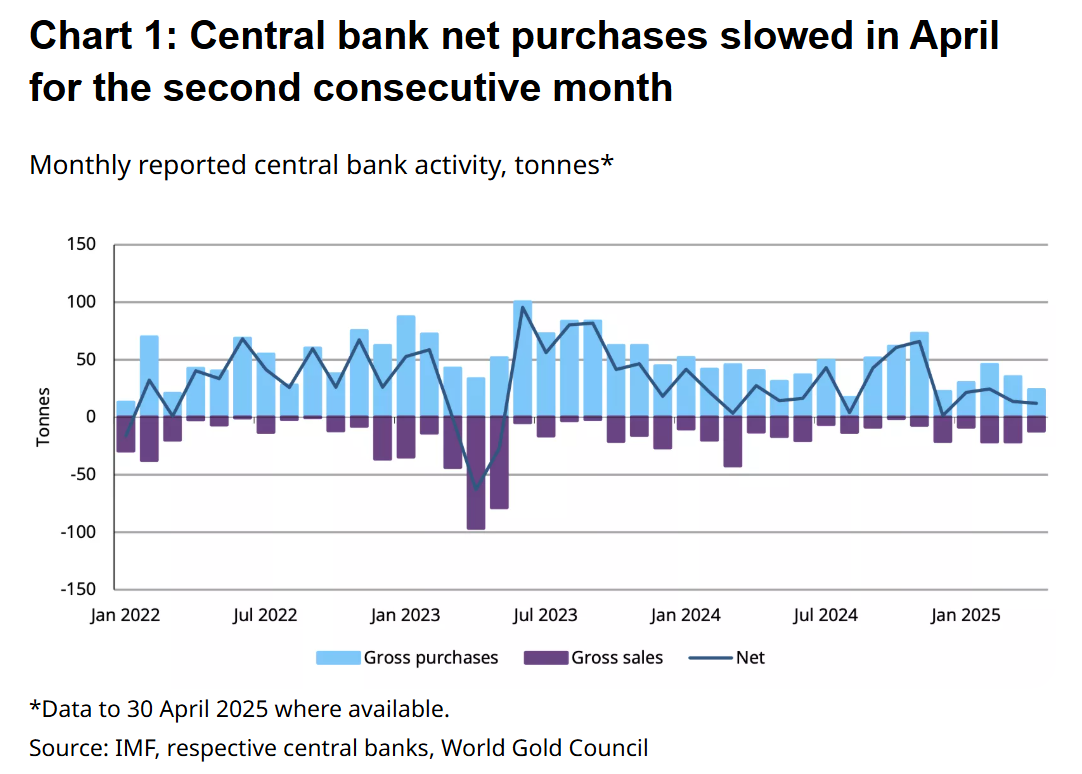
“As the chart above shows, the data series are very volatile, meaning that activity in one month is not necessarily an indication of activity in subsequent months,” he said. “What’s more, data can be released with, at times, a significant lag. As such, we caution against reading too much into this recent slowdown in reported purchases. And while higher prices may have pushed up gold allocations in some central bank portfolios, possibly closer to targets, we still expect overall buying to continue, given that the economic and geopolitical outlook remains highly uncertain.”
Poland once again led all central banks in gold purchases in April, one of five countries reporting changes of one tonne or more to their gold reserves.
“In April, the NBP added a further 12t to its gold reserves, lifting them to 509t, higher than gold reserves at the European Central Bank (507t),” Gopaul noted. “Since the start of the year, NBP gold reserves have increased by 61t, two-thirds of the 90t they added in 2024.”
The Czech National Bank increased its gold reserves by three tonnes in April. “It has now added gold for 26 consecutive months, over which time it has bought a total of 47t,” he said. “Total gold holdings were nearly 59t at the end of April.”
Next was the People's Bank of China, with data showing it increased its gold reserves by two tonnes in April, marking the sixth consecutive month of purchases. “Y-t-d net purchases now total 15t, helping to lift gold reserves to 2,294t,” Gopaul noted.
The Central Banks of Turkey and Kyrgyzstan also each reported a two tonne increase in official gold holdings during the month, while the National Bank of Kazakhstan added one tonne to its gold reserves, and the Central Bank of Jordan increased its gold reserves by almost one tonne.
“Central Bank of Uzbekistan gold reserves fell by 11t in April, the third consecutive month of sales around that level,” he wrote. “Y-t-d total gold holdings have fallen by 26t, to 356t.
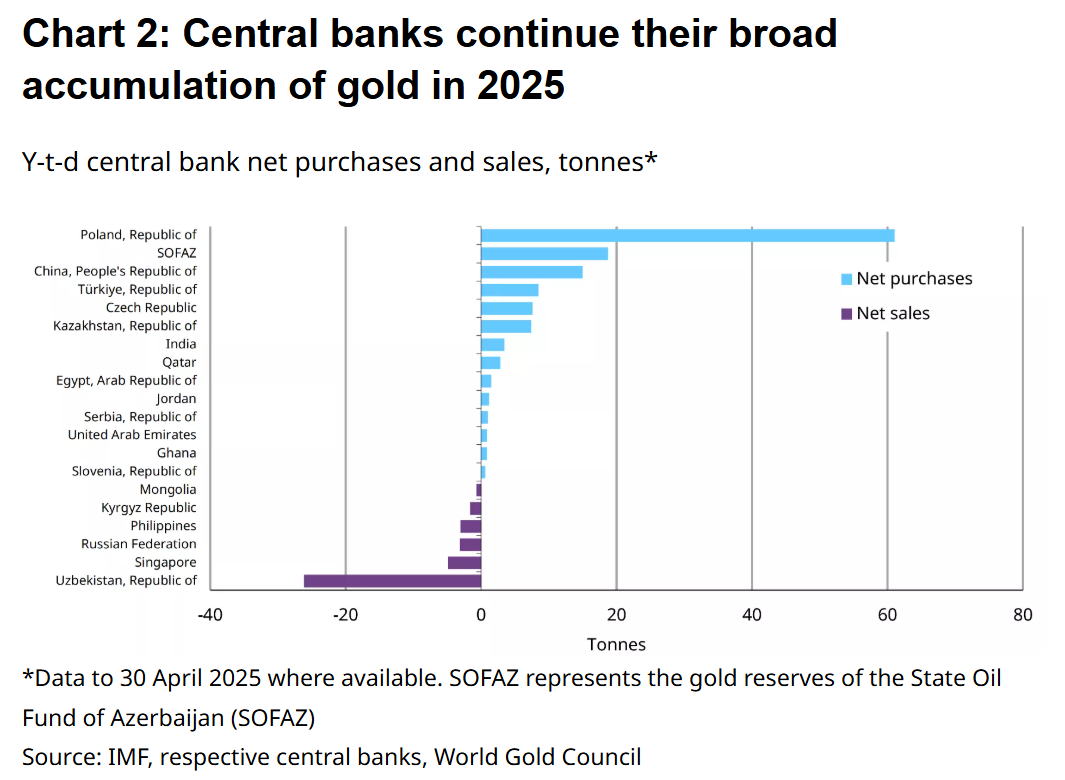
“On a y-t-d basis, central bank buying continues to be broad-based, although confined to emerging markets and dominated by the National Bank of Poland,” Gopaul noted. “By comparison, sales are less widespread, but similarly dominated by a single bank.”
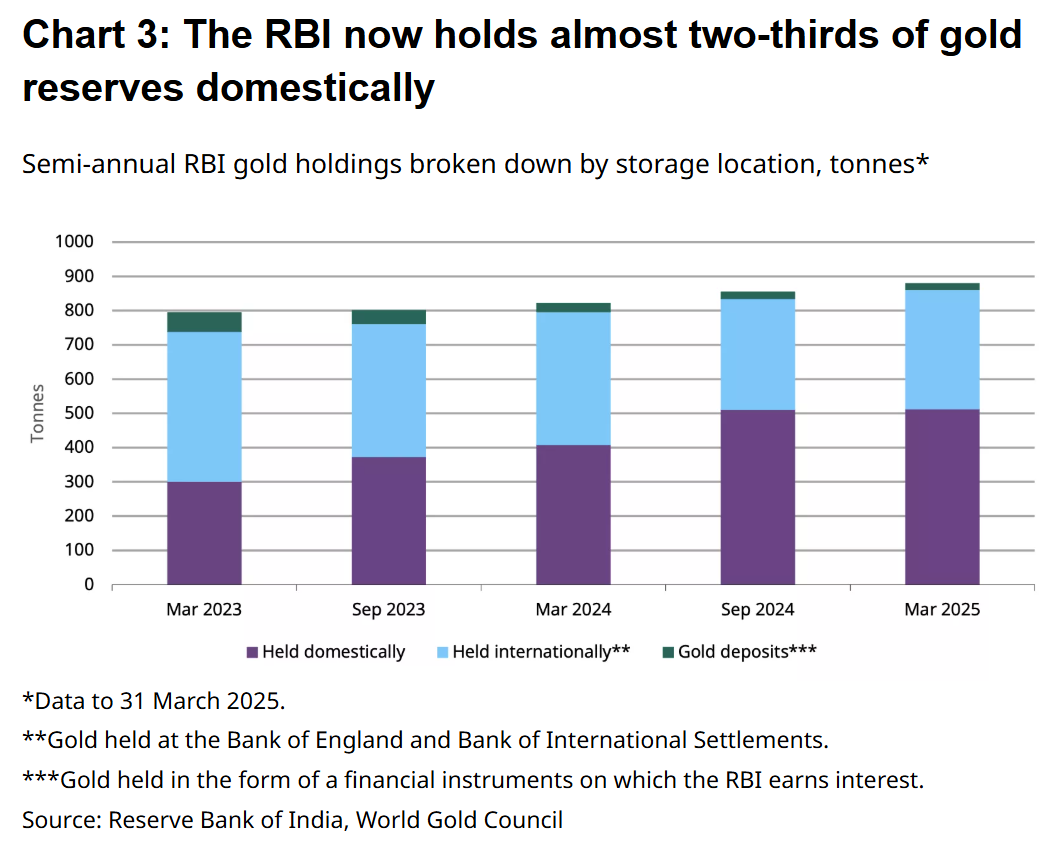
And while the Reserve Bank of India (RBI) maintained its gold reserves at 880 tonnes in April, it did issue a detailed update on its reserves. “In its half-yearly report the RBI stated that 512t (58%) was held domestically at the end of March, slightly higher on a tonnage basis (510t) but lower on a percentage basis (60%) compared to six months earlier,” he said. “The RBI has made significant efforts in recent years to store a higher proportion of its gold reserves domestically – just two years ago it reported that only 38% of its gold reserves were held in India.”
A number of African central banks announced plans to boost their gold reserves going forward as well.
“At the start of May the Bank of Namibia announced plans to accumulate gold with the aim of increasing it to 3% of total reserves,” Gopaul said. “The bank stated that this ‘aligns with global central banking trends, given gold’s strategic value in hedging against inflation and enhancing resilience during economic shocks.’” According to the latest available IMF data from March 2019, Namibia’s central bank held no gold reserves.
The National Bank of Rwanda also announced last month that it intends to build gold reserves. “Similar to our peers, the central bank of Rwanda is conducting a study to see whether gold can be embraced as an additional asset that we can invest in given its ability to counter shocks on financial markets and as a hedging option in terms of external shocks,” Governor Soraya Hakuziyaremye told the media. The central bank will commence purchases beginning in its new fiscal year in July.
Bank of Uganda Governor Michael Atingi-Ego also told Bloomberg TV in May that they would be diversifying their reserves with gold sourced from domestic artisanal miners. “The aim was to use this gold accumulation to deal with maturing (cross currency) repos,” Gopaul said.
The Central Bank of Madagascar also indicated that “it will acquire 4t of gold as part of a plan to boost reserves and formalise gold exports,” he noted, “while Central Bank of Kenya Governor, Kamau Thugge told the media in April that they are “actively considering” adding gold to their reserves for diversification purposes, though no timeline was announced.
