
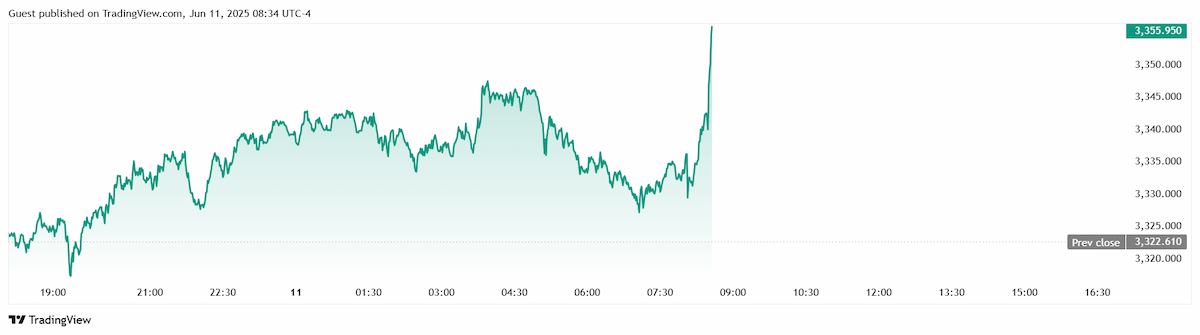
(Kitco News) - The gold market is trading at season highs above $3,350 per ounce after U.S. inflation pressures fell more than expected last month.
The Consumer Price Index (CPI) rose by 0.1% last month after April’s 0.2% increase, the U.S. Bureau of Labor Statistics announced on Wednesday. The inflation data was cooler than expected, as economists were looking for a 0.2% increase.
The report noted that headline inflation rose by 2.4% over the last 12 months, following the 2.3% reported in April. Economists had expected annual inflation to rise by 2.5%.
Core CPI, which strips out volatile food and energy prices, increased by 0.1% last month, also coming in cooler than expected, as economists had forecast a 0.3% increase in core consumer prices following April’s 0.2% rise.
The report stated that annual core inflation rose by 2.8% last month. Economists were expecting to see annual inflation rise by 2.9%.
The gold market shot to session highs above $3,350 following the latest inflation data. Spot gold last traded at $3,356.14 per ounce, up 1.01% on the day.
U.S. inflation has become a complicated issue for the gold market. Elevated consumer prices are forcing the Federal Reserve to maintain a neutral monetary policy, keeping rates unchanged, which increases the opportunity costs of holding gold. However, high inflation is also increasing the risks that the U.S. could fall into a recession, which is supporting safe-haven demand for the precious metal.
Weaker inflation data give the Federal Reserve room to cut interest rates, while it also eases fears of stagflation.
“The index for shelter rose 0.3 percent in May and was the primary factor in the all items monthly increase,” the report noted. “The food index increased 0.3 percent as both of its major components, the index for food at home and the index for food away from home, also rose 0.3 percent in May. In contrast, the energy index declined 1.0 percent in May as the gasoline index fell over the month.”
The report noted mixed inflation pressures in core consumer prices. The shelter index increased 0.3 percent over the month, while the index for owners' equivalent rent rose 0.3 percent in May and the index for rent increased 0.2 percent. The lodging away from home index fell 0.1 percent in May.
“The medical care index increased 0.3 percent over the month, following a 0.5-percent increase in April,” the report noted. “The index for hospital services increased 0.4 percent in May and the index for prescription drugs rose 0.6 percent. The physicians' services index fell 0.3 percent over the month.”
The motor vehicle insurance index also rose 0.7 percent in May, after rising 0.6 percent in April.
"Surprisingly, new and used vehicle prices declined in May, despite many expecting an increase in prices from tariffs," wrote Jeffrey Roach, Chief Economist for LPL Financial in a comment to Kitco News. "Bottom Line: Prices for apparel and autos, both highly sensitive to trade conditions, declined in May. Apparel prices also declined in April, indicating that these companies likely absorbed tariff costs. But don’t expect that to continue."
Eric Teal, Chief Investment Officer for Comerica Wealth Management, told Kitco that despite sticky inflation, tariffs have yet to show up in consumer prices. "But a lot depends on the absorption rate of U.S. companies and foreign suppliers," he said. "We believe that the majority of the tariffs will eventually get passed to the consumer, but companies are cautious at this juncture about passing along the price increase."
Jamie Cox, Managing Partner for Harris Financial Group, noted that shelter and energy should keep the disinflation trend intact. "Prices are moving down in two of the largest categories, so investors should expect further declines in inflation in the coming months," he said.
