
(Kitco News) – After gold’s sustained rally to a succession of all-time highs over the last two years, silver prices have finally started to break out over the last two weeks. And the unresolved market distortions between New York and London could see the gray metal hitting new highs of its own before long, according to Daniel Ghali, senior commodity strategist with TD Securities.
“Right now, the silver market is buzzing with excitement because prices broke through $35 an ounce,” Ghali said. “That's been very difficult to break through over the last several years. The last time silver prices broke through this level, we traded $50 an ounce within six weeks, so of course, the excitement is building.”
“We think this has been a long time coming,” he added. “And we think the current market structure favors these kinds of mini-squeeze events going forward.”
Ghali said that silver’s sharp move higher was caused in part by an imbalance between the major trading hubs in London and New York.
“The breakout itself, when we crossed through that $35 an ounce level, was a futures-led breakout,” he said. “This contrasts with what you might expect, given that we're now five years running into a structural deficit. That deficit has eroded physical inventories, and you would expect such a breakout to be led by the physical side. That hasn't been the case, and as a result, it suggests more speculative activity in silver markets, which [makes it] more difficult to forecast what might occur as a result.”
But even though the breakout was futures-led, Ghali said it might represent a psychological shift in the physical market. “The fact that last time we broke through this level, we rallied very substantially thereafter might start to attract subsequent ETF inflows,” he said. “Those ETF inflows are increasingly draining what little is left in the world's largest bullion vaulting system for silver out of London. You have to think about this massive imbalance that has occurred as a result of the threat of tariffs earlier this year. A tidal wave of metal moved from London into New York because the relative prices between New York silver and London silver incentivize that move.”
“We're now left with a market structure in which London is critically scarce,” Ghali said. “There's less silver that is freely available for purchase in London than is typically traded on any given day, and meanwhile, you have this oversupply in New York. And yet, London markets aren't pricing that scarcity, and the markets as a whole aren't pricing the incentives required for the metal to flow back to where it's actually physically traded.”
“This structure, we think, is going to catalyze a series of rolling mini squeezes, as we've called them, that should support a higher trend in prices.”
Turning to the demand side, Ghali said it remains strong as well.
“Demand is doing just fine,” he said. “The one thing that I will say since the threat of the trade war became more apparent is that most analysts out there expected a downturn in demand for raw materials, a downturn in the global economy, and we've not seen any sign of that just yet. Our proprietary gauge of broad commodity demand growth is now at the same levels that it was prior to Liberation Day. It's hard to know whether that's being unduly influenced by stockpiling and front-loading of demand, because the world still remains uncertain how the tariff outlook will evolve. But for the time being, demand is doing absolutely just fine.”
As for what silver might do in the weeks and months ahead, Ghali sees one of three potential scenarios unfolding.
“One is the imbalance isn't resolved,” he said. “That's the current state. In the current state, because physical silver is mostly traded out of London, and there is a lack of availability, then firstly, the market will become increasingly illiquid, such that any demand for physical out of London will have a bigger impact on the price.”
Ghali warned this could result in London’s available silver supply becoming increasingly concentrated among fewer market participants. “Again, that fuels more illiquidity, and that's really what drives our view of rolling mini squeezes going forward.”
The other two scenarios involve different ways that the market could incentivize the flow of silver from New York back to London.
“One is you have to create an increase in supply of futures,” he said. “It would catalyze this transportation arbitrage [because] of London prices being higher than New York prices. The interesting part about that is that we just went through a major liquidation event. Speculators – whether they're algorithmic traders, discretionary traders – in the aftermath of Liberation Day, we saw large-scale, massive liquidations from those cohorts, and that wasn't enough to catalyze the supply of futures required for this to occur.”
“The third option is, ultimately, a rise in the price of London [physical silver] relative to the [U.S.]futures,” Ghali said. “And that goes back to our view of this successive series of rolling mini squeezes that are actually probably required to address this imbalance.”
Regardless of which scenario eventually plays out, Ghali sees silver prices gaining another 10% in 2025. “We forecast higher silver prices on the horizon,” he said. “We think that we could trade $40 an ounce before the end of this year.”
Silver has traded in a relatively wide range on Wednesday, with multiple sharp selloffs, but each retest of support near $36 has held.
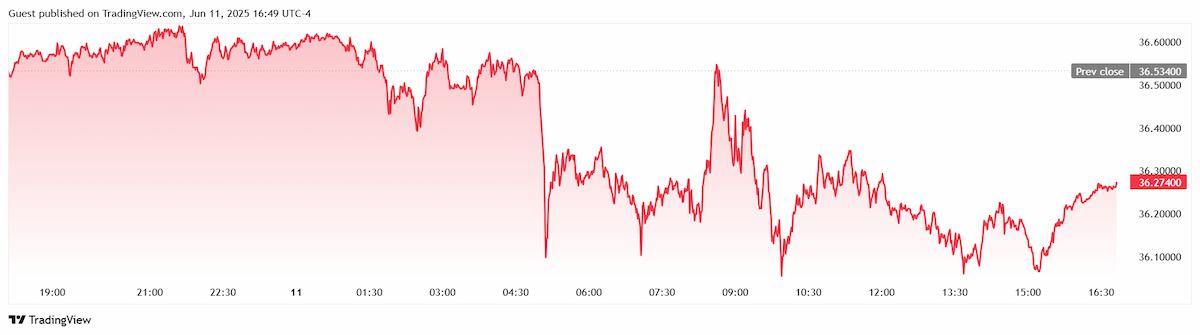
Spot silver last traded at $36.274 per ounce for a loss of 0.71% on the daily chart.
