
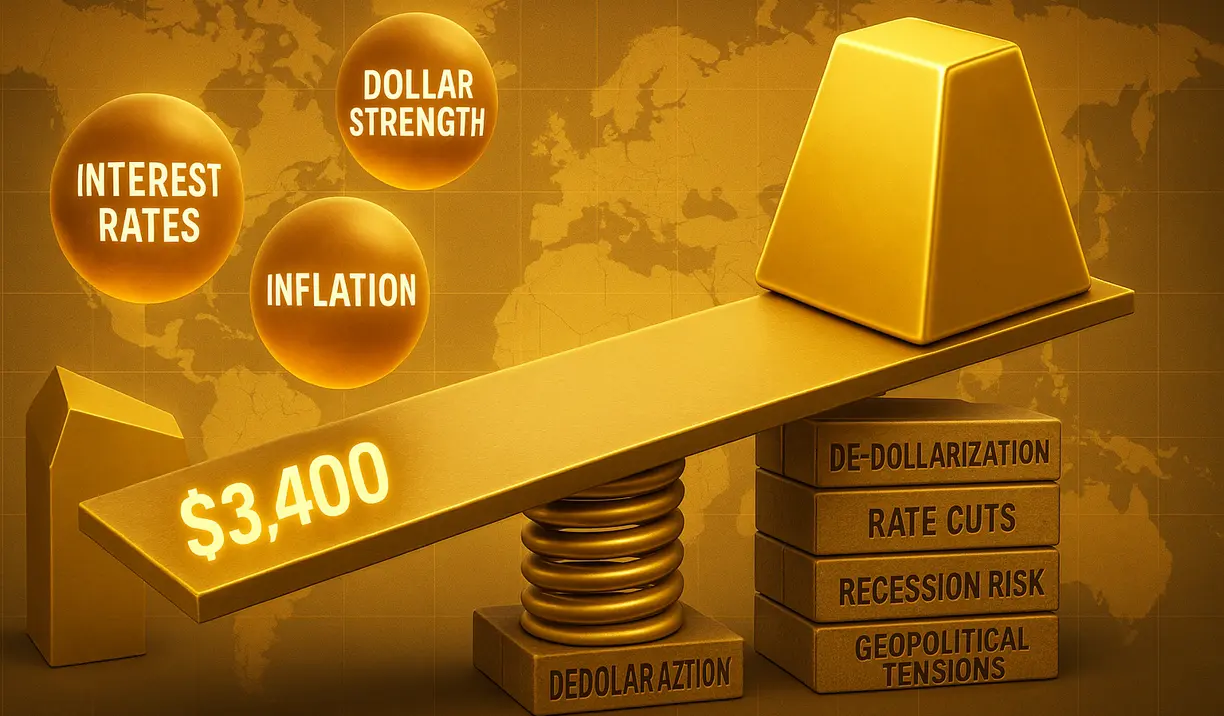
(Kitco News) - Gold prices have broken out above initial resistance at $3,400 an ounce but continue to consolidate well below April’s all-time highs of $3,500 an ounce. Looking beyond near-term volatility, one strategist says the precious metal will continue to benefit from bullish cyclical and structural forces through the second half of 2025.
In a recent interview with Kitco News, Roukaya Ibrahim, Commodity Strategist at BCA Research, said their model portfolio continues to maintain an overweight position in precious metals, including silver and platinum. However, gold remains the key asset, as all three are experiencing robust momentum.
While silver and platinum have been quickly catching up to gold, Ibrahim noted that the yellow metal still holds a significant advantage in the precious metals space, having reestablished itself as an important monetary asset amid global efforts to diversify away from the U.S. dollar and Treasuries.
Ibrahim explained that persistent inflation risks, driven by unsustainable government debt, are helping to reduce gold’s opportunity cost as a non-yielding asset. At the same time, she pointed out that renewed geopolitical uncertainty—stemming from President Donald Trump’s elevated tariffs and a global trade war—has created an additional tailwind for gold, alongside persistent demand.
“We are seeing a high correlation between stocks and bonds, and that is creating upside pressure for gold as investors look for new diversification tools,” she said. “In this environment, gold is positioned to benefit in several different scenarios.”
Ibrahim explained that if the “Sell America” trade continues—as nations lose faith in the U.S. as a reliable trading partner—gold will remain an attractive safe-haven asset. But she also noted that if this trade fizzles out and tariff concerns diminish, the Federal Reserve would have room to cut interest rates, further reducing gold’s opportunity cost.
“Right now, I struggle to see a scenario where gold moves significantly lower,” she said.
Although gold was significantly overbought in April, when momentum pushed prices to $3,500 an ounce, Ibrahim said the current consolidation period has helped remove some froth from the market and brought prices closer to fair value.
She added that, given the prevailing uncertainty, she sees a solid floor forming at $3,000 an ounce.
While there are some concerns that a rate cut could spur renewed investment in equities and draw interest away from gold, Ibrahim views this as a limited risk.
The Montreal-based research firm sees elevated risks of a recession, which Ibrahim said implies that when the Federal Reserve does cut rates, it will be out of necessity.
“The Fed is going to cut rates, but it’s going to be in response to weakening growth conditions. That environment is, of course, negative for equities. We are actually quite bearish on the outlook for equities because of the growth outlook,” she said.
Ibrahim also expressed bullishness on gold as the market navigates a critical inflection point. Since late 2022, gold’s price rally has largely been driven by unprecedented central bank demand. Official gold reserves have risen by 1,000 tonnes in each of the past three years, with expectations for another 1,000-tonne increase in 2025, marking a fourth consecutive year of strong reserve growth.
Ibrahim said this demand has created real value in the marketplace, which investors are just beginning to recognize.
“Not only are we seeing a pickup in investment demand, but it’s coming as prices continue to trade near their record highs,” she said. “Even with gold prices above $3,000, investors continue to see value in this market. With everything happening in the global economy—whether you’re a central bank or a private investor—people are starting to recognize gold’s role as an important diversification tool.”
