(Kitco News) - Conflict has once again erupted in the Middle East following Israel’s attacks on Iran. Surprisingly, however, the global economy has remained relatively unshaken, as financial markets have not responded in the way one might have predicted—an outcome that could carry significant implications for gold moving forward.
As expected, Israel’s preemptive strike triggered a selloff in equity markets and a spike in oil prices. At the same time, safe-haven demand pushed gold prices to their highest level since April’s all-time record high of $3,500. Yet the biggest surprise is that bond yields and the U.S. dollar have barely moved.
The gold market is ending the week with a 3.7% gain, while the U.S. dollar appears poised to close the week with a 1% loss, trading at its lowest level in roughly three years.
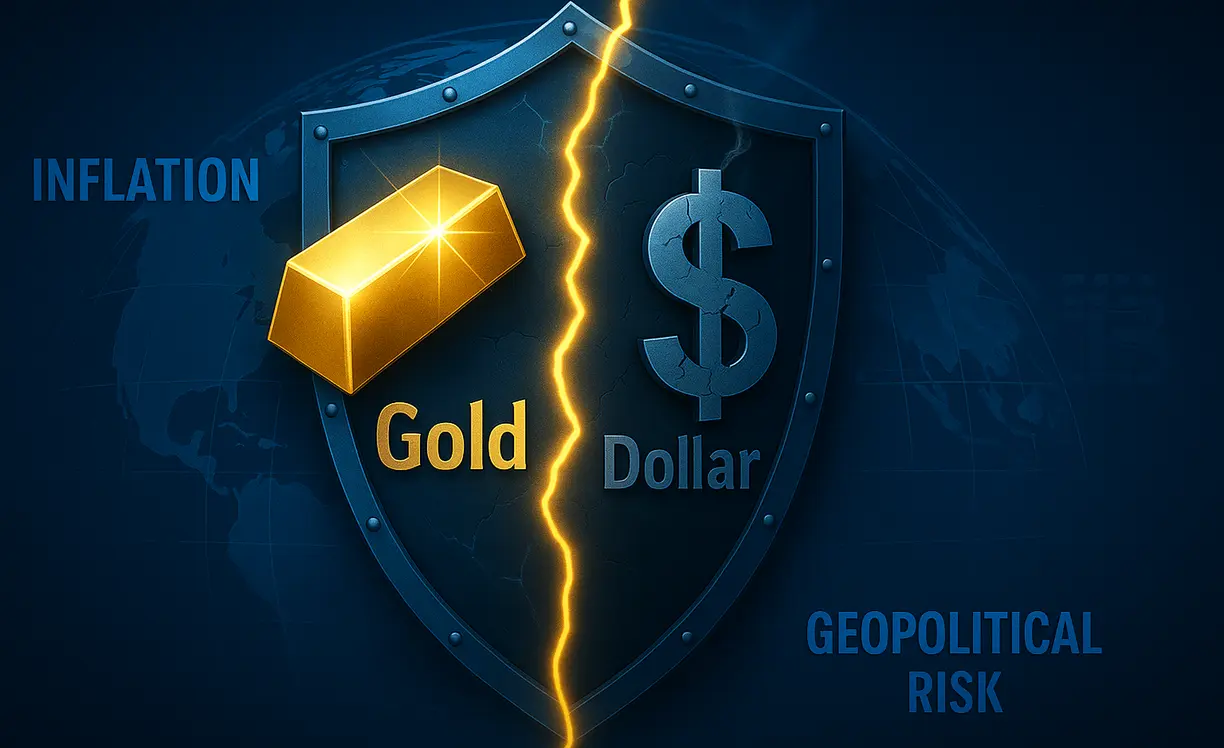
This weakness in the U.S. dollar is surprising given the current environment. The U.S. economy is generally viewed as a stable anchor for the global economy. When fear rises, investors traditionally seek safe assets to preserve capital—typically U.S. dollars and Treasuries, long considered top-tier safe-haven assets. In such scenarios, safe-haven demand typically drives both the U.S. dollar and gold higher in tandem.
This time, however, gold appears to be climbing alone. Over the past few months, markets have increasingly questioned America’s reliability as a trading partner. Since President Donald Trump’s ‘Liberation Day,’ investors have been reluctant to buy U.S. debt, anticipating that the trade war will lead to higher inflation and slower growth. The global economy has suffered trillions in losses as bond yields rose from 3.98% before April to current levels of around 4.42%.
We are now beginning to see the real consequences of this erosion of faith in the United States. As fear escalates, there are fewer perceived safe harbors. Gold continues to shine as the most attractive safe-haven asset—free from geopolitical third-party risk.
In a world where old certainties are unraveling, gold isn’t just a hedge against inflation or volatility. It’s becoming a refuge from a system in flux.
That said, while gold remains a compelling long-term alternative monetary asset, investors should be cautious about chasing the market at current levels.
The issue with these event-driven breakouts is that momentum often fades quickly once tensions ease or market attention shifts elsewhere. The key risk next week is that this renewed turmoil could stoke inflationary pressures, which may prompt the Federal Reserve to maintain its neutral stance.
But that’s a conversation for another day. For now, I hope you have a safe and happy weekend.

Neils Christensen
Neils Christensen has a diploma in journalism from Lethbridge College and has more than a decade of reporting experience working for news organizations throughout Canada. His experiences include covering territorial and federal politics in Nunavut, Canada. He has worked exclusively within the financial sector since 2007, when he started with the Canadian Economic Press. Neils can be contacted at: 1 866 925 4826 ext. 1526 nchristensen at kitco.com @KitcoNewsNOW

Disclaimer: The views expressed in this article are those of the author and may not reflect those of Kitco Metals Inc. The author has made every effort to ensure accuracy of information provided; however, neither Kitco Metals Inc. nor the author can guarantee such accuracy. This article is strictly for informational purposes only. It is not a solicitation to make any exchange in commodities, securities or other financial instruments. Kitco Metals Inc. and the author of this article do not accept culpability for losses and/ or damages arising from the use of this publication.