
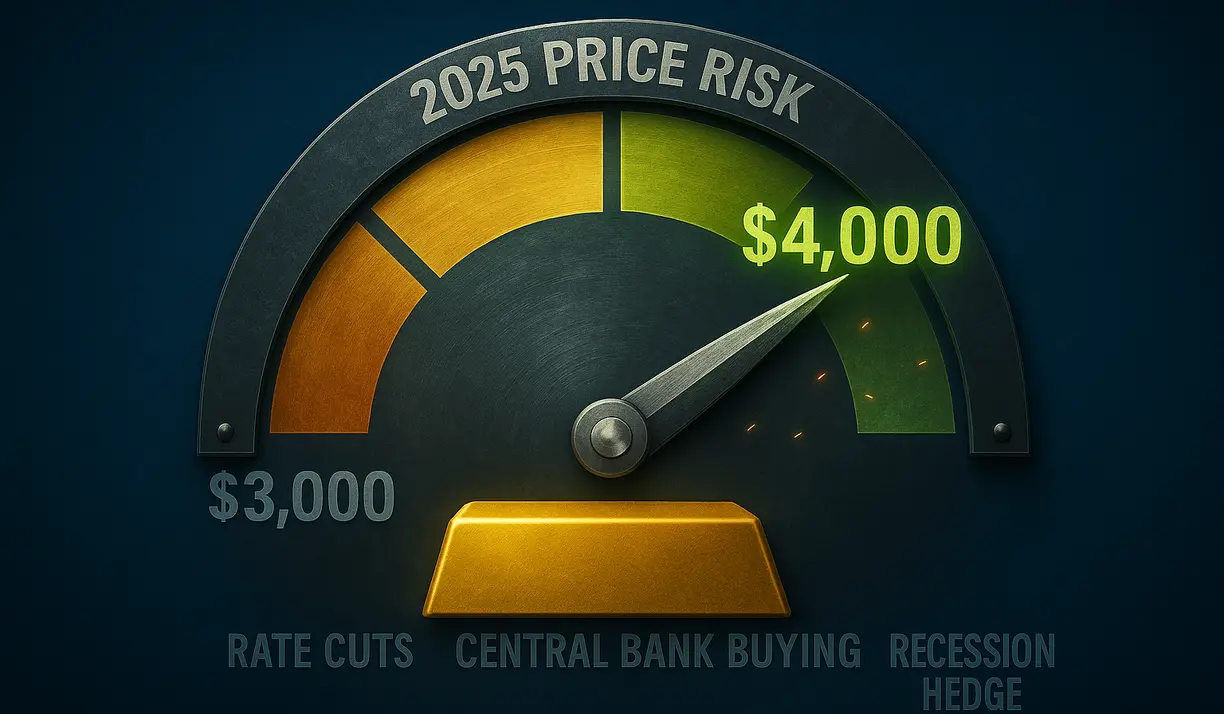
(Kitco News) - With a growing number of market participants looking toward a price target of $4,000, investors should get comfortable with gold above $3,000 an ounce, as that could now be the new floor in the marketplace, according to one analyst.
In a recent interview with Kitco News, Aakash Doshi, Head of Gold Strategy at State Street Global Advisors, explained that major financial crises effectively set new floors beneath the yellow metal.
Doshi said the 2008 global financial crisis established a foundation for gold above $1,000. Then 2020 COVID-19 pandemic lifted that floor to $2,000, and the emergence of a new monetary regime, driven by deglobalization, has raised the floor further to $3,000.
These comments come as State Street publishes its mid-year outlook. Doshi’s base-case scenario calls for gold to consolidate at current elevated levels, ranging between $3,100 and $3,500 an ounce. However, he added that a strong case is building for his bullish scenario, which sees gold prices reaching $4,000 within the next six to nine months.
“Gold is right now asymmetrically skewed bullish,” he said. “What I mean by that is, I think the next $500 to $1,000 move is more likely to be higher than lower—or at least, the odds of being flat or higher over the next six to 12 months are much greater than moving lower.”
Doshi noted that economic uncertainty and geopolitical instability make gold an attractive safe-haven asset. Simultaneously, as global debt continues to rise at an unsustainable pace, gold has become an essential monetary instrument.
In its report, State Street highlighted that global debt hit a record $324 trillion in Q1 2025, with nearly 30% on government balance sheets—an all-time high.
“There has been a shift in demand from investors and others for alternatives to fiat currencies, and we believe gold is part of that story. It is the original alternative to fiat,” he said.
“We are at an inflection point—I wouldn’t call it a breaking point—but an inflection point in how investors perceive debt and term premium risk in various bond and currency markets,” he added. “That favors alternatives such as gold.”
In this environment, the first segment of the gold market Doshi is watching is central bank demand. State Street expects central banks to purchase roughly 900 tonnes of gold this year. While this is down from last year’s 1,000 tonnes, it remains well above the historical average.
Central bank buying has supported gold’s price rally over the past three years. But according to Doshi, investors are now reentering the market—particularly through gold-backed exchange-traded funds (ETFs). In Q1, gold-backed ETFs saw a notable surge in inflows; however, Doshi pointed out that demand is still well below the record levels set in 2020.
He explained that what makes gold appealing to generalist investors is the broader cyclical shift in the marketplace. No major government is currently taking steps to rein in its deficits. At the same time, the fragmentation of global trade threatens economic growth and may drive inflationary pressures higher.
Although his base case does not call for a recession this year, Doshi emphasized that the risk cannot be ignored.
“Recession risks today are much higher than they were at the beginning of the year,” he said. “Because of these elevated risks, there’s going to be a higher uncertainty premium—and that’s supportive for gold. I don’t think we’re going back to the euphoria we saw in December or January.”
As for what could push gold above $3,500 and toward $4,000, Doshi said investors should watch the Federal Reserve. Even if the U.S. avoids a recession, slowing economic growth may compel the central bank to cut interest rates as many as two times before the end of the year.
