
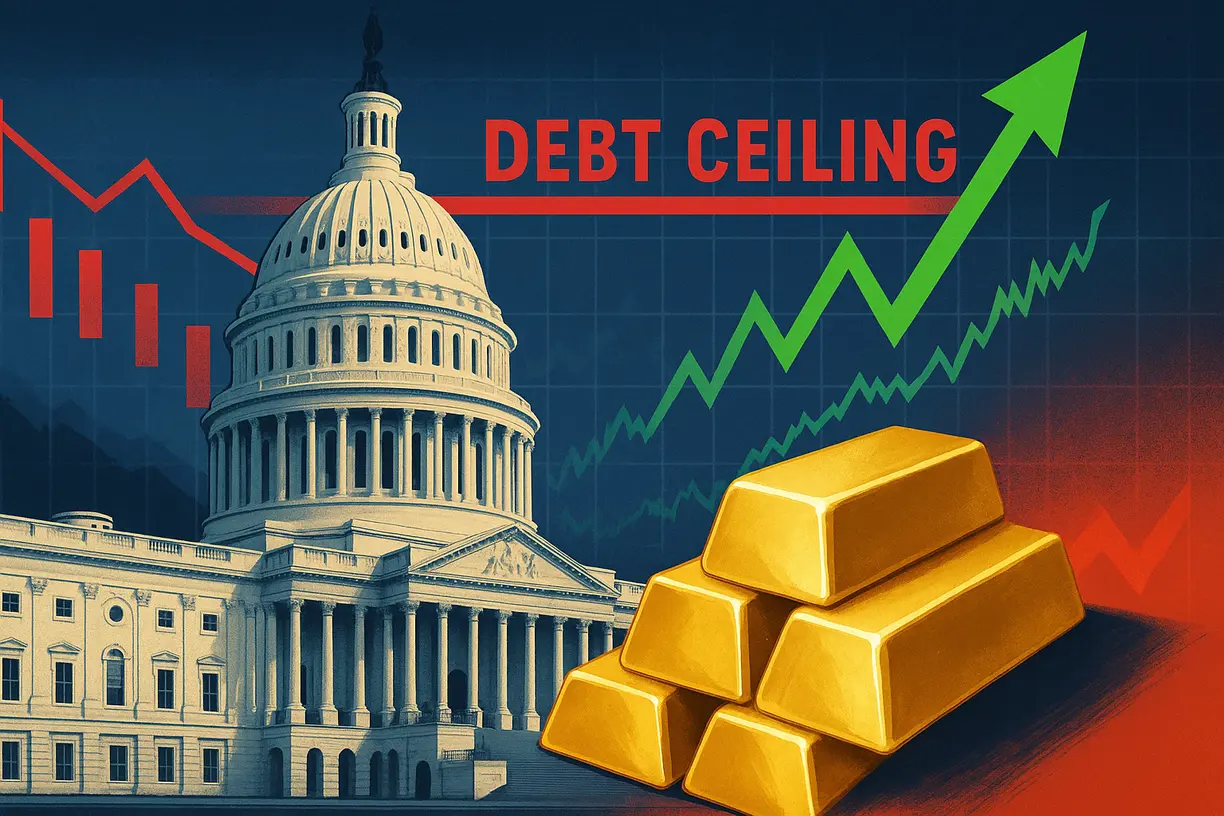
(Kitco News) – While the attention of the world is fixed on the Israel-Iran conflict, geopolitics has once again proven a fickle driver for gold prices, with the yellow metal sliding back below $3,400 per ounce on Monday.
According to Adrian Day of Adrian Day Asset Management, the critical countdown for precious metals markets isn’t for a nuclear deal in the Middle East, but for a debt deal in the United States.
“The U.S. Treasury is facing a funding crisis, because the debt ceiling hasn't been raised yet, and because the Biden administration left the incoming Trump administration with literally an empty cupboard,” Day said in an interview with Kitco News. “On the Friday before Trump was sworn in, [Biden Treasury Secretary Janet] Yellen gave an interview saying that we're going to hit the debt ceiling on Tuesday. Basically, ‘Good luck, Trump.’”
Day said that as a result, there has been no net new Treasury issuance to date in 2025.
“The only Treasury issuances we've had have been Treasuries that are maturing, so if $100 billion matures, then they go out and issue $100 billion. But they haven't been able to do any more than that, and they're running out of tricks. They're talking about the reserve requirement for banks being reduced, but a quid pro quo is that instead of putting the money on deposit with the Fed, they'd turn around and buy Treasuries with it.”
“Now we're not even at that point yet, because the Treasury isn't even able to issue new Treasuries.”
Day said this situation puts the Treasury Department in a very difficult position, as they now face two challenges going forward.
“One is, at the moment, they can't issue any,” he said. “But even when they can issue them, the question still remains: Who is going to buy them? Because official foreign buyers are not buying longer-term Treasuries at the moment – I mean anything over 10 years.”
And the longer new Treasury issuance is delayed, the worse it will be if and when the ceiling is finally raised.
“When they do have that capacity to issue new bonds, there's a shorter window in which to issue them, which means they'll be issuing many more over a shorter period of time rather than spreading it out over the whole year.”
This means there won’t be enough demand to fetch higher prices, which means yields will rise further, which in turn makes the debt servicing payments even worse, in a vicious cycle.
“The punchline is, the Fed is obviously going to go back to QE [Quantitative Easing],” Day said. “I think there's very little doubt to that.”
Day said the roots of this crisis go back to the Obama years, when the U.S. essentially had lower bound rates of essentially zero percent.
“The US never went to negative rates like Japan, but short-term Treasury bills were paying an eighth of a percent or something stupid,” he said. “And during that timeframe, countries like Austria, Italy, even Argentina were able to issue 100-year dollar-denominated bonds at less than 8%. Now, if Argentina – which has defaulted, what, five, six times in the last hundred years? – if Argentina can issue 100-year bonds at less than 8%, what would the U.S. have had to pay? 3.5% or 4%? Wouldn't that look pretty darn good today, if we'd issued 100-year bonds at 4%?”
“I think it was criminally irresponsible not to do that,” Day added. “But of course, as always, politicians are short-term oriented, so they preferred to issue the short end of 0.25% or 0.50% than come up with 100-year bonds at 4%.”
“That’s why we are where we are today. We don't have that option anymore.”
Day said that while Trump might get the blame for the debt crisis, this one is not on him. “There's enough we can blame him for, so let's not blame him for things that aren't his fault,” he said. “This funding crisis is something that's been building for more than a decade now.”
But with no good options left, Day said they're going to try every trick in the book.
“Some of it will be political, like persuading in quotes JP Morgan to buy some long-term Treasuries,” he said. “This is all linked with Trump's Mar-a-Lago Accord for a global monetary reset. One of the ideas in that program is, we'll give you defense if you buy bonds, but if you don't buy our bonds, don't expect our defense.”
“There's going to be a multi-pronged attempt, and all sorts of tricks and persuasions are going to be used to try to get people to buy bonds.”
Day said that a whole year's world of issuance could be compressed into six months, if not less.
“If the last administration had difficulty selling long-term bonds when they were spread out over a whole year, it's going to be extremely difficult to sell those bonds in half a year,” he said. “And that's assuming they get the debt agreement, which I think is by no means a certainty. They were talking about having it done by July 4th; that was their optimistic case. If they don't actually get it done till the end of August, which is when the crisis hits, then you’ve got September, October, November, December, four months instead of 12. That's a huge amount of bonds in a short period of time.”
Day said that while he doesn’t see any chance that the United States actually defaults on its debt, just the threat of it would be enough to send gold prices into the stratosphere.
And even if the debt ceiling is raised in time, he thinks gold will still rally if the Fed is again forced to act as the buyer of last resort.
“If the U.S. were to come close to a default, as has happened a couple of times in the past, that in and of itself will be very bullish for gold,” he said. “But if the debt ceiling is raised and they start issuing 10- and 20-year bonds, and even some 30-year bonds, and the Fed turns out to be the major buyer, that is wildly bullish for gold. QE is just wildly bullish for gold because it's pumping money into the economy and setting off an inflation spiral.”
“Let's say they do raise the debt ceiling,” Day warned. “Let's say the Treasury issues the bonds, and the auctions, let's say it all goes well… but then we find out that it's not China buying, it's not Japan buying, it's not U.S. pension funds, but the big buying is coming from the Fed. I think that's going to be very bullish.”
