
(Kitco News) - The gold market continues to consolidate at elevated levels, but near-term downside risks are growing as sentiment remains extremely bullish, raising concerns among some fund managers.
According to the latest Bank of America Fund Managers Survey, 41% of respondents said that “long gold” is currently the most crowded trade in the marketplace for the third consecutive month. However, sentiment has declined from its peak in May.
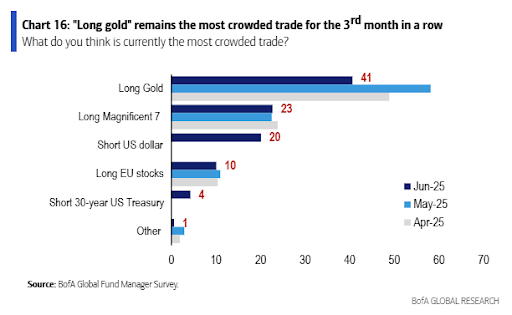
Meanwhile, 20% of fund managers identified the “short dollar” trade as the third most crowded position in global markets.
In this environment, the survey indicated that the top contrarian trade is now to go long on the U.S. dollar and short on gold.
Although the short-term outlook for gold is negative, 13% of fund managers believe the yellow metal will remain one of the best-performing assets over the next five years. Nonetheless, a majority—54%—said international stocks will be the top-performing asset during that period.
The cautious sentiment around gold emerges as overall investor confidence in the broader market improves. Fund managers are reducing their cash holdings and perceiving a lower risk of recession.
The survey noted that investor sentiment has risen to a three-month high as recession fears have significantly declined. Only 36% of participants said they expect the U.S. economy to fall into a recession, down from 44% in April. At the same time, 66% foresee a soft landing, while 13% anticipate a hard landing and 16%—an eight-month high—see no landing at all.
Despite near-term speculative risks, the survey highlighted some potential long-term positive trends for gold. Among those surveyed, 59% do not expect the U.S. government’s funding bill—which includes new tax cuts aimed at boosting economic activity in the second half of the year—to pass. However, 81% expect the government budget deficit to increase.
Analysts have noted that gold prices remain well supported, as rising government debt heightens inflationary pressures and undermines the value of the U.S. dollar.
While the U.S. dollar index is significantly undervalued—trading near a three-year low—many commodity analysts argue that gold has little to fear from renewed bullish momentum in the greenback. The negative correlation between gold and the U.S. dollar has weakened in recent years, as many nations have diversified away from the dollar and into gold.
Last week, commodity analysts at Bank of America reiterated that gold still has a path to $4,000 per ounce this year, as investors remain concerned about the government’s growing deficit.
“Market concerns over fiscal sustainability are unlikely to fade, regardless of the outcome of Senate negotiations,” the analysts said in the report. “Rates volatility and a weaker USD should then keep gold supported, especially if the U.S. Treasury or the Fed is ultimately forced to step in and support markets. As such, while wars and conflicts are usually not sustained price drivers, we see a path for gold to rally to $4,000/oz over the next 12 months.”
Although gold has been considered a crowded trade over the past three months, historically it has not consistently been on investors’ radars.
At the same time, some analysts argue that gold still has room to grow, as holdings in gold-backed exchange-traded funds (ETFs) remain well below the record highs reached in 2020.

