
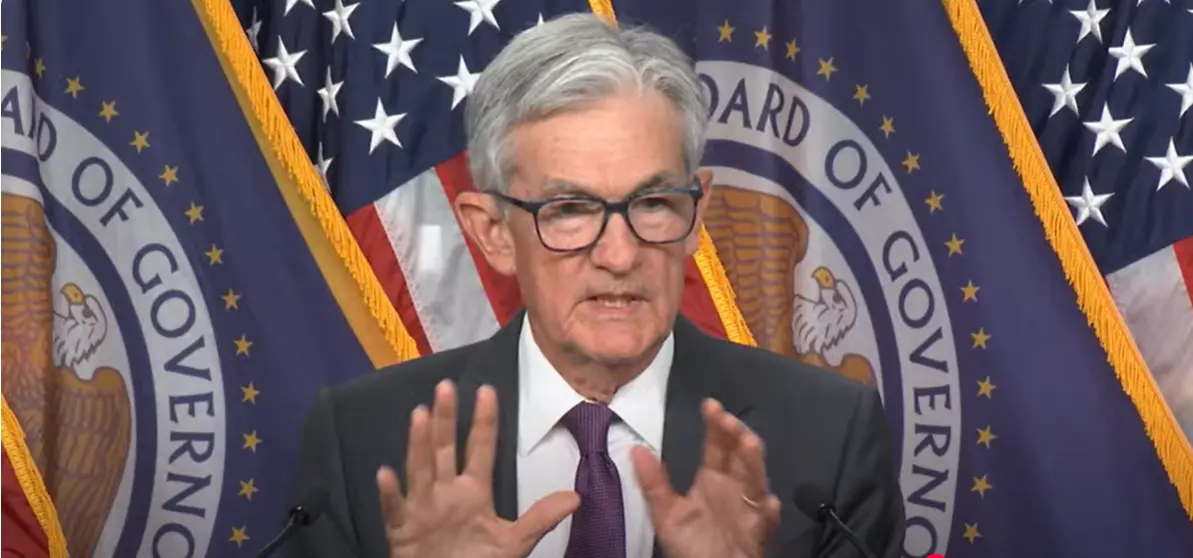
(Kitco News) – With the Federal Reserve once again maintaining interest rates unchanged, FOMC Chair Jerome Powell once again struck a measured tone in his post-meeting press conference on Wednesday afternoon, noting that anxiety over tariffs had diminished and the economy remained resilient.
Powell was asked at the outset how his view of the tariffs has evolved. “We've had three months of favorable readings since January and February, and that's highly welcome news,” he said. “We've had goods inflation just moving up a bit and, of course, we do expect to see more of that over the course of the summer. We're beginning to see some effects. We expect to see more.”
“Today, the amount of the tariff effects - the size of the tariff effects, their duration, and the time it will take - are all highly uncertain,” he added. “That is why we think the appropriate thing to do is to hold where we are as we learn more. And we think our policy stance is in a good place where we're well-positioned to react to incoming developments.”
The Fed Chair was also challenged on his assertion in the FOMC statement that tariff risks have diminished, given that the July 9 ‘drop dead day’ looms.
“We said uncertainty about the economic outlook has diminished but remains elevated,” he replied. “Many surveys say that. Tariff uncertainty really peaked in April, and since then has come down. That's what that's acknowledging. It's diminished but still elevated.”
Powell also sidestepped questions about President Trump’s insults and criticisms of his leadership and decision-making, particularly around the FOMC’s refusal to cut rates.
“From my standpoint, it's not complicated,” he said. “What everyone on the FOMC wants is a good, solid American economy with a strong labor market and price stability. Our policy is well-positioned right now to deliver that, and to be able to respond in a timely way as the data lead us. That is what matters to us. Pretty much that's all that matters to us.”
Pressed on whether he would stay on as governor when your term ends if he were not reappointed, Powell replied, “I'm not thinking about that. I'm thinking about this.”
The Fed Chair was also asked how he views the potential impact of the Israel-Iran conflict on inflation given the experience of the Russian invasion of Ukraine in 2022 sending oil and gas prices skyrocketing.
“We're watching like everybody else,” he said. “It’s possible that we'll see higher energy prices. What's tended to happen is when there's turmoil in the Middle East you may see a spike in energy prices, but it tends to come down. Those things don't generally tend to have lasting effects on inflation.”
The final question was about the rate path, and Powell offered a little bit more insight into the FOMC’s view of the likely trajectory.
“We don't rule things in or out,” he said. “Certainly, a hike is not the base case at all. It's not something people are writing down. But in the meantime, we do the best we can with these forecasts, and I think they're representative of the different forecasts and different reaction functions that people on the committee have.”
Eric Teal, Chief Investment Officer for Comerica Wealth Management, told Kitco News that they still expect rates and inflation to rise down the road.
“We continue to expect a delayed monetary policy response with immigration policy, reshoring of manufacturing production, and budget and deficit concerns likely to drive real rates and expected inflation higher,” he said. “The economy is less rate sensitive, and we believe a significant amount of easing would be required to impact consumer behavior.”
Jamie Cox, Managing Partner for Harris Financial Group, said the real risks are to growth, and they expect cuts sooner rather than later.
“The Fed continues to overplay the inflation story and isn't paying attention to burgeoning demand weakness,” Cox said. “While the dot plot forecasts 3 rate cuts through 2026, the more likely scenario is 3 rate cuts by the end of 2025.”
