

(Kitco News) – After another week where geopolitical escalation failed to materialize while economic data continued to moderate, gold bulls appeared exhausted as prices slid decisively below $3,300.
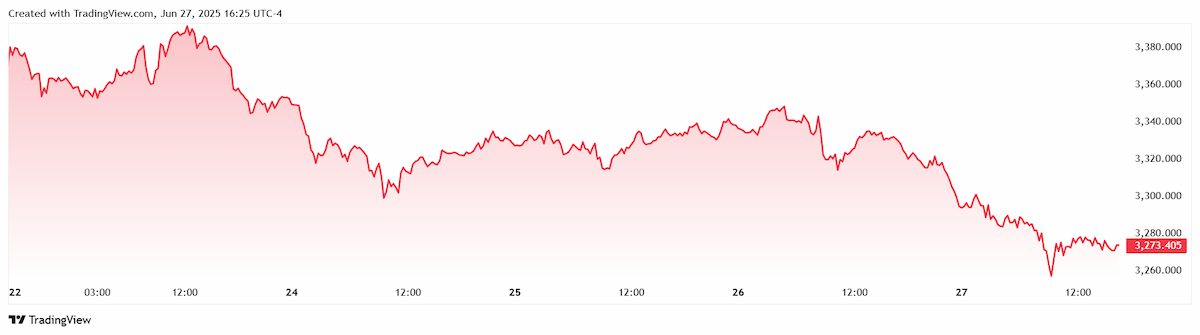
Spot gold kicked off the week trading at $3380.10 per ounce, but the yellow metal would spend very little time at or above that level in the days that followed.
After dipping down to test near-term support around $3,350 per ounce, gold was right back at $3,380 by 7:45 a.m. EDT on Monday morning. By 12:30 p.m., spot gold topped out at $3,391 per ounce, which would prove to be the week's high-water mark.
The $3,350 support level would be converted to resistance by the time of the Asian open on Monday evening, and at 2:30 a.m. on Tuesday, spot gold was trading below $3,320 per ounce. By the time of the North American open, the yellow metal dipped below $3,300 per ounce for the first time.
Gold did see a decent bounce thereafter, as it spent the next two days trading between $3,315 and $3,350 per ounce, but the yellow metal was unable to breach resistance, and by late Thursday evening, spot gold was back below $3,300.
This time, however, there would be no recovery, as gold declined steadily through the Asian and European sessions on Friday, ultimately falling to the weekly low of 3,256 per ounce 15 minutes before the North American open.
Spot gold quickly recovered to trade in the $3,275 area by 10:15 a.m. EDT, but that was the end of any real volatility, as the precious metal traded in a narrow $10 range for the duration of the session.
The latest Kitco News Weekly Gold Survey showed industry experts souring on gold’s near-term prospects, while retail traders stuck to their slight bullish bias.
“Higher,” said Rich Checkan, president and COO of Asset Strategies International. “If the correction was overdone last week, it is further overdone this week. Further, Big, Beautiful Tax Bill will either make it through by July 1st… or it won’t. If it doesn’t make it, gold should go higher on dysfunction in DC. If it does make it through, gold should go higher on the overspending in the bill.”
Up,” said Darin Newsom, senior market analyst at Barchart.com. “Nothing has changed. We are heading into another weekend of certain uncertainty. Yes, gold could find some short-term selling interest, but it will continue to be supported by long-term buying, regardless of price.”
“We may well see the pullback lasting into next week (or more),” said Adrian Day, president of Adrian Day Asset Management. “A ceasefire between Israel and Iran, new trade deals promised, an intransigent Fed chairman Powell all come together for softness. So down.”
“Up,” said James Stanley, senior market strategist at Forex.com. “I think we’re seeing some window dressing ahead of quarter-end and I don’t see the bullish case for gold as having changed much over the past week, with members of the FOMC, particularly Chair Powell, sounding more dovish and talking up the possibility of rate cuts in the second half of the year.”
Daniel Pavilonis, senior commodities broker at RJO Futures, said he expects to see the geopolitical and tariff bids continue to back off, even as bets on Fed rate cuts and worries about Fed independence continue to rise.
“I think that’s what we're going to continue to see, and especially if there's some trade deals around the corner, I think a lot of the geopolitical risk is going to eventually fall to the wayside,” he said. “I think a lot of the drive for gold demand over the last several months will start to subside, and we could see lower oil prices.”
Pavilonis said he expects gold prices to return to their 200-day moving average. “I think ultimately gold will continue to move higher,” he added. “But especially over the last couple of months, I haven't seen order flow come in to buy gold. I've started to see some profit taking, and I haven't really seen anybody get short gold, but I think that's in the mix.”
What he has seen is more order flow going into other metals like platinum, palladium, and especially silver.
“I think that's what we're going to see now,” Pavilonis said. “I think gold has plateaued for the time being, and I think the rotation into the other metals is more predominant.”
Pavilonis said the market’s renewed risk-on sentiment is weakening both gold and the U.S. dollar. “What was driving money into and out of the US dollar is the same reason why money was going into gold and out of gold as a safe haven,” he said. “I think things are becoming more normalized now, and there's less necessity to run into gold and to run into the dollar.”
As for Trump’s latest comments about Fed Chair Powell, Pavilonis doesn’t see them as very impactful for gold or the greenback.
“I think it's politics. I don't think it really means anything,” he said. “I think the Fed is going to lower interest rates by the end of the year anyway. Powell’s term is up pretty soon, and eventually, somebody else is going to be there.”
“I think the more important thing is just looking at the yield curve, and looking at yields themselves,” he added. “The Fed can set the Fed funds rate, but the market's going to do what it truly believes. The yields are going to go up if they feel that inflation is still prevalent, and yields will go down if they feel otherwise. And yields have just been sideways now. So I think from a debt standpoint, being able to roll debt at a lower interest rate, based on the Fed funds rate, is pretty important.”
That said, Pavilonis doesn’t expect this will have a profound effect on gold. “I think the biggest driver now at these elevated levels is all-out war with Israel and Iran, the possibility of escalation. With all that was going on, it never came to fruition, and gold couldn't even make a new high. It had its shot to make new highs, and it couldn't do it, so the path of least resistance now is to the downside.”
“The next target to the downside is somewhere around the 100-day moving average, which would be about $3,175, somewhere in that area, right below $3,200.”
This week, 17 analysts participated in the Kitco News Gold Survey, with Wall Street turning bearish after rising risk appetite sapped gold’s momentum. Six experts, or 35%, expected to see gold prices rise during the week ahead, while nine analysts, or 53%, predicted a price decline for the yellow metal. The remaining two analysts, representing 12%, saw gold trading sideways next week.
Meanwhile, 233 votes were cast in Kitco’s online poll, with Main Street holding to its narrow bullish majority. 119 retail traders, or 51%, looked for gold prices to rise next week, while 63, or 27%, expected the yellow metal to slide lower. The remaining 49 investors, or 21%, saw prices consolidating during the week ahead.

After a week of data focused on the health of the U.S. consumer, markets will be focused on the employment picture, along with the manufacturing and services sectors, during the shortened Independence Day week.
Tuesday will see the release of the ISM Manufacturing PMI, along with JOLTS Job Openings. On Wednesday, traders will pay attention to the ADP Non-Farm Employment Change report. Then on Thursday, markets will receive the U.S. nonfarm payrolls report a day earlier than usual, along with weekly jobless claims and the ISM Services PMI.
“Up,” said Marc Chandler, managing director at Bannockburn Global Forex. “Nothing has changed. We are heading into another weekend of certain uncertainty. Yes, gold could find some short-term selling interest, but it will continue to be supported by long-term buying, regardless of price.”
Kevin Grady, president of Phoenix Futures and Options, was looking at the trading volume for clues as to what the gold market was likely to do as its various drivers realigned.
“The active contract in gold is August,” he said. “Right now, the volume is 179,000 contracts at 11 o'clock in the morning, on a day where it's down $66. Not a lot of people trading. It's a lot of program trading, a lot of speculators. I think those are the people right now that are in the market. Again, that's very low volume. I think that's significant to think about.”
Grady said that while he wasn’t in favor of rate cuts a few months ago, the data today would support them.
“The last few numbers that I've been watching, inflation has been coming down,” he said. “I would think that [Powell] should cut rates in July. I don't think he's going to, but I do think that he should cut rates in July. All the metrics that they're looking for, everything says their target inflation number is getting close to 2%. And when you really dive into the inflation numbers, the thing that has been keeping the last numbers up was housing and rent, but they're calculated on an annual basis, so they take some time to filter through the numbers and the data. I think if you can extrapolate and say ‘This is where everything else is, I think this is where the housing is,’ I think you are at your target, no doubt.”
On whether the other precious metals could continue their recent rallies, Grady said the flows would be the best place to look for answers.
“I think you can learn a lot by looking inside the data and looking at where the volumes are,” he said. “Now, platinum is a small market. The exchange raised margins last night, the margins are going to take effect after today's close. A lot of times when they raise margins like that, you do see some people liquidating positions because it costs more for them to put money up.”
“I think it went pretty fast, especially platinum, went up pretty fast,” he added. “I think that today is a healthy correction.”
As for gold prices, with geopolitical drivers fading, Grady will be focusing on the Fed for direction.
“I think we have to keep an eye on what [Powell] is going to be doing with inflation and the interest rates,” he said. “I think that's the key, that's what I'm watching. The bond market, as of yesterday, was saying rates are lower. You have the 10-year yielding 4.2% yesterday. I think the bond market is saying rates should be lower. It's just whether they're going to listen to it or not. But that's my main focus right now, is interest rates.”
In the interim, Grady said that even if gold dips lower, it will find support. “Even if it's $3,100 or $3,150, or $3,200, I think gold will find some footing down here,” he said. “But I do think, especially in an environment of lower interest rates, you should start seeing some higher gold prices.”
“I expect gold’s price to move down next week,” said Alex Kuptsikevich, senior market analyst at FxPro. “Recent price action shows clear weakness, with gold breaking below key technical support at the 50-day moving average (~$3,324) and struggling to stay above $3,300. The lack of upward momentum and repeated failure to break $3,500 suggests a short-term bearish outlook.”
Kuptsikevich noted that the recent de-escalation between Israel and Iran has reduced safe-haven demand, weakening one of the key drivers behind gold’s earlier rally. “At the same time, the consolidation range between $3,100 and $3,400 has held firm, and technical signals are turning negative,” he said. “With sellers taking control and momentum fading, there’s a high chance we’ll see further downside pressure before any new leg higher can begin.”
Analysts at Commerzbank are bullish on gold for the coming week.
“Although the gold price has fallen somewhat in the face of the de-escalation in the Middle East conflict, the current weakness of the US dollar combined with increasing expectations of US interest rate cuts should limit the downside potential,” they said. “We do not see a trend reversal here, especially if the US labour market weakens in June and creates room for further interest rate cuts.”
“DOWN, unless we break back above the formation mentioned in the Lower time frame below,” said Michael Moor, founder of Moor Analytics. “In a Higher time frame: I cautioned on 8/16/18 the break above $1,179.7-$1,183.0 warned of renewed strength. We have seen $2,326.2. The solid trade above 21484 projected this upward $954 (+). We attained $1,361.5. These are ON HOLD. On a Medium time frame: The break above 31482 warned of strength for days—we rallied $328.1 The trade above 32214 projects this upward $100 (+)—we rallied $254.9. The above are ON HOLD.”
“On a Lower time frame: The failure back below 34465 brought in $153.1 of pressure,” Moor said. “On 6/16, we left a bearish reversal above—we have come off $142.4 from the 34358 open. The trade below 33227 (+2.3 tics per/hour) further warns of decent pressure, but if we break back above decently, look for decent strength. At the same time, I would WARN we are likely in the last stretch of the move down from 34763, with possible exhaustion at 32739-601. Trade below 32584 will suggest the downside has more longevity.”
And Kitco Senior Analyst Jim Wyckoff expects gold to continue its recent downward trajectory. “Steady-lower amid deteriorating chart posture and much improved investor risk appetite in the general marketplace.”
At the time of writing, spot gold last traded at $3,273.71 per ounce for a loss of 1.61% on the day and 3.24% on the week.

